

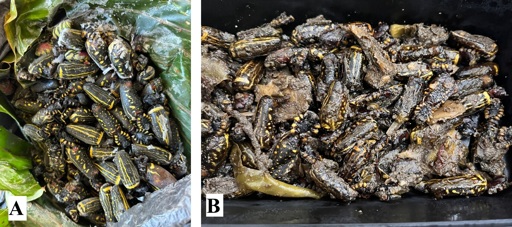
In India’s northeastern Nagaland state, orb-weaver spiders are a sought-after source of protein, according to a new study in Frontiers in Sustainable Food Systems. Here, “edible spiders hold a significant place in the local diet and have been consumed for generations,” study lead author Lobeno Mozhui, from Nagaland University, told Mongabay by email. The researchers surveyed 33 people with traditional knowledge about the consumption of two orb-weaver spider species: Nephila pilipes and Trichonephila clavata. Both species are locally known as siyankyü in the Lotha Naga language. Respondents told the researchers that before cooking, they remove the spiders’ head and legs. They then clean and cook them with seasoning, resulting in a “creamy, nutty” and nutritious meat substitute. The researchers also collected specimens of the two orb-weaver spiders from Nagaland University, and examined their total protein content, with legs removed. Both were rich in protein, ranging from 36.03-73.65% in N. pilipes and 34.17-57.65% in T. clavata — much higher than some commonly eaten insects. Mozhui said this research is an important baseline and that “the consumption of edible spiders has the potential to gain wider acceptance.” Arachnophagy, or the consumption of arachnids like spiders, scorpions, ticks and mites, has a long history, the authors write, yet only about 23 of the world’s more than 50,000 known spider species are eaten. The world’s largest spider, the goliath bird-eater (Theraphosa blondi), is part of the traditional diet of the Yanomamo and Piaroa peoples of the Amazon. Orb-weavers of the genus Nephila are eaten…This article was originally published on Mongabay
From Conservation news via This RSS Feed.