

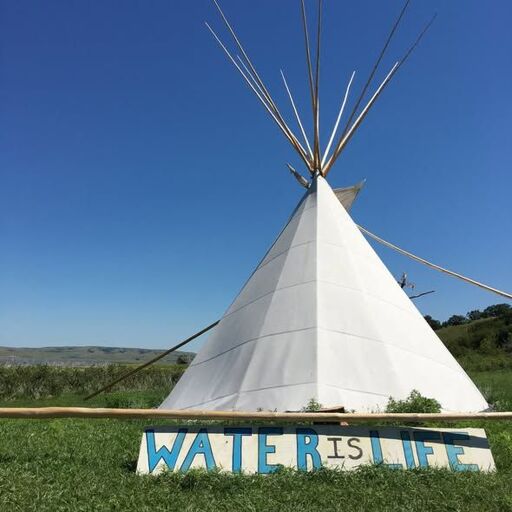

This story is part of ICT’s series on the 10th anniversary of the Standing Rock movement.
Water protectors came from far and wide. It was 2016 and the protest against the Dakota Access Pipeline just begun. ICT shares the stories of those who were there.
JODY NOE
Jody Noe, a doctor and vice chief for the Eastern Cherokee, Southern Iroquois and United Tribes of South Carolina, was at Standing Rock on the Medic Healers Council and a part of the Sacred Stone Village.
“It was light. Everybody was drawn to the light and the protest for what was right and the injustice that we saw happening. Nobody could imagine that what happened in Standing Rock is now standard issue in America. It was a pre-warning 10 years ago. What could happen if people don’t unite? You can do it in a peaceful way with prayer, diligence, and devotion,” Noe said.
Noe, Cherokee, Sualey, Tuscarora, said she volunteered to assist with decolonizing healthcare and education at the Sacred Stone camp. She said it burnt down on March 10, 2017 when protesters went to Washington D.C.
She added how she learnt about the Missing and Murdered Indigenous Women crisis from Two Spirit people and elders around the campfires.
“I think that they were really instrumental. And that was the medicine. The women and the vibration that was raised because of that, all through Indian nation. I mean Two Spirits started coming back to the front in their tribes and being recognized and called their traditional names,” Noe said.
It was a uniting experience where people from different tribes came together. She also remembers how the youth would wake up people in the morning telling them it wasn’t a vacation.
“It was more like you went home to a big old family and everybody looked out for everybody,” Noe said. “I saw people trading. Everybody was taking care of everybody else. It was communal cooking, communal eating.”
JOSEPH ARNOUX
Joseph Arnoux, Amskapi Piikani, ap’q’n’i? (Spokane), arrived at Standing Rock on Thanksgiving day. The camp he stayed at was with the American Indian Movement Albuquerque camp.
“Remembering back on it, it was like something that really started my journey in activism in that respect,” Arnoux said.
He connects how Standing Rock is similar to recent protests and social issues like the George Floyd Movement and the Pro-Palestine protests.
“It’s almost daunting in a certain way when we’re trying to stand up for these certain things and not just for us as Indigenous people or Native people, like just worldwide,” he said.
He said the experience was helpful to learn more about his identity as an Indigenous person and become more involved in activism.
“Because, honestly, before that, I was pretty shy and I wouldn’t have as much courage unless I was with others, who were like-minded and we were all standing up for the same cause,” Arnoux said.
He also recalls the strong sense of community.

(Left to right) Michael Arnoux, Joeseph Arnoux, brother of Jacob Johns, Jeff Ferguson, and Jacob Johns. Joseph at Standing Rock in 2016. (Photo courtesy of Joeseph Arnoux)
“It’s just crazy how we all came together in one place, just a sense of community for someone who wasn’t there and experienced it. I remember just walking along one day and all of a sudden this guy is out of his trailer giving away free food. He’s a cook from like, California or something, but he’s there purposely just to give away food. And then other times where I’m like helping chop wood or seeing people chop wood and having to get wood.”
Did you go to Standing Rock and want to share your experience? Reach out to kolby@ictnews.org
The post Standing Rock: ‘A sense of community” appeared first on ICT.
From ICT via This RSS Feed.