

Dozens of Democrats in the Republican-controlled US House of Representatives helped the GOP send a key spying bill to the Senate on Wednesday, earning sharp condemnation from the diverse movement that has called for privacy reforms.
The House voted 235-191 in favor of the bill released last week by Speaker Mike Johnson (R-La.), who has been trying for months to get an extension of Section 702 of the Foreign Intelligence Surveillance Act (FISA) to President Donald Trump’s desk.
FISA’s Section 702 allows the US government to surveil electronic communications of noncitizens located outside the United States to acquire foreign intelligence information, without a warrant. However, Americans’ data is also swept up, and civil society, along with some lawmakers from both major parties, has demanded reforms to prevent further abuse by federal agencies.
In the lead-up to the vote, progressives such as Rep. Ilhan Omar (D-Minn.) warned that “this bill has no meaningful reforms to stop warrantless surveillance, directly undermining the Fourth Amendment” to the US Constitution, which is supposed to protect Americans against unreasonable searches and seizures.
Another “Squad” member, Rep. Rashida Tlaib (D-Mich.), took to the House floor to blast Section 702 as “a dangerous mass surveillance tool” that “has been used to spy on Black Lives Matter protesters, members of Congress, journalists, and more.”
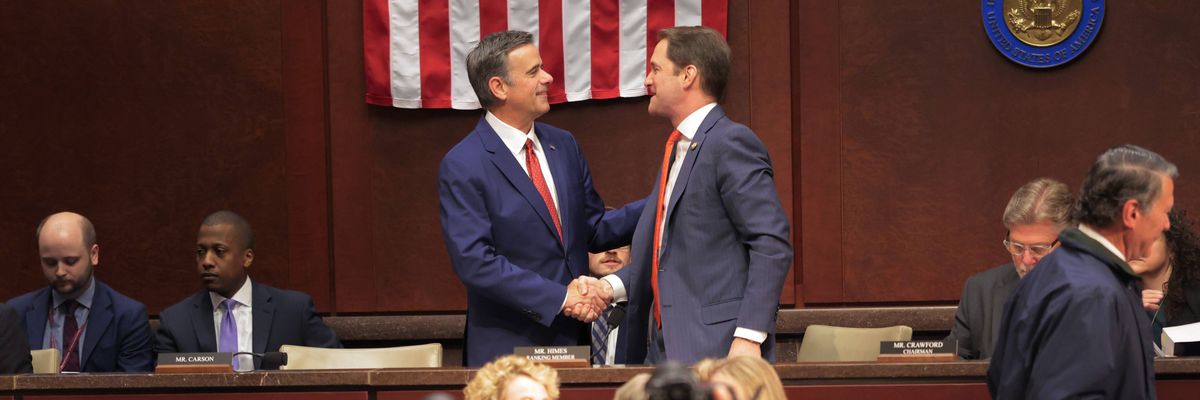
However, 42 Democrats—including House Permanent Select Committee on Intelligence Ranking Member Jim Himes (Conn.)—still joined most House Republicans in advancing the legislation.
“It’s incredibly disappointing the House approved this measure,” said Jake Laperruque, deputy director of the Center for Democracy and Technology’s Security and Surveillance Project, in a statement. “This bill is empty calories through and through. It contains no warrant for querying Americans’ messages, and no meaningful reforms of any kind. The razor-thin procedural vote this afternoon makes clear that there’s an appetite for reform, but House leadership took meaningful reforms off the menu.”
“There is nothing in this bill that would have prevented the abuses of FISA 702 we’ve already seen—snooping on lawmakers, protesters, and campaign donors—and there is nothing that would stop even worse abuses in the future. A vote for this bill was a vote to give the FBI and other intelligence agencies a three-year blank check for surveillance abuse.”
Hajar Hammado, senior policy adviser at Demand Progress—which helped convene over 100 artificial intelligence, civil rights, and other progressive groups pressuring Congress to include privacy protections in any renewal bill for the spying power—took aim at the House Democrats who supported the legislation.
“The 42 Democratic votes to advance Speaker Johnson and Donald Trump’s surveillance agenda are dangerous and shameful,” she declared. “These Democrats defied their constituents and common sense to undercut meaningful privacy reforms in the House and instead voted to hand over sweeping spy powers to the Trump administration,” she stressed. “This means continuing warrantless backdoor searches and allowing an increasing number of federal agencies to exploit the data broker loophole to supercharge AI and fuel mass domestic surveillance.”
Hammado said that “their vote today has major consequences, as even 22 Republicans put principles over politics and voted against renewing FISA without warrant protections. It was these Democrats’ responsibility to stand up against this administration and they voted to stand down instead.”
While stressing that “no administration should have these powers,” Free Press Action advocacy director Jenna Ruddock directed attention at “the champions for a clean extension of Section 702 in the Trump administration in particular,” including the president’s homeland security adviser, Stephen Miller.
“Stephen Miller has advocated against reforms to Section 702, claiming it is critical to his and Trump’s homeland security agenda, even as members of the administration refer to political opponents as ‘enemies within,’” she noted. “Today, 42 Democrats joined 192 Republicans to co-sign Donald Trump and Stephen Miller’s domestic surveillance agenda, jeopardizing the civil rights and liberties of every person in the United States.”
Zeteo News reporter Prem Thakker pointed out that House “Democratic leadership did not whip their members, enabling them to vote with Republicans and give Trump the surveillance powers.”
While calling out the House Democrats who backed the bill, campaigners also set their sights on the Senate, where Punchbowl News reporter Anthony Adragna predicted that “it’s DOA,” or dead on arrival. Republicans have a slim majority in the chamber and, due to its rules, need at least some Democratic support to pass most bills, including this one.
A key issue is the central bank digital currency ban included in the House bill. Senate Majority Leader John Thune (R-SD) told reporters on Wednesday that he may try to pass a 45-day extension instead. After a recent short-term extension, the spying authority is set to expire Thursday night.
“Now the fight moves to the Senate, where privacy champions in both parties are gearing up to try and stop this reckless giveaway to the surveillance state,” Hammado said. She urged members of the upper chamber to join “bipartisan reformers” like Sens. Dick Durbin (D-Ill.), Mike Lee (R-Utah), Rand Paul (R-Ky.), and Ron Wyden (D-Ore.) “in voting against any FISA measure that lacks real reforms like a warrant requirement to close the backdoor search and data broker loopholes.”
Laperruque similarly said that “we hope senators will stand strong and reject this dangerous proposal.”
Ruddock highlighted that “there is bipartisan legislation already introduced in both the House and Senate that would make desperately needed reforms to government surveillance powers.”
“The Senate should reject the fake reforms in the current House bill and demand a vote on real reforms to Section 702, including a warrant requirement, and closing the data broker loophole,” she said. “Our constitutional rights depend on it.”
From Common Dreams via This RSS Feed.