

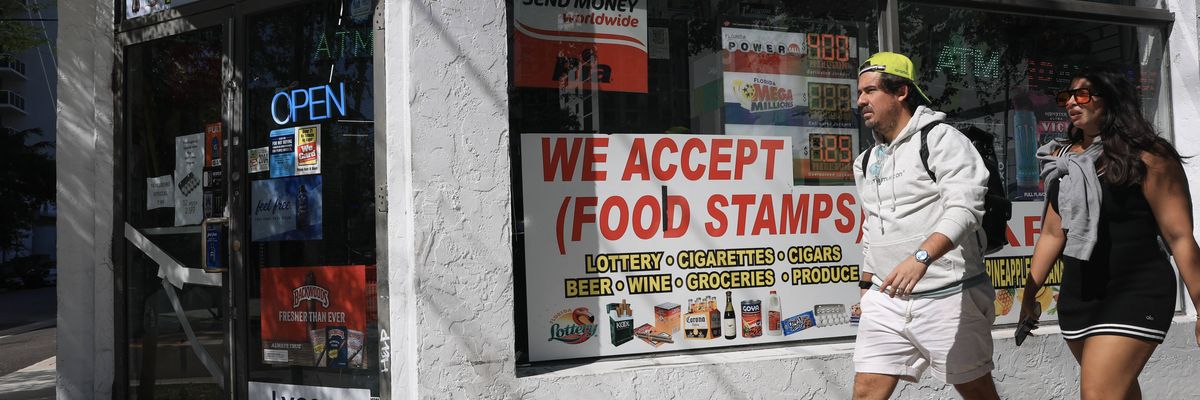
Within just six months of President Donald Trump signing last year’s Republican mega budget bill and enacting an unprecedented cut to federal food assistance, more than 3 million low-income Americans lost benefits.
According to data from the US Department of Agriculture, cataloged by the Center on Budget and Policy Priorities (CBPP), participation in the Supplemental Nutrition Assistance Program (SNAP) dropped by 8% nationwide in the six months following the bill’s passage in July 2025.
It is the steepest drop recorded in more than three decades, even greater than that experienced amid the recovery from the Great Recession, when millions of Americans left the program as their economic conditions rebounded after a period of widespread unemployment and economic precarity.
Enrollment levels have fallen in every single state over the past year, with some drops particularly startling. In Arizona, where nearly 900,000 people received benefits in January 2025, just over 500,000 were on SNAP a year later—a 43% drop.
Levels of enrollment in SNAP, which provides monthly funds to Americans with incomes at or below 130% of the federal poverty line to pay for food, have often been a reliable indicator of poverty in America, with more people enrolling during hard times.
But unlike during that period of mass disenrollment from 2012-16, Joseph Llobrera, CBPP’s senior director of research, said in a report on Wednesday that the dramatic fall in SNAP participation “cannot be explained by a rapid improvement in people’s economic well-being or reduced need for help affording food.”
“Labor force data show that the unemployment rate was flat between July 2025 and March 2026, the most recent data available,” Llobrera said. In Arizona, where nearly half of SNAP recipients lost their benefits, unemployment actually increased during the same period.
“A more likely explanation for why people are losing access to food assistance,” he said, “is that states are now facing new challenges as they respond to the cuts in HR 1—the largest in the program’s history.”
While funding more than $1 trillion worth of tax breaks for the wealthiest 1% of Americans, HR 1—known as the One Big Beautiful Bill Act—mandated around $186 billion worth of cuts to SNAP over a decade, including through harsher work requirements for older adults, parents, veterans, and homeless people.
Katie Bergh, a senior food assistance policy analyst at CBPP, noted that “the harm will only grow as the full brunt of HR 1’s SNAP cuts takes effect.”
Beginning in 2027, the law will require states to cover 75% of SNAP administrative costs, up from the previous 50%. They will also have to cover a larger share of the benefit costs if they provide benefits to large numbers of ineligible people.
“States will soon be required to pay for part of SNAP benefits costs—totaling billions of dollars across all states—creating enormous fiscal challenges,” explained Llobrera. “Many steps states are taking to lower error rates in response to this cost shift could make it harder for eligible people to access SNAP, driving down caseloads.”
He noted that some states like Illinois and Georgia are now expending more resources on means testing, requiring households to recertify their eligibility for SNAP twice as often and “putting families at risk of losing SNAP if they can’t navigate the additional red tape.”
Other states have made cuts preemptively. In the year leading up to the GOP bill’s passage, Arizona cut staffing at its SNAP agency by more than a third, creating a major backlog of cases. While the state remains an outlier, Llobrera and research analyst Catlin Nchako said that “other states may not be far behind.”
“In the face of massive new costs,” Llobrera warned, “states may even withdraw from the program altogether, terminating food assistance for all low-income people, including children, seniors, people with disabilities, and veterans.”
He said, “Congress must delay the cost shift before even more people lose the food assistance they need.”
From Common Dreams via This RSS Feed.
How could BIDEN do This?
-Free Thinkers who Do Their Own Research TM!