

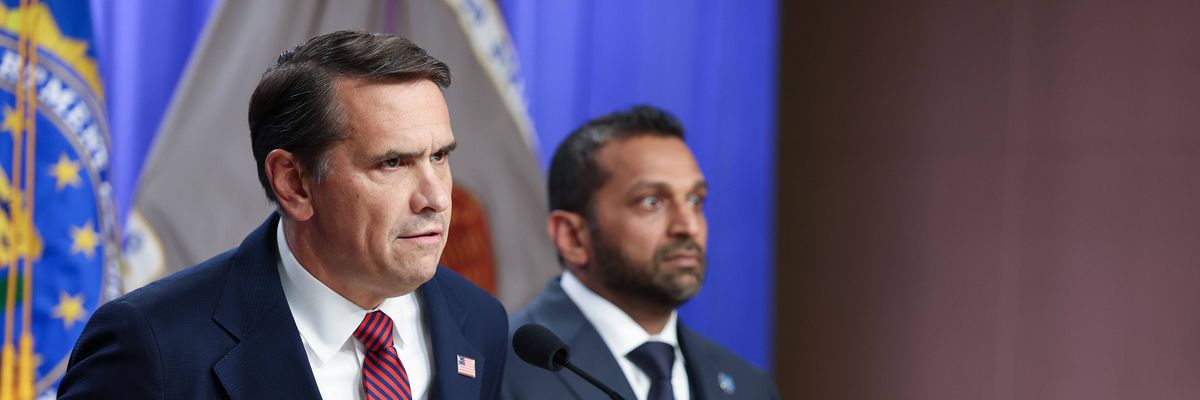
As the corporate media joins the White House in a new round of accusations against critics of President Donald Trump in the wake of an attempted attack on the White House Correspondents’ Association dinner last week—with acting Attorney General Todd Blanche blaming anti-Trump “rhetoric” for the violence at the event—the administration on Tuesday unveiled a new indictment of longtime Trump foe James Comey in what legal experts called a transparent attack on the First Amendment.
At a press conference held by Blanche and FBI Director Kash Patel, the officials made the case—without presenting specific evidence—that a federal grand jury in North Carolina had indicted former FBI chief Comey because he’d “knowingly and willfully [made] a threat to take the life of, and to inflict bodily harm upon” Trump in May 2025 in a photo he posted on Instagram.
The picture showed seashells grouped together in a pattern, reading, “86 47.”
Trump is the 47th president of the United States, and the slang term “86” means “to get rid of,” originating in the 1930s. According to Merriam-Webster, the term began being used as a verb in the 1950s when restaurants and bars used it to mean refusing service to a customer or throwing them out of an establishment. That use of the term is still the most common, according to the dictionary, which wrote: “Among the most recent senses adopted is a logical extension of the previous ones, with the meaning of ‘to kill.’ We do not enter this sense, due to its relative recency and sparseness of use.”
Comey quickly deleted his post last May, which he said he had shared after finding the seashells in the arrangement during a walk on a beach. The former FBI director said he deleted that post after realizing “some folks associate those numbers with violence,” and said he opposes violence “of any kind.”
Nevertheless, the indictment handed down on Tuesday reads that the shells were “arranged in a pattern making out ‘86 47,’ which a reasonable recipient who is familiar with the circumstances would interpret as a serious expression of an intent to do harm to the president of the United States.”
Comey was charged with one count of making threats against Trump and one count of transmitting a threat across state lines.
Federal officials issued a warrant for Comey’s arrest, but Blanche did not say whether any court dates had been scheduled in the case.
The indictment was dismissed by several legal experts, with prosecutors within the US Department of Justice reportedly calling it “the flimsiest federal indictment in memory,” according to ABC News correspondent Jonathan Karl. Building a case based solely on an image of seashells will be an uphill battle for the DOJ, particularly considering First Amendment protections on speech.
New York University law professor Ryan Goodman called the indictment “laughably ludicrous” and a “political act masquerading as an indictment,” while US Sen. Chris Van Hollen (D-Md.) condemned the president for using the DOJ as his “personal attack dog, using taxpayer money to settle Trump’s petty grievances.”
This is the second federal indictment that’s been handed down by the DOJ for Comey in seven months. Last September he was indicted on two counts of lying to Congress during a testimony he gave in 2020 regarding the FBI’s handling of its investigation into Trump’s 2016 presidential campaign’s ties to Russia.
The DOJ indicted Comey in that case even though a Trump-appointed US attorney had concluded there was insufficient evidence to charge him; the president later forced the prosecutor out of his job. A judge ultimately threw out the indictment, ruling that the prosecutor’s replacement had been unlawfully appointed to oversee the case.
Both cases have come years after Trump, during his first term, fired Comey as FBI director over the agency’s investigation into his 2016 campaign.
Conservative lawyer Gregg Nunziata of the Society for the Rule of Law called the latest indictment of Comey “legally deficient” and a “scandalous marker of a president and his administration corruptly using government power to punish dissent.”
American Immigration Council senior fellow Aaron Reichlin-Melnick noted that the administration has “repeatedly pursued criminal charges (or other punishments) against political opponents for their speech, at a level not seen since the most censorious days of the early 20th century,” including by attempting to charge members of Congress for reminding service members they are obligated to disobey illegal orders.
“In an administration at war with the First Amendment,” said Reichlin-Melnick, “this is a new low.”
From Common Dreams via This RSS Feed.
Lower than mass kidnappings?
