

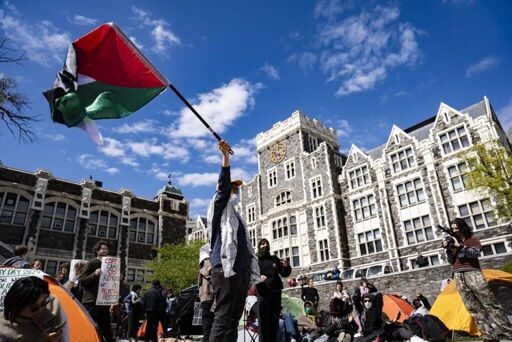
When I walked onto campus Monday morning, I was thinking about what a sunny, beautiful day it was. Just like the encampment, I thought. And then I realized, it really was just like that, because this week, the week preceding May Day, is when hundreds of City University of New York (CUNY) students and workers gathered on my campus’s quad for the five demands: divestment, academic boycott, solidarity, demilitarize, and A People’s CUNY. That was now two years ago.
So I sat on the quad for awhile, half reading the book chapter I’d assigned my students for later in the week, and half reminiscing. Just in front of me was the stone bench where I’d finished coloring in the bubble letters on a sign while the students were setting up their tents. And beyond that was the patch of grass where two friends and I gave a teach-in about the labor movement. The central flag pole, its base once covered in Gaza solidarity signs, is now bare.
In the two years since then, the school has not taken down the “temporary” fencing blocking every previously open entrance to our campus. We have new “time, place, and manner” restrictions for “student demonstrations” that prohibit “structures,” even folding tables. The college claims this policy is “not political” because it is applied equally to all demonstrations regardless of topic or point of view; but this policy was implemented in 1969, after the most famous student occupation of City College, revised in 1989 and 1990 (two more occupations of City College), and revised once more in 2024, after the most recent occupation of, again, City College.
Our student, Hadeeqa Arzoo Malik, formerly president of Students for Justice in Palestine, has been suspended and banned from setting foot on any CUNY campus for the duration. Starting this year, whenever anyone wants to table for an organization or cause, we now have to request permission at least two weeks in advance. As my colleague pointed out last week, imagine the United States invades Cuba tomorrow; we’d have to wait two weeks before we were allowed to table about it.
Meanwhile, despite the purported “ceasefire,” Israel continues to bomb Gaza, the majority of the population remains displaced, and many are still experiencing serious shortages of food, medical supplies, and safe shelter. As Mohammed R. Mhawish explains for The Nation, the war in Iran and simultaneous escalated attacks in Lebanon weakens Gaza’s military allies, leaving it more exposed to future attacks while spreading even more death and suffering throughout the region.
This year, the City College “rites of spring” (as one journalist writing during the 1991 occupation called them) are quieter than in 2024, and are mostly focused on immigrant solidarity. Students from Hunter College organizing with the CUNY Internationalist Club and the Hunter Coalition to Defend Immigrants were detained for daring to table at City College with a petition to establish immigrant student support centers on the campuses that do not already have them; now, they are distributing flyers at the edge of campus to raise awareness about their own repression.
Other campuses are feeling the repression too. Our colleagues, the Fired Four, lost their positions as adjunct faculty at Brooklyn College shortly after their alleged involvement in a campus protest for Palestine. Three have been reinstated, but one is still fighting for her job. Six full-time faculty and staff members at Brooklyn College, and several students, were also placed under investigation for their alleged participation in the protest. CUNY School of Law and the College of Staten Island have banned their graduating classes from having live student speakers. Students at Brooklyn College have just been informed they will not be permitted to walk across the stage at graduation — according to the college, it’s due to time restrictions with the venue, although some wonder whether it’s really to prevent student protest actions on stage.
This Wednesday, April 29, will mark two years to the day when roughly two hundred members of the Professional Staff Congress (PSC), the faculty, staff, and graduate assistant union at CUNY, gathered alongside students and community members on the cobblestones just west of the quad for a mass assembly to discuss how the union should relate to the encampment. The assembly voted several agreements, including to support the five demands, to hold “pickets to protect” the encampment on the following day (Tuesday, the final day of spring break, when most people expected the college would try to dismantle the encampment), and to — if a certain pledge threshold was reached by Tuesday night — to participate in a sick-out on May Day.
The night of April 30, campus security closed the gates, and the NYPD closed in on our campus, arresting approximately 170 people, many of whom had left campus and were standing on the nearby public sidewalks. As the CUNY community watched events unfold through group chats, Twitter, and our intrepid student reporter who was livestreaming for the campus newspaper from the ground, the sickout pledge met the threshold.
And so this Friday, May Day 2026, will be the two year anniversary of the PSC’s first-ever (known) sickout, organized in solidarity with our colleagues and students who were brutalized and/or arrested and with the people of Palestine. Then, the union leadership released a statement condemning and distancing itself from the sickout. While the union formally authorized a strike in 2016, it has never actually done one. The sick-out is an important lesson that breaking the Taylor Law does not automatically mean that all of its penalties will be imposed. For whatever confluence of reasons, the university and the governor decided not to attempt to prosecute sick-out participants.
This year, when groups around the country are calling for a May Day of “no work, no school, no shopping,” following the days of action with the same slogan in solidarity with the people of Minneapolis and Saint Paul during Operation Metro Surge following the murders of Renee Nicole Good and Alex Pretti by ICE agents, the PSC executive committee is once again being clear that it is not calling for a strike. Yet they are also now explicitly using the language of strike readiness — not calling for one now, but invoking the possibility of one in the future, especially if ICE begins surge operations in New York City, or if Trump and his allies attempt to steal the midterm elections.
This change in rhetoric is an indicator of how the political situation has shifted in the last two years, especially since Trump took office for his second term. Funding for education and research has been cut by the billions, Trump’s Department of Education is attempting to block teaching and research about race, gender, and sexuality and impose harsh restrictions in exchange for preferential treatment for funds.
Several university administrators, including CUNY Chancellor Felix Matos Rodriguez, have been called to testify before the House Committee on Education and the Workforce to prove they’re being sufficiently repressive of pro-Palestine speech on campus. Last spring, international students had their visas (or, in the case of Mahmoud Khalil, green cards) revoked, and several were detained by immigration enforcement. There is plenty to be alarmed about, and it’s progressive that the PSC is taking up a leadership role among the city unions in responding to these attacks.
Everyone in the CUNY community should march with the PSC on May Day; but we must go further, with our demands and with our organizing. The Graduate Center and Professional Schools chapter of the union, for instance, voted to adopt three additional slogans: down with U.S. imperialism in Iran, Lebanon and Palestine and beyond; full rights for immigrants and international students; and reinstate the Fired Fourth. And longtime PSC members know it will not be enough to be strike ready in name only; in 2016, even after a strike authorization vote passed, an actual strike was never called.
To actually strike as a whole union against ICE, against election interference, for a good contract, for immigrant rights, for education funding, or for any other cause will require organized anger and fervor from an activated rank and file that believes in both its power as workers and the necessity of using that power, for ourselves and for the working class and oppressed of New York and the world.
The post Two Years After The CUNY Gaza Solidarity Encampment appeared first on Left Voice.
From Left Voice via This RSS Feed.