

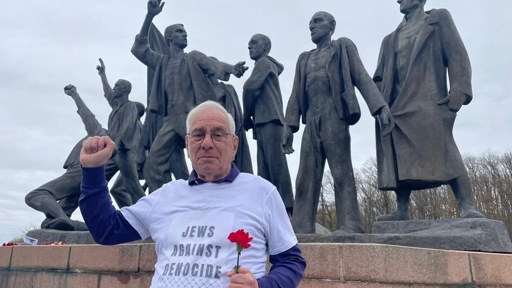
After the incorporation of the socialist GDR into the capitalist Federal Republic of Germany (FRG), communist and antifascist traditions and memory culture were massively rolled back. Resistance emerged already in the 1990s, but in recent years German memory politics has increasingly served pro-Israeli foreign policy and an increasingly authoritarian domestic agenda. Under the banner of the “Kufiyas in Buchenwald” campaign, mainly young activists – most of them descendants of Holocaust survivors and resistance fighters – have begun contesting interpretive authority over fascism and antifascism. They face fierce backlash from Zionist actors in politics and media.
State revisionism of history in Germany
The Buchenwald concentration camp held a special status: the Nazis imprisoned large numbers of political prisoners there – communists, social democrats, and trade unionists. KPD (Communist Party of Germany) leader Ernst Thälmann was murdered there in 1944 on Hitler’s personal order. It is therefore unsurprising that it was the only camp where prisoners openly rebelled against SS guards and liberated themselves: on April 11, 1945, the illegal International Camp Committee – led by communists – took control of the camp, and on April 16 the liberated prisoners greeted the advancing US Army.
While this is preserved in GDR memory culture and emphasized by communists today, official German remembrance works to erase it, at times dismissing it as a “myth”. The Buchenwald and Mittelbau-Dora Memorials Foundation even refers to the communist “claimed ‘self-liberation’ of the prisoners.”
Organized resistance to fascism – especially under communist leadership – does not fit the narrative of German “coming to terms with the past.” Instead of “fascism,” official discourse consistently uses “National Socialism” (NS), stressing alleged uniqueness and an implied proximity to socialism. Fascism is thus not framed as bourgeois rule relying on open dictatorship by finance capital, but as a “collective crime” of the entire German people, equally shared by workers and industrial elites such as Thyssen, Krupp, and IG Farben (today BAYER, BASF, and others), who profited from persecution, war, plunder, and forced labor.
Resistance is reduced to Nazis and aristocrats like Count von Stauffenberg or bourgeois idealists like the Scholl siblings. Communist resister Georg Elser is reframed as an apolitical lone actor. Students are taught that communists enabled Hitler by destabilizing Weimar democracy and that WWII began with the “Hitler-Stalin Pact,” stripped of context.
This narrative also excludes two of fascism’s largest victim groups – communists and Soviet citizens – from remembrance. This was central to FRG legitimacy as an anti-communist frontline state built during the Cold War by former Nazis and the Western powers. Accordingly, the GDR – founded by camp survivors, resistance fighters, and exiles – is still targeted by disinformation campaigns.
Zionism as “Substitute antifascism”
The same logic shapes FRG Holocaust remembrance, which centers Jewish victims. To cleanse its image, the West German ruling class aligned with the “Jewish state”. Nearly all FRG reparations went to Israel (while 96–98% of payments were handled by the socialist GDR). These were labeled not reparations but “Wiedergutmachung” (“making things right again”), which Holocaust survivors denounced as “blood money.” Weapons shipments followed. The militarization of the Zionist settler project became a form of “substitute antifascism” for a state built by former Nazis in alliance with Western powers.
During the Cold War, this pro-Israel alignment strained relations with Arab states. Anti-Arab racism surged in 1967 and again in 1972/73, alongside media campaigns, raids, and deportations. Yet governments avoided openly pro-Israel escalation, especially after the 1973 oil crisis.
After the collapse of the socialist bloc, the GDR was dismantled along with its legacy, including solidarity with Palestine. At the same time, campaigns delegitimizing it intensified. The GDR is labeled a “second German dictatorship,” and more recently accused of “Israel-related antisemitism.” Neo-conservative US-Historian Jeffrey Herf even called it a “second antisemitic dictatorship in Germany.”
From Anti-Muslim to Anti-Palestinian racism
With the collapse of the socialist camp, the Palestinian movement lost its main ally. The PLO largely dissolved itself through Oslo, while Arab states integrated into or – as Iraq – were forced into the US-led order. But this interregnum was short-lived.
After 9/11, the West launched its global “war on terror.” Palestinians were increasingly framed as part of this “Axis of Evil,” especially after the Second Intifada and Hamas’s 2006 election victory. Israel, meanwhile, was deeply integrated into US/NATO wars through its repeated assaults on Lebanon and Gaza in 2006, 2008/09, 2012 and 2014.
Germany joined this trajectory: after its 1999 aggression on Yugoslavia, its first post-WWII war, it expanded deployments across Afghanistan, Lebanon, Palestine, Türkiye, Uzbekistan, the Horn of Africa, the Arabian Sea, and later Iraq, Jordan, Saudi Arabia, Syria, the Arab-Persian Golf and the Red Sea.
At the same time a new anti-Muslim racism emerged – useful for external enemy construction and internal social control. It merged with anti-Turkish racism against migrant workers, anti-refugee racism against Afghans and Syrians, and increasingly with explicit anti-Palestinian racism framed through “Hamas,” “terrorism,” and “antisemitism.”
Regression of the German left
The 1990s also saw the rise of the “Anti-Germans,” who gained prominence after 9/11: militant Zionists who supported the Iraq invasion, described Palestinians as an “antisemitic collective,” labeled Islam “fascist,” and still claimed to be “leftists.” They later rebranded as “anti-nationals,” “value critics,” “ideology critics,” and “anti-authoritarians.”
Many entered academia, media, unions, the Left Party, the Greens, foundations, and NGOs. Today they occupy key positions across politics, education, NGOs, and mainstream media. Their influence extends into antifascist organizations like the VVN-BdA (Association of Those Persecuted by the Nazi Regime – Federation of Antifascists). Their Zionist and anti-Muslim ideology has thus become widely normalized – from parts of the radical left to state media and security agencies. This strong influence is possible because it fits German imperial policy and neoliberal transatlanticism.
Challenging the “German state reason”
Berlin hosts one of the largest Palestinian communities outside West Asia, significantly expanded after 2011. These largely young migrants brought new momentum to Palestine solidarity work. The German state responded with increasing repression, as this movement challenges the pro-Zionist state doctrine – Angela Merkel’s 2008 “Staatsräson.”
From the 2010s onward, cancellations of Palestine-related events increased in Germany. In 2019, the Bundestag declared BDS antisemitic. By 2020, the slogan “From the River to the Sea Palestine will be free” was criminalized. In 2022 and 2023, Nakba commemorations were banned in Berlin. After October 2023, mass repression followed, alongside Germany becoming Israel’s second-largest arms supplier after the US.
This active support for the Gaza genocide and this open repression is justified through “German guilt,” while Palestinians are increasingly framed as Nazi successors, with the „Al-Aqsa Flood“ operation presented as the “largest massacre of Jews since the Holocaust.”
Against this, the “Kufiyas in Buchenwald” (KiB) campaign formed. Triggered by a ban on Anna M., a German communist with Jewish roots, who attempted to attend the 80th anniversary commemoration wearing a kufiya. Shortly after, an internal memo from the Buchenwald memorial leaked, labeling Palestinian symbols – kufiya, watermelon, key, olive branch – as antisemitic, along with terms like “genocide,” “ceasefire now,” and “From the River to the Sea Palestine will be free.”
Kufiyas in Buchenwald
Anna M. launched KiB, joined by groups including Jewish Voice for a Just Peace and the International Jewish Anti-Zionist Network (IJAN). In its statement, signed internationally, KiB demands:
-
Openly addressing the genocide in Gaza at the Buchenwald Memorial.
-
No ban on Palestinian symbols at the Buchenwald Memorial and no denigration of them as anti-Semitic.
-
No entry or speaking bans due to solidarity with Palestine or criticism of the apartheid state of Israel.”
They planned a parallel commemoration during the 81st anniversary of Buchenwald’s liberation, alongside the official state ceremony attended by Israeli representatives, Zionist lobbyists, and right-wing German politicians. After weeks of media attacks and calls for bans, the event was prohibited; a court upheld the decision.
On April 11, activists nevertheless held an intervention at the camp entrance reading “Jedem das seine” (“To each his own”), wearing shirts stating “Jews Against Genocide” and “From Buchenwald to Gaza – From Resistance to Liberation.” Rachel Shapiro (IJAN, KiB) said they came as descendants of Holocaust survivors “to honor victims and survivors of all genocides.” She accused Germany of “white washing” support for the Gaza genocide and declared solidarity with Palestinians: “We honor the Palestinians in their liberation struggle. Long live the resistance, from Buchenwald to Gaza. We believe we will see the freedom of all Palestinian prisoners, the end of the Zionist entity, and the full liberation of Palestine.”
“Attacking the ideology of German imperialism”
After the action, a tour of the former camp grounds took place, followed by a conference. There, several speakers presented and discussed the instrumentalization of the Holocaust by Zionists and Germany, continuities of German colonial and genocidal policy from Namibia (genocide of the Herero and Nama) and Tanzania (Maji-Maji uprising), through participation in the genocide of Armenians and the Nazi genocide of European Jews, Roma, and Slavic peoples, to the current genocide in Gaza – and lessons from East German antifascism versus West German postwar failure.
On April 12, KiB participants joined a vigil where previously excluded voices spoke, including the Russian cultural attaché, barred from official ceremonies since 2022. Thomas Geggel (KiB), son of a Holocaust survivor, criticized German memory politics as “falsifying history” and Germany’s rearmament leadership. He called Israel “fascist,” described its wars on Palestinians, Lebanon and Iran as fascist policy, and contrasted remembrance of the Warsaw Ghetto uprising with the “Ghetto of Gaza”.
Zionist alliances mobilized against KiB, from “Anti-Germans“ to conservative actors, demonstrating in Weimar with Israeli, US, Ukrainian, and Shah flags and imagery linking Hitler and the kufiya. Media outrage focused on alleged rule violations while omitting that participants were Jewish descendants of Holocaust survivors. The Buchenwald memorial demanded removal of intervention footage and threatened a €15,000 fine.
At a press conference, organizers declared success in generating pressure and visibility. As at the conference itself, it was emphasized that this was only the beginning. The backlash was seen as confirmation. Earlier, KiB representatives had already made clear how they understood the attacks. Anna M. stated: “We are attacking a central point of the ruling ideology of German imperialism. That is why they are reacting so strongly.“
The post From Buchenwald to Gaza: Holocaust survivors defend the legacy of anti-fascist resistance appeared first on Peoples Dispatch.
From Peoples Dispatch via This RSS Feed.