

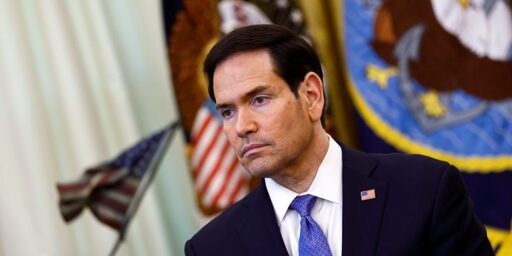
The State Department has shifted its public image in favor of explicit Christian messaging and iconography and away from secular and multicultural causes, an analysis by The Intercept of the department’s Instagram posts has found.
Posts marking Passover, Good Friday, and Easter in 2026 included explicitly religious messaging, including imagery of Christian crosses and references to “Christ’s sacrifice” and the Resurrection. The Intercept’s analysis, which catalogued of the department’s Instagram posts from 2020 through early 2026, found these posts show a clear change in messaging not only from the Biden years, but also from President Donald Trump’s first term.
“From a digital diplomacy point of view, this looks like more than a change in images. It suggests a shift in how the U.S. government is presenting itself online,” said Corneliu Bjola, a professor of digital diplomacy at the University of Oxford. “In earlier years, posts projected a broad and inclusive image — what you might call ‘the shiny city on the hill.’ The 2026 pattern points to a narrower and more controlled message about strength and authority — ‘fortress America.’”
Long considered the government’s primary diplomatic arm, the State Department historically used its account to highlight a wide range of international, cultural, and religious observances. In 2020, under the leadership of former Secretary of State Mike Pompeo, the State Department used its account to mark holidays and observances including Juneteenth, Chinese New Year, Ramadan, Eid al-Fitr, Eid al-Adha, Yom Kippur, and Kwanzaa.
Since Secretary of State Marco Rubio assumed his role, observance-related posts have been limited to Christian and Jewish holidays, including one that featured an impassioned speech by Rubio describing the resurrection of Jesus Christ. The account has not marked major Islamic holidays or other widely observed cultural events that it routinely highlighted in prior years.
Federal agencies have already faced scrutiny over controversial social media posts. The Department of Homeland Security has recently drawn scrutiny for using a neo-Nazi-linked song in a recruiting post, and the Department of Labor has faced criticism for social media imagery depicting an all-white, all-male workforce in a 1950s-style campaign, including a post that read, “One Homeland. One People. One Heritage. Remember who you are, American.”
Meanwhile, the State Department has moved away from posts highlighting multiculturalism in the United States and abroad.
Under Pompeo, the State Department made posts highlighting initiatives such as the International Religious Freedom Alliance and women’s empowerment efforts. The account also recognized events such as World Press Freedom Day, World Refugee Day, Asian American and Pacific Islander Heritage Month, and the International Day of Reflection on the Rwanda Genocide, among others.
The range narrows significantly under Rubio. Posts during this period place greater emphasis on borders, sovereignty, and enforcement, alongside a more limited set of cultural and religious observances. In September 2025, the account featured a video of Rubio meeting with Prime Minister Benjamin Netanyahu in Israel as the country continued its assault on Gaza in what human rights groups and some international observers have described as a genocide.
[
Related
Trump’s Orwellian Board of Peace Consists Entirely of Human Rights Abusers](https://theintercept.com/2026/03/02/trump-board-peace-human-right-abuses/)
In 2025, posts marking observances were limited to a small set of holidays and commemorations, including International Holocaust Remembrance Day, Yom HaShoah, Independence Day, Labor Day, Columbus Day, Christmas, and D-Day. Several posts emphasized religious or national themes, including a Columbus Day post that referenced “glory to God and country.”
The posts have also shifted to heavily feature the likeness of President Donald Trump. In early 2026, roughly 40 percent of posts included Trump’s image, a higher share than during either the Biden administration or Trump’s first term. On Tuesday, The Bulwark reported that the State Department is finalizing plans to include President Donald Trump’s image in a redesigned U.S. passport.
Asked why the account no longer marks a broader range of international and religious observances, including major Islamic holidays that had been featured in prior years, a State Department spokesperson said the content reflects the priorities of the current administration.
“Our content reflects the priorities of the current administration, including a renewed focus on seriousness and diplomacy.”
“Obviously, the president is featured prominently in our posts. He sets U.S. foreign policy, and the State Department’s role is to execute and communicate that agenda,” the spokesperson said. “Our content reflects the priorities of the current administration, including a renewed focus on seriousness and diplomacy. Decisions about what to highlight, including observances, are made by communications professionals.”
[
Related
He Tweeted Charlie Kirk “Won’t Be Remembered as a Hero.” The State Dept. Revoked His Visa.](https://theintercept.com/2025/10/15/state-department-charlie-kirk-visa-social-media-censorship/)
Rather than highlighting diplomatic events or cultural observances, the account frequently features stylized graphics of Trump and administration officials alongside slogans emphasizing immigration enforcement, national sovereignty and security. Some posts resemble campaign messaging, including phrases such as “Send Them Back” and “This Is Our Hemisphere,” as well as graphics touting policy outcomes like visa revocations.
Former U.S. diplomats and public diplomacy officials told The Intercept the shift marks a break from long-standing norms that have historically emphasized nonpartisan messaging and broad cultural representation in official government communications.
Daniel Kreiss, a political communication scholar at the University of North Carolina at Chapel Hill, said the shift reflects a broader pattern across government agencies.
“The cultural and religious diversity that represents all of America — and frankly, for the State Department, the world — is no longer being represented, based on your data, in favor of overrepresenting what the administration cares about,” Kreiss said. “It’s sending a key public signal that these agencies are operating faithfully to the president and his coalition.”
The shift, experts say, is not just about what the United States chooses to show the world, but also what it no longer does. In digital diplomacy, what is omitted can be as consequential as what is shown.
The post Marco Rubio Is Rebranding the State Department as Explicitly Christian appeared first on The Intercept.
From The Intercept via This RSS Feed.
Boy, it’s going to be a fun ride when somebody starts to flush the toilet and we watch them all circle and go down the drain.