

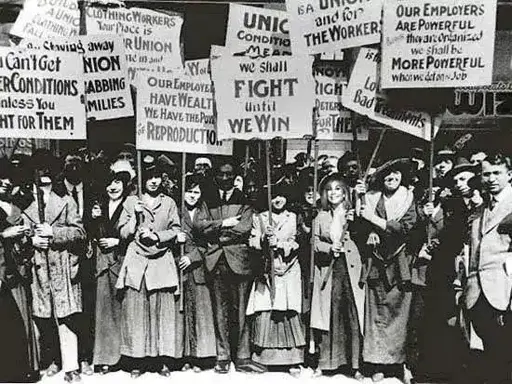
This May Day comes as workers across the country have been fighting Trump’s attacks on the economic stability and basic democratic rights of workers across the country. Some of the worst attacks have been against immigrant communities and those who stand in solidarity with their immigrant neighbors. The fight for immigrant rights cannot be separated from the fight for a strong labor movement in the United States.
Since the beginning, immigrants have been foundational to the U.S. labor movement. Immigrants from southern and eastern Europe, shaped by upheavals during the 18th century, brought lessons of working-class organization to the United States.
In the 1930s, the CIO movement was shaped by immigrant workers and socialists who fought against racism and nativist pressures in the labor movement. Immigrant women connected the fight for women’s rights to that for worker’s rights.
The most formative chapters of the labor movement, including the strikes that paved the way, have had immigrants at the forefront. The fight for the rights of the working class is, and has always been, intrinsically tied to immigrant rights. Ahead of May Day, we reflect on a few of those examples from history.
Triangle Shirtwaist Company Strike, 1909
Over 20,000 New York garment workers in the International Ladies’ Garment Workers’ Union (ILGWU) went on strike against the Triangle Shirtwaist Company — the largest strike of women workers in U.S. history. Nearly 90% of them were Jewish immigrants from Eastern Europe, who struck for 11 weeks, fighting for shorter work weeks and paid time off. It was formative in building the ILGWU which played an essential role in organizing the working class in the early 20th century.
Pressed Steel Car Company Strike, 1909
Also in 1909, in McKees Rock, PA, nearly 8,000 non-union immigrant workers from 16 different countries went on strike in solidarity with three fired workers, demanding their reinstatement and consistent, higher wages. Management called the police to the picket line, and the cops killed a striking worker. Five thousand workers walked in his funeral procession. The workers eventually won a 10 percent wage increase and the reinstatement of all fired strikers.
Bread and Roses Strike, 1912
In Lawrence, MA, over 20,000 immigrant textile workers, mostly women, walked off the job after their pay was cut by 32 cents — equivalent to several loaves of bread. Immigrants from dozens of countries, speaking 30 different languages, struck for almost 10 weeks. Inspired by the James Oppenheim poem of the same name, this became known as the Bread and Roses strike, as workers fought not only for a decent living (bread) but for dignity and quality of life (roses).
Great Steel Strike, 1919
Nearly 350,000 steelworkers struck across the Midwest to demand better wages and conditions. Czech and Polish immigrants played a pivotal role in organizing the strike, distributing pamphlets and speaking with workers in six different languages. Steel bosses and the press viciously red-baited immigrant strikers. For its part, the AFL largely abandoned the immigrant rank-and-file, prioritizing native-born workers, which acted as a real barrier to strengthening the strike.
The Big Three Strikes, 1934
The role of immigrant workers was essential for the success of the strikes in 1934 in Toledo, San Francisco, and Minneapolis. In these strikes that paved the way for industrial unionism, workers rejected the “divide and rule” that bosses relied on, and united across racial and ethnic lines to strengthen their picket lines. This unity from below was an important antithesis to the AFL’s nativist adaptations and would have an important effect on the CIO movement to come.
Pecan Shellers Strike, 1938
Over 12,000 pecan shellers in San Antonio, TX walked off the job, most of whom were immigrant women from Mexico and Central America. These women worked 10 hours a day, seven days a week for just $2 weekly. After 3 months on strike, they won higher wages and the recognition of their new union: International Pecan Shellers Union No. 172.
May Day, 2026
In the face of new and old attacks on immigrants, the labor movement — built on the backs of immigrants — must take up this fight. Our unions have the power to challenge the system of raids, deportations, and intimidation that keeps immigrant workers vulnerable.
When immigrant workers are denied rights, the bosses use that vulnerability to drive down wages and divide the working class. The fight for immigrants rights is intrinsically tied to our right to organize. Unions must use all of their resources to mobilize workers to fight forfull social and civil rights for all immigrants, including the right to citizenship for all.
This May Day and after, we can write a new chapter in the history of class struggle in the United States. We must demand and take up the fight for full rights for all immigrants!
The post This May Day We Must Remember How Immigrants Built the Labor Movement appeared first on Left Voice.
From Left Voice via This RSS Feed.