

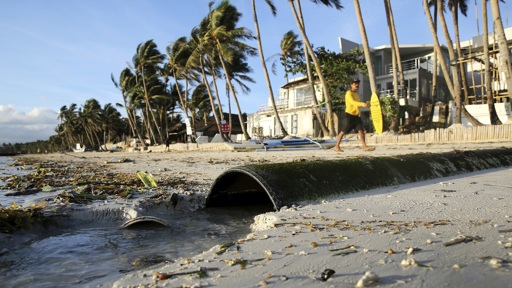
Wastewater pollution levels are higher inside many marine protected areas than in nearby unprotected areas, according to a new study published in the journal Ocean & Coastal Management. The researchers also found that nearly three-quarters of all MPAs — more than 12,000 globally — are exposed to wastewater nitrogen pollution from sewage and agricultural runoff. “[O]ur results expose that we are not systematically incorporating information about pollution into marine spatial planning or implementing integrated land-sea management,” study co-author Amelia Wenger, a senior research fellow at the University of Queensland in Australia and global water pollution program lead with the U.S.-headquartered NGO Wildlife Conservation Society (WCS), told Mongabay. “Land and sea are deeply connected, but the way we manage them is not,” she added. The researchers modeled nitrogen pollution within MPAs globally and looked at levels both inside and outside MPAs throughout a 50-kilometer-wide (30-mile) coastal zone in six tropical regions with high biodiversity. Median pollution levels were up to 10 times higher inside MPAs across four of the study’s six focus regions, including the Caribbean and Bahamas, the Middle East and North Africa, the Coral Triangle in the Western Pacific, and the Indian Ocean. “In regions such as East Africa and the Middle East and North Africa, around 60% of MPAs are exposed to [nitrogen] loads higher than the global median,” Wenger said. The findings raise questions about the effectiveness of current MPA strategy, according to Jasmine Fournier, executive director of the Ocean Sewage Alliance (OSA), an international organization focused…This article was originally published on Mongabay
From Conservation news via This RSS Feed.