

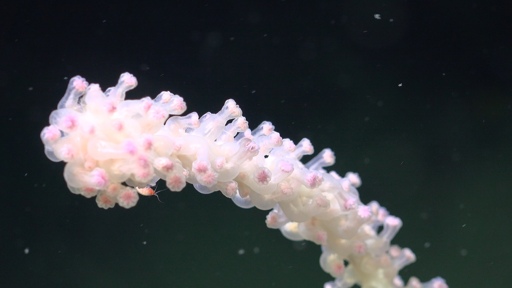
Biologist Erik Cordes has spent much of his career studying cold-water reefs — coral systems typically found in chilly, dark waters far below the ocean’s surface. But his latest project took him by surprise when he and a group of colleagues discovered what might be one of the world’s largest deep-sea, cold-water reefs. Over the course of two expeditions aboard the research ship R/V Falkor (too) — first in July 2025, and then in December 2025–January 2026 — Cordes and a team of scientists explored a previously undocumented cold-water coral reef system along a 900-kilometer (560-mile) stretch of Argentina’s territorial waters, about 1,000 meters (3,300 feet) below the surface. Globally, cold-water reefs can be found in depths as shallow as 50 m (164 ft) and as deep as 4,000 m (13,100 ft). Just one of the coral mounds — underwater hills made up of coral skeletons topped by living coral that take thousands or even millions of years to form — stretched out over an area of 0.4 square kilometers (0.15 square miles), nearly the size of Vatican City. The expeditions, mounted by the U.S.-based Schmidt Ocean Institute, identified many more of these mounds across the 900 km that it mapped, leading the researchers to believe the corals could be part of one of the most extensive cold-water reefs in the world. “It still amazes me when we can discover something this size still on our planet,” Cordes, a professor of biology at Temple University in the U.S., told Mongabay.…This article was originally published on Mongabay
From Conservation news via This RSS Feed.