

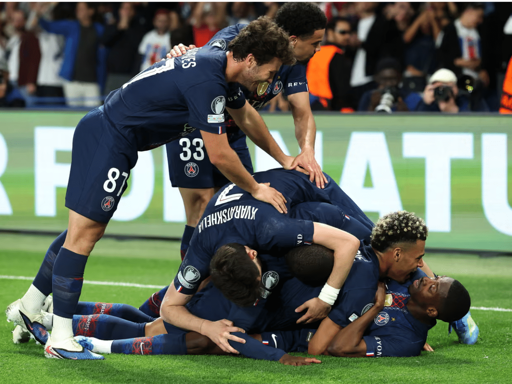

Paris Saint-Germain (PSG) edged Bayern Munich 5-4 in a first-leg Champions League semi-final that delivered everything the fixture promised, plus more.
An electric pace, finishing and a tactical chess match that rarely settled into a defensive contest. The scoreline tells the crazy story, nine goals, momentum swings and a slender advantage for the holders to take to Munich next week.
How the PSG vs Bayern Munich match unfolded
Bayern struck first when Harry Kane converted a penalty in the 17th minute, but PSG responded quickly.
Khvicha Kvaratskhelia levelled with a high-quality strike before João Neves headed the hosts in front from a corner.
Michael Olise pulled Bayern level again just before half-time, and Ousmane Dembélé restored PSG’s lead from the spot in stoppage time to make it 3-2 at the break.
The second half began in similar fashion, Kvaratskhelia and Dembélé scored within minutes to push PSG 5-2 ahead, only for Bayern to rally with headers from Dayot Upamecano and a Luis Díaz finish that reduced the deficit to 5-4.
What mattered?
Clinical finishing.
PSG scored with all five of their shots on target, an efficiency rarely seen at this level and a decisive factor in a game where both defences were stretched.
And big-game players really delivered.
In this game, Dembélé and Kvaratskhelia both scored twice, carrying PSG’s attacking threat through moments when Bayern looked set to dominate. Harry Kane’s penalty underlined Bayern’s threat, but the German side were repeatedly undone by quick transitions and individual moments of quality.
VAR and fine margins for PSG and Bayern
The match featured a contentious stoppage-time penalty for PSG after a VAR review. A later VAR check that allowed Díaz’s goal to stand after an initial offside flag was also overturned.
Those marginal decisions shaped the scoreboard and the tactical choices both managers will make ahead of the return leg.
Tactical takeaways
Luis Enrique set PSG up to attack and to invite moments of chaos. The plan worked because PSG’s forwards were sharper and more decisive in the final third.
Bayern, coached to press and probe, created chances but were vulnerable to quick counters and set-piece moments, the route by which Neves scored.
Both teams showed an appetite to win rather than to protect a result, which explains the open nature of the game and the high goal count.
Attack vs defence
Defensively, neither side can be absolved. There were positional lapses and moments of poor concentration, but the quality of the goals, long-range strikes, well-worked finishes and clinical headers, suggests this was as much about attacking excellence as defensive failure.
That context matters when assessing how the tie might play out in Munich. It has all the ingredients for another goal fest.
View this post on Instagram
What does this mean for the tie?
PSG take a one-goal lead to the Allianz Arena. In isolation that is not decisive.
Bayern showed they can score away from home and will be confident of overturning a single-goal deficit in front of their crowd. But PSG’s five goals in Paris give them a psychological edge and force Bayern to balance attack with caution in the return.
If Bayern score twice in Munich, the tie will be wide open. If PSG can nick an early goal, the pressure on Bayern increases significantly.
Players to watch in the return leg
- Ousmane Dembélé — He proves how decisive he is in the final third and how comfortable he is taking responsibility in big moments.
- Khvicha Kvaratskhelia — The timings of his two goals underline how dangerous he is in transition. When given space on the flank, he is able to change the dynamics of a game in an instant.
- Harry Kane — He is still Bayern’s focal point, as he has been for most of this season. Kane’s penalty and general ball movement will be central to Bayern’s plan to unsettle PSG. The fourth goal scored by Diaz was created by a killer pass from Kane.
The final verdict?
This was not a football match that will be remembered for defensive masterclasses, but it will be remembered for entertainment and for the way both teams committed to attack.
PSG leave Paris with a lead that is valuable but fragile. Bayern leave with belief that the tie is far from over.
The second leg promises to be tactical, intense and, given what we saw in Paris, likely to produce more goals. For neutral observers, that is exactly the kind of semi-final football the Champions League exists to provide.
An exciting potential awaits us in the second leg. If five goals are scored in the return leg, this tie would set a new record for the highest-scoring Champions League knockout tie in history.
Featured image via Getty Images/ Alexander Hassenstein
By Faz Ali
From Canary via This RSS Feed.