

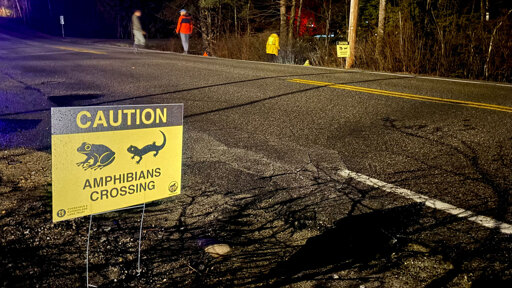
On a Tuesday night in April, beneath a sky mottled with clouds, a slick stretch of road in Cumberland, Maine, erupted in sound. It started with a few high-pitched chirps, like the coos of chicks. Within minutes, dozens, then hundreds more joined a chorus punctuated by low clucks. By the time the sun dipped below the horizon and rain began to splatter the pavement, the sound had risen to a din. Cars stopped on the shoulder and people spilled onto the road wearing neon vests and waving bright flashlights. They fanned out, and raised their voices as they spoke, like guests at a bustling cocktail party.
“I got a big one!” called a youngster in a yellow raincoat. She held out her hand for other volunteers who crowded around her. A yellow-spotted salamander about 9 inches long stretched across her gloved palm, its slick tail draped between her fingers.
Each year in New England, on the first warm, wet night of spring, when the ground has thawed, and the temperature is just right, armies of frogs and maelstroms of salamanders emerge from the woods. They hop and undulate through the night, following the same routes their ancestors traveled to the vernal pools of their birth, where they lay their eggs, chirping and clucking all the while.
“They’re calling to the ones that are still in the woods, telling them to come,” said Penny Asherman, who leads the Chebeague and Cumberland Land Trust.
For the past decade, “Big Night” has drawn dozens of people who drop everything at a moment’s notice to help the amphibians migrate safely. But climate change is scrambling that ancient trek. The journey begins less predictably, has grown deadlier, and become more tenuous as the seasonal wetlands they depend on are transformed by climate change. That has prompted the volunteers to become citizen scientists, tracking when the animals emerge and how many survive. Coordinated by Maine Big Night, the effort, which came on April 14 this year, is generating data that is reshaping how communities think about culverts, road maintenance, and other infrastructure.
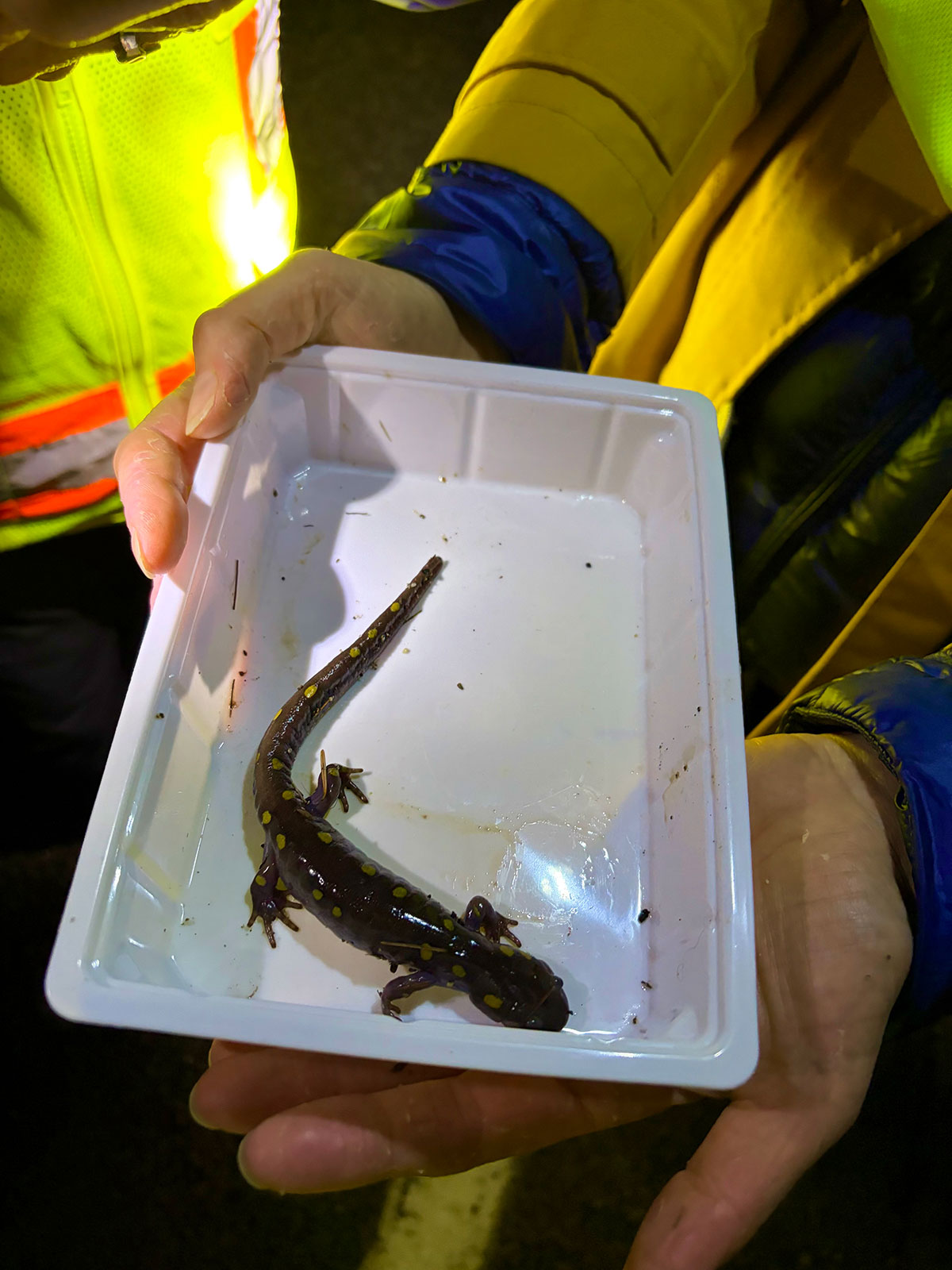
Volunteers hold a yellow spotted salamander after ferrying it across the road. Grace Benninghoff
In the past, these amphibian protectors were little more than crossing guards, shepherding the tiny creatures to safety. But a nonprofit formed in 2018, Big Night Maine, has asked them to meticulously document what happens along these migration paths. This year, more than 1,200 observers at 650 migration sites statewide submitted observations.
Tim Kaijala has been a regular for seven years along with his children, Theo, 10, and Kai, 8. “The data side is pretty cool,” he said. “When we first came, it was just bringing frogs and salamanders over, but the last couple years it’s been more about counting and keeping track.”
As he spoke, Theo and Kai peered into a pool, watching a wood frog they’d helped across the road kick through the clear water. “Remember that one time, Theo,” Kai said, looking at her brother.
“Oh yeah,” he said.
“Tell it,” she urged.
“One time there was a car coming down, and I ran out and saved the peeper,” he paused, solemnly. “I do not want any peepers to die. If I stepped on one, I would never forgive myself.”
When data last year showed that eight out of 10 amphibians were hit by motorists in Orono, at the state’s most ecologically diverse migration site, Big Night worked with city officials to secure a grant for cameras and fencing that guide the animals toward an existing culvert beneath the road. When the group also saw rising numbers with edema linked to road salt runoff, it pushed for alternative deicing methods, including pickle juice.
Greg LeClair founded Big Night Maine. By day, he’s a municipal planning biologist for the Maine Department of Inland Fisheries and Wildlife. He started the organization because he knew data collection would be essential for protecting the amphibians he’s adored since childhood.
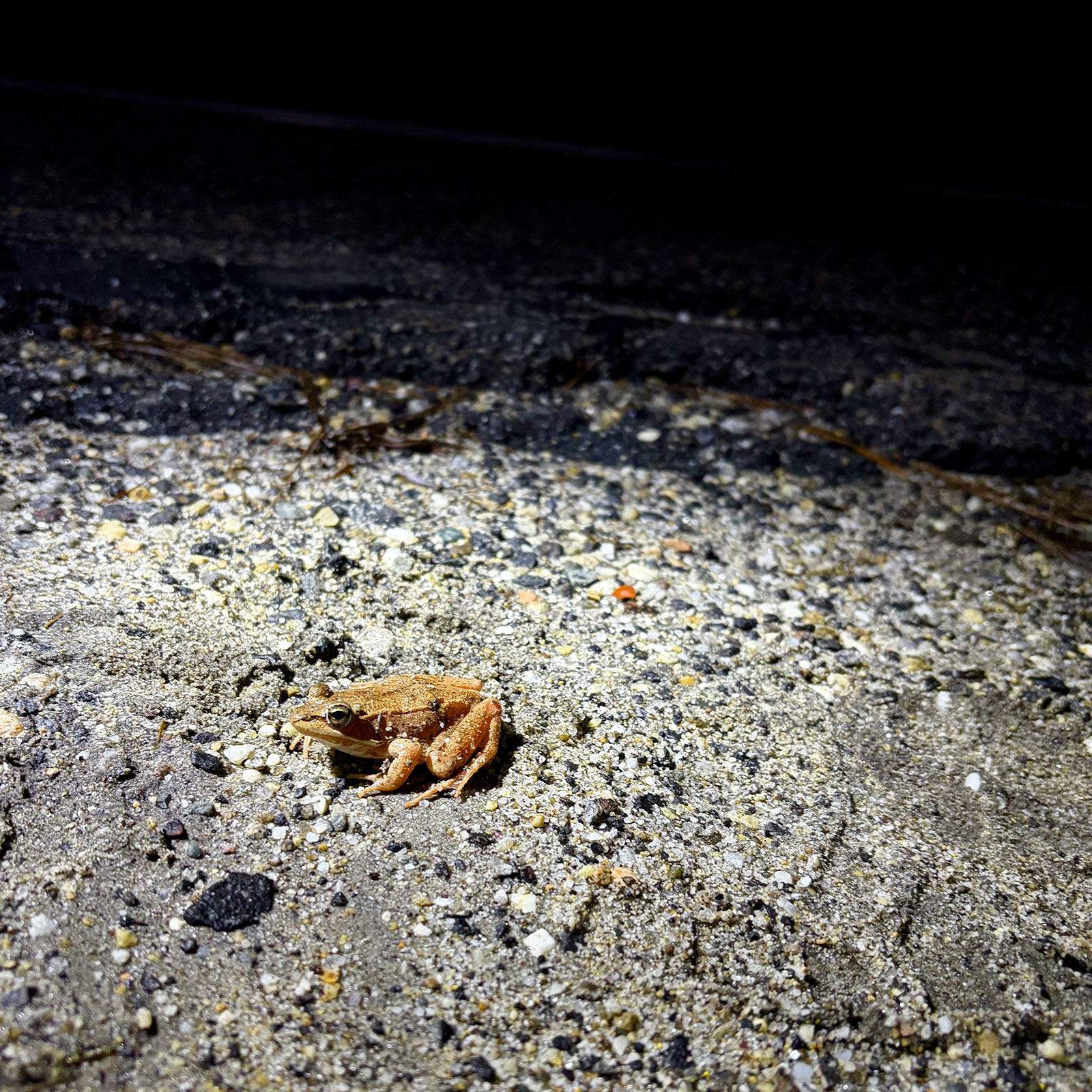
A wood frog considers taking a leap into a vernal pool after being helped across the road. Grace Benninghoff
It’s easy to see why. Wood frogs are palm-sized, dappled brown creatures with dark markings smattering the skin around their wide eyes. Spring peepers are the size of a thumb and camouflage so well with the leaf litter of the forest floor that they’re nearly invisible until they unleash calls that echo through the night.
But loving them and saving them are two different things.
“I knew that in order to make change, you needed data, especially when we’re talking about critters folks aren’t as keen on,” LeClair said. Conserving land and installing culverts, two effective ways to protect the amphibians, aren’t cheap. “Nobody will give you the money unless you have data,” he said. “That money for infrastructure and conservation is not just floating around.”
Trouble is, little data exists on amphibian migration patterns. They’re small, spend most of the year burrowed in the woods, and are hard to track. “Any time anyone has a collision with a deer or moose and an insurance claim is filed, a data point is collected, but nobody files an insurance claim when they hit a frog.”
Good data does more than help amphibian advocates win protections. It ensures conservationists spend limited resources where they’ll do the most good. The fencing project in Orono is one example. For years, scientists thought specialized culverts were the only reliable way to get the hoppers and creepers off roads. But cameras there have already captured frogs and salamanders using an existing crossing. If the new fencing the town recently installed proves nearly as effective, it could save tens of thousands of dollars.
Protecting amphibians matters far beyond frogs and salamanders themselves. They are foundational to New England’s food web. Eggs, larvae, and adults all sustain a surprising range of animals from owls and herons to foxes and even moose. “If you remove one piece of the puzzle or two, you don’t know which piece could kick the whole system out of whack,” said Sally Stockwell of Maine Audubon. “But there are huge trickle-down impacts when you lose the base of the food chain.”
Amphibians are also particularly vulnerable to climate change. They can’t regulate their body temperature, and they need moisture to move. In the winter, when they burrow into the soil to stay warm, dwindling snowpack can leave them without enough insulation, and they freeze to death. Unusually warm winter days can draw them out of their hiding places, and the return of freezing temperatures kills them. A dry spring or sudden heatwave can dry out the vernal pools where they lay their eggs, killing the next generation.
As the climate warms, fungi adapted to warmer, drier conditions are becoming a greater threat. Among them is the deadly chytrid fungus, which grows on amphibians’ skin, impairs their ability to breathe, and has been seen more frequently in recent years.
Yet we remain their greatest threat. Development eliminates their habitat, and cars kill untold numbers of them. That is why data is so important: It reveals what would otherwise go unseen. In Cumberland this year, volunteers counted 10 species crossing, including more than 100 spring peepers, 34 wood frogs, and 18 spotted salamanders. Just nine amphibians were found dead. “Anything we can do to reduce mortality is a benefit,” said Stockwell.
And on that rainy night in April, volunteers did all they could. Until nearly midnight, children and parents, college kids, and retirees patrolled the road and forest beyond, jotting notes on clipboards and ferrying frogs to safety in Tupperware. They paused only to watch as the tiny cold-blooded critters stretched their limbs and swam, sometimes bobbing at the surface to call — at shocking volume — to the ones still in the woods.
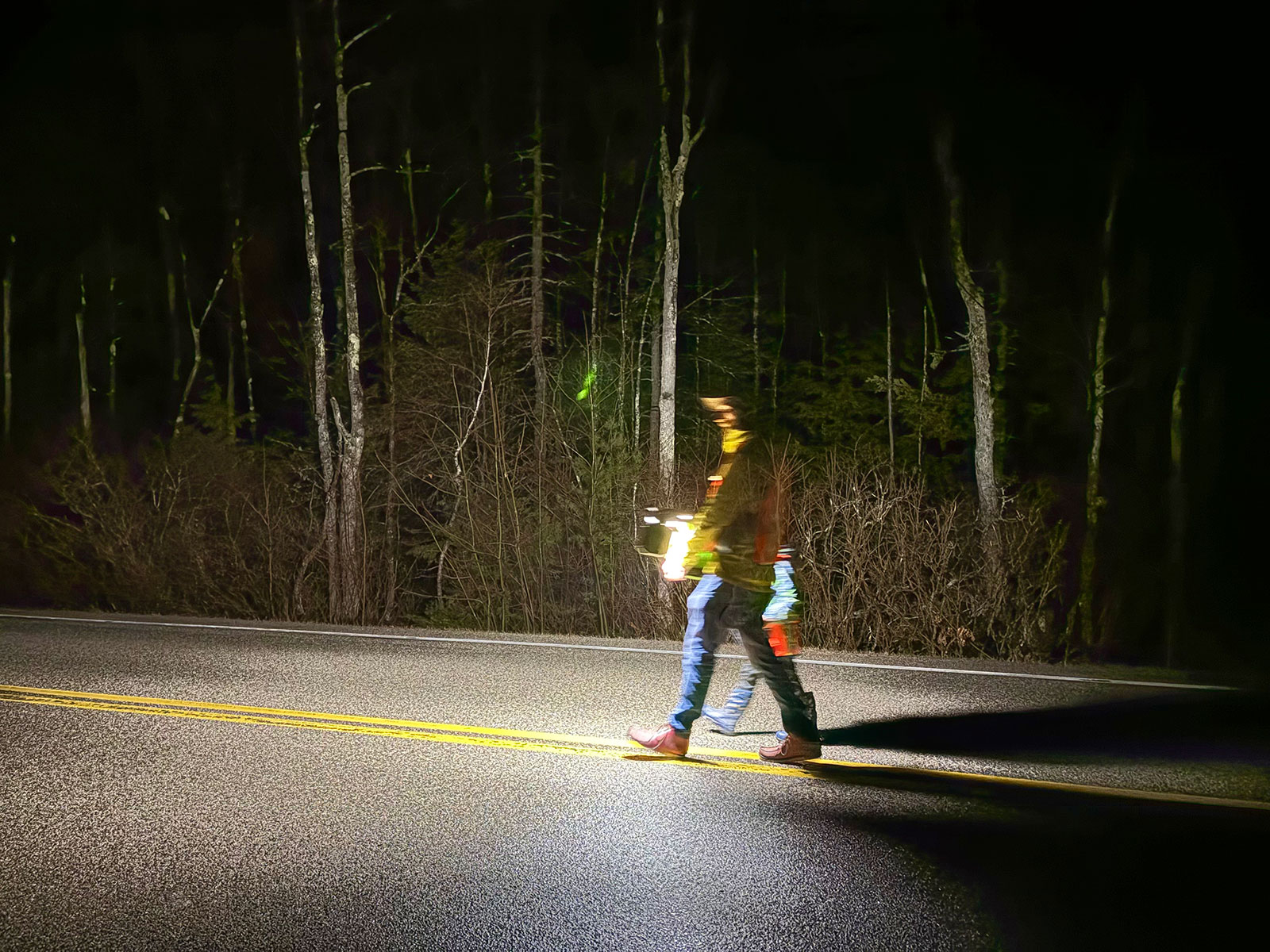
A father and son look for amphibians to assist. Grace Benninghoff
This story was originally published by Grist with the headline One night a year, humans command this march of frogs and salamanders on Apr 29, 2026.
From Grist via This RSS Feed.