

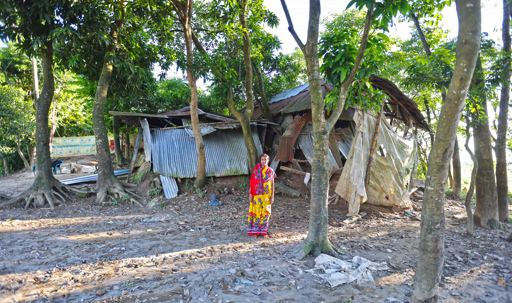
Flash floods are a common occurrence in Bangladesh’s northeastern haor (shallow wetland ecosystem) region. These large bowl-shaped topographic depressions remain inundated for around seven months every year. At the beginning of every monsoon, runoff from the heavy rainfall in the Himalayan foothills of India’s Meghalaya state, which neighbors Bangladesh, overflows via the trans-boundary rivers and causes flooding in the haors of Sylhet, Sunamganj, Netrokona and Kishoreganj districts. While the changing climate and silting of rivers are worsening the flooding impact (such as that of 2017), pressures from population growth have also been seen to complicate things when it comes to the vulnerability of residents here. For example, newly established villages like Rangpur Bosti or Notun Jibonpur in Companiganj, Sylhet — located at the base of the Himalayan foothills of Meghalaya — were washed away by multiple flash floods in 2022. While flash floods are nothing new in the area, the scale of destruction in these villages are. House after house in these villages — located on the banks of Dholai River, a transboundary river originating in India — was devastated; in some cases they were totally washed away. The devastation demonstrated the brute force of raging floods, a rather uncommon sight even in a flash flood-prone area. The reason: These villages were not supposed to be here, and they were not built to withstand the magnitude of the flood. Flood-ravaged houses seen in Chanpur in Sylhet’s Companiganj subdistrict. Built right on the edge of a transboundary river, the community has…This article was originally published on Mongabay
From Conservation news via This RSS Feed.