

Last September, Texas State University history professor and socialist activist, Tom Alter was fired without due process after giving a talk about resisting U.S. imperialism at an online conference on socialism. Just two months before, four Brooklyn College professors were terminated for supporting a rally for Palestine at Brooklyn College, also without any due process.
In both cases the university administrations that carried out these firings were acting in response to pressure from the state to punish activists who support Palestine or are critical of the Far Right. In the case of Alter, it was right-wing Texas Governor, Greg Abott who demanded his termination less than 24 hours after the assassination of Charlie Kirk. At CUNY, the fired four were part of an attempt by the chancellor, Felix Matos Rodriguez, to appease the House Committee on Education, which was investigating the university for what it claimed were increasing levels of antisemitism. This same cynical weaponization of antisemitism has been used to go after pro-Palestine activists at universities across the country.
Since then, three of the CUNY Fired Four have been reinstated thanks to an aggressive campaign organized by workers and students, but the fourth fired adjunct remains blacklisted at the university and, like Alter, is continuing to fight for her job.
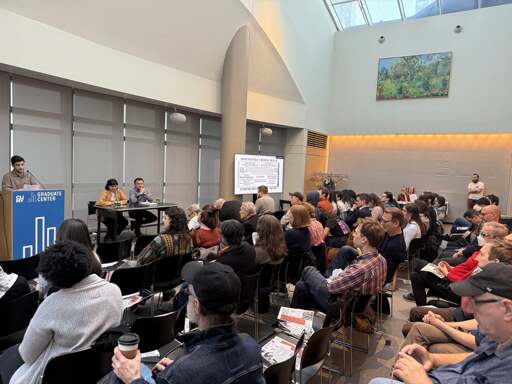
This repression and how to fight against it, was the subject of a discussion with Professor Alter and Noelle Mapes, one of the reinstated faculty, held at the Graduate Center on Monday. The event was sponsored by the Professional Staff Congress (PSC-CUNY), the Movement of Rank and File Educators (M.O.R.E.), and several socialist organizations, including The Tempest Collective, Socialist Horizon, and Left Voice.
Speaking about the Fired Four campaign, Mapes discussed the importance of solidarity, the progressive role the union played in quickly organizing to defend faculty, and how such struggles can really galvanize organizations like the PSC-CUNY and raise the political consciousness of its members.
“We shape the institutions that we are part of.” said Mapes, “The president of our union has been very supportive, but he didn’t talk about solidarity with Palestinian liberation until this fight. And that is something that pushed for more openness and willingness to engage with the huge number of students and faculty members who are on the side of the Palestinians.”
Indeed, in February of 2025, Davis successfully led the charge, within the midst of the ongoing genocide in Gaza, to repeal a resolution passed by the union’s delegate assembly that declared the PSC’s support for the Palestinian people and the Boycott Divestment and Sanctions movement. That he is now standing up for Palestinian liberation as part of this campaign shows the way that rank-and-file actions like this can have profound political consequences even when they fail to win their immediate demands. But of course, pushing the union bureaucracy to confront the state and the status quo is a difficult process.
Later in the question and answer portion of the evening Mapes made the astute observation that the union’s lack of strike-readiness was a serious weakness, and that unions like the PSC CUNY should be prepared to take strike action against such repression of its own members. Of course, such strike actions can become a reality when the rank and file enthusiastically take up campaigns like the one to defend the Fired Four and demand that the union take every action possible to win.
Mapes also talked about the need to theorize and organize more deeply around the question of who runs the university. So long as decisions about who can be hired and fired are left to bureaucrats like Matos Rodriguez and the political hacks that make up the CUNY Board of Trustees, this kind of political repression will continue. Our vision therefore has to be for a university that is run by faculty, students, and workers collectively for the benefit of the working class and society, not in service of the politics and profits of the bourgeoisie.
Alter, who is on a nationwide tour to fight against academic repression, spoke at greater length about his case and about other examples of state repression across the country, including the case of the Prairieland Defenders and the ban on discussions of LGBTQ+ topics at Texas Tech. Alter then connected this repression to U.S. imperialism, the decline of U.S. hegemony, and the rise of the Far Right. As more and more people begin to question the legitimacy of the U.S. state, and as the state and the ruling classes increasingly lose their ability to rule by consent, they inevitably turn more toward the use of open force and repression. Like Mapes, Alter also discussed the ways in which campaigns like his are about much more than any one individual and how they can really build the power of students and workers. According to Alter, membership in the American Association of University Professors (AAUP) chapter at Texas State where he teaches and across the entire state have skyrocketed as a consequence of the campaign for his reinstatement.
Meanwhile both Mapes and Alter discussed the important role that students have played in both campaigns and the need to build greater connections between students, workers, and faculty. Just as several of the Fired Four defended students against the violence of the New York Police Department, students have stood up to defend their teachers. This is the kind of solidarity that comes from struggle and it is in such unity that our greatest power lies.
In this sense the talk itself, which brought together many different sectors of the Left, rank-and-file union members, and students, was a testament to the power that working people have to act independently of the bureaucrats and politicians that claim to lead us.
The post Tom Alter and CUNY Fired Four Speak Out Against Academic Repression appeared first on Left Voice.
From Left Voice via This RSS Feed.