

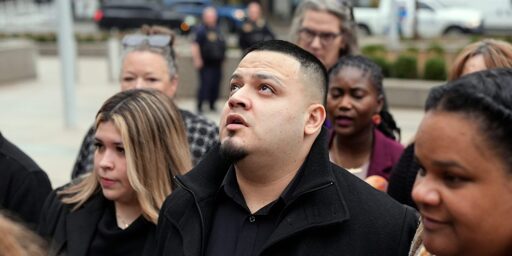
More than a year after Kilmar Abrego Garcia won at the U.S. Supreme Court — forcing the Trump administration to bring him back from El Salvador — federal officials can’t seem to decide what, exactly, they want to do with him.
On the one hand, Trump officials continue to insist that Abrego must be deported to Africa, recently settling on Liberia. At the same time, the Department of Justice has pressed forward with its prosecution of Abrego for human smuggling — a criminal case that must be resolved before the government deports him.
“You can’t have it both ways,” Maryland District Judge Paula Xinis, who first ordered Abrego’s return to the U.S. and who is still presiding over his immigration case, recently told the DOJ. “He physically needs to be in this country to be prosecuted.”
The criminal case against Abrego stems from a 2022 traffic stop in Tennessee, which, according to federal prosecutors, was proof he was enmeshed in a human smuggling plot. The case was set to go trial in Nashville this year but presiding District Judge Waverly Crenshaw of the Middle District of Tennessee canceled the trial date to consider a key question: whether Abrego is the target of a “selective and vindictive prosecution.” The answer will determine whether the case moves forward; Crenshaw is expected to rule any day.
Defense attorneys argue that the Trump DOJ brought the charges against Abrego as revenge for his successful legal challenges, which freed him from the notorious Salvadoran prison known as CECOT. “This case results from the government’s concerted effort to punish him for having the audacity to fight back, rather than accept a brutal injustice,” they wrote in their motion to dismiss the case.
Crenshaw has already found some evidence to support these allegations, writing last fall that there was a “realistic likelihood of vindictiveness” against Abrego. He pointed to numerous public statements made by top Trump officials, particularly that of then-Deputy Attorney General Todd Blanche, formerly Trump’s personal defense attorney, who told Fox News that the Justice Department began investigating Abrego after “a judge in Maryland” interfered with Trump’s decision to deport him.
[
Related
Trump Won’t Stop Trying to Punish Kilmar Abrego Garcia](https://theintercept.com/2026/02/24/trump-kilmar-abrego-garcia-vindictive-prosecution/)
Still, proving their case has been a challenge for Abrego’s defense. The DOJ has refused to turn over evidence that would illuminate its decision-making — and tracing the prosecution to its roots requires untangling the Tennessee case from a previous probe originating in Baltimore. The Maryland investigation, which was linked to Abrego’s immigration case, probed Abrego’s 2022 traffic stop and stayed open for more than two and a half years, only to be closed after Abrego was shipped to El Salvador.
After Abrego prevailed at the Supreme Court, however, the Maryland investigation was suddenly reopened to great fanfare. The Department of Homeland Security sent out press releases trumpeting the “bombshell” revelations supposedly derived from the traffic stop – namely that Abrego was a human smuggler and a member of MS-13. It was in the wake of this publicity that the U.S. attorney’s office in the Middle District of Tennessee began its case, repackaging the evidence from the Baltimore investigation and indicting Abrego in May 2025.
To further probe the government’s motivations, Crenshaw ordered an evidentiary hearing, where the DOJ would be required to present “objective, on-the-record explanations for Abrego’s prosecution.” If the DOJ could not rebut his previous finding that there was a “likelihood of vindictiveness” against Abrego, he would have to throw out the case.
That hearing took place in late February, with lawyers on both sides filing post-hearing briefs earlier this month. In its 24-page filing, which contained the word “undisputed” 20 times, the DOJ insisted that it proved once and for all that Abrego’s prosecution was rooted in evidence of criminality rather than revenge. “Regardless of the tale Defendant invites this Court to believe,” wrote Associate Attorney General Stanley Woodward, “any narrative of animus has been affirmatively disproven by the Government’s undisputed evidence.”
In reality, the testimony offered by the government raised more questions than answers — while revealing that DOJ higher-ups were involved at every step leading up to Abrego’s indictment. Though Woodward cast the prosecution as one steered by law enforcement officers duty-bound to the evidence and their own moral compass, this was hard to take seriously. Donald Trump, after all, has spent the past 15 months trying to transform the DOJ into his personal law firm, demanding that prosecutors go after his political enemies.
In their own post-hearing brief, Abrego’s lawyers argued that the government has “tried to sanitize the origins of this prosecution.” Its story is “at odds with both the documentary record in this case and common sense.”
Abrego arrived at the hearing on February 26 in a black pea coat, black zip-up sweater, and black shirt. It was a gray, humid morning in downtown Nashville as TV cameras set up outside the federal courthouse plaza. While a line formed at security, Abrego, 30, headed toward the elevators with his legal team and supporters. Crenshaw’s fifth-floor courtroom quickly filled up; Abrego was given headphones to listen to the hearing in Spanish. An overflow area was provided for press.
Representing the federal government was Woodward, a former assistant to Trump who previously helped orchestrate his defense in the classified documents case. He sat alongside three members of Task Force Vulcan, a multiagency body created by the Trump administration to go after international gangs.
Woodward called Rana Saoud, a former special agent at the Nashville office of Homeland Security Investigations, which is part of the Department of Homeland Security. According to Saoud, who retired last December, she first heard that Abrego had been stopped by the Tennessee Highway Patrol through an article in the conservative Tennessee Star. She did not remember who sent it to her. “I don’t have my phone anymore,” she said.
The story was published on April 23, 2025 — five days after DHS announced its reopening of the Baltimore investigation — and was heavily based on the government’s claims. While it was not clear when Saoud read the article, she called Robert McGuire, the acting U.S. Attorney for the Middle District of Tennessee, the following Sunday, April 27. McGuire apparently was not yet aware of the traffic stop or the Baltimore investigation either. He agreed they should take a closer look.
Although Abrego was famous by then for his exile to CECOT, Saoud testified that this had no bearing on her actions. “We’re not waived by political attention or political posturing,” she said.
On cross-examination, one of Abrego’s lawyers asked Saoud if she’d seen the DHS press releases publicizing the traffic stop. She said no. Nor did she apparently see Trump boast about it in the press. Saoud said she had “stopped listening to the news. … I had other priorities to investigate and focus on.”
Saoud conceded that she was not privy to the decision-making process at DOJ. But she insisted that the evidence supported charges against Abrego. “The facts were leading us towards an individual who was involved in a human smuggling crime,” she said.
In a list of witnesses in advance of the hearing, the DOJ had included a second HSI investigator, Special Agent John VanWie, who led the investigation in Baltimore. But since then, Woodward had apparently changed his mind. Rather than calling the man who could explain why his office reopened the investigation into Abrego after the Supreme Court ruling, Woodward went straight to his second and last witness: Assistant U.S. Attorney McGuire.
Wearing a dark suit and his hair parted to the side, McGuire took the stand with the air of a seasoned but humble public servant. Once an unsuccessful candidate for local district attorney, McGuire found himself in charge of the Nashville U.S. attorney’s office by chance. He joined the office in 2018, working as a line prosecutor until back-to-back resignations catapulted him to the top just weeks before Trump was inaugurated in 2025. “Here I am, kind of the accidental acting U.S. attorney,” he told the Tennessee Banner that February. A few months later, he was in charge of the Abrego prosecution.
“I’d like to get right to the heart of the matter everyone is here for,” Woodward began. “Who made the decision to seek an indictment of Mr. Abrego?”
“Who made the decision to seek an indictment of Mr. Abrego?”
“I did,” McGuire said.
“Did Deputy Attorney General Todd Blanche direct you to do so?”
“No.”
“Anyone at Main Justice?”
“No sir.”
“What about the White House?”
“Absolutely not.”
McGuire reiterated what he’d previously written in a sworn affidavit, insisting that the decision to prosecute Abrego was his alone. He said he recognized signs of human smuggling in the footage from the traffic stop, which showed Abrego driving eight other Latino men in a van with no luggage, and decided to pursue the case personally.
Yet McGuire’s written narrative contained a key omission. Email records had subsequently revealed that another DOJ prosecutor played an active role — a man with a reputation as Trump’s “brashest enforcer when it comes to clamping down on US attorneys’ autonomy”: Associate Deputy Attorney General Aakash Singh.
Singh, it turned out, had written to McGuire about Abrego’s case on the same Sunday he got the call from Saoud — the first of several emails from the D.C.-based prosecutor. Singh wanted to meet the next morning with McGuire and two other AUSAs who’d been involved in providing evidence for the Baltimore investigation. There was nothing unusual about this, McGuire maintained. Singh was simply a point person for U.S. attorneys across the country when it came to communicating with the deputy attorney general’s office in Washington. “If there was a noteworthy case — if there was an important matter that happened in the Middle District of Tennessee — he would be my conduit to let them know what was going on,” he said.
[
Related
Deportation, Inc.](https://theintercept.com/2025/12/19/deportation-abrego-garcia-ice-immigration/)
McGuire insisted that he was in charge of Abrego’s prosecution at every step. His correspondence with Singh was simply intended to provide updates on his work. But Abrego’s lawyers zeroed in on the emails as proof that the prosecution was being driven by officials in D.C. On cross-examination, defense attorney David Patton went through the correspondence one email at a time. The first message concerned a confidential informant who would later testify against Abrego before the grand jury. Singh “knew about that witness before you did,” Patton pointed out. In another, Singh wrote to McGuire thanking him for his work on the case, writing, “It’s a top priority for us.”
Who was the “us” in this email?
“I presumed it was Main Justice leadership,” McGuire replied.
In another email, Singh pressed McGuire for an update on the timing for a possible indictment even though McGuire had already updated him earlier that day. “He’s pretty eager here isn’t he?” Patton asked. McGuire demurred. It was pretty typical for the DAG’s office to ask for updates “in any high-profile matter,” he said. Yet “high-profile” — a term McGuire repeatedly invoked on the stand — did not begin to capture the extent of the Trump administration’s particular fixation on Abrego.
Patton also grilled McGuire about his correspondence with his own staff. In one email, McGuire wrote to several members of the Nashville U.S. attorney’s office to provide them with a memo laying out the potential charges against Abrego, noting that he’d heard anecdotally that Blanche and then-Principal Deputy Attorney General Emil Bove “would like Garcia charged sooner rather than later.” According to McGuire, this was merely an attempt to keep his colleagues in Nashville apprised of the situation. “I just wanted to be transparent with my team that I hadn’t been told to do anything but there was some interest,” he said.
Yet, in the same message, McGuire told the recipients not to put their thoughts on the matter in an email. “Isn’t it true that you didn’t want people putting in writing that they opposed the prosecution?” Patton asked. McGuire said he just preferred to hash things out face to face.
One person, however, had replied in writing: Ben Schrader, chief of the criminal division at the Nashville U.S. attorney’s office, who firmly opposed the prosecution. He sent back a memo of his own, asking McGuire to “please pass it along to relevant parties in D.C.” McGuire said he didn’t recall if he did. On the day that Abrego was indicted, Schrader resigned.
Although McGuire denied ever discussing his decisions with the highest Trump officials, Patton pointed to at least one conversation. Records showed that, on June 6, the same day Abrego was returned from El Salvador, Blanche personally called McGuire. It was a “very brief phone call,” McGuire said. The deputy attorney general simply wanted to notify him that Abrego was headed back to the country. “I’ll be honest, I don’t totally remember all the things he said.”
Over the past year, Abrego’s case has faded amid the constant chaos and upheaval of Trump’s second term. Today it is impossible to keep track of all the resignations and firings across the federal government. The DOJ has itself lost thousands of employees.
Yet Abrego’s ordeal was one of the first shocks of Trump’s second term, revealing the chilling lengths to which his administration would retaliate against employees who failed to fall in lockstep behind the president. It was Abrego’s case that spurred veteran prosecutor Erez Reuveni to become a whistleblower after he was punished for conceding that Abrego had been erroneously deported to El Salvador.
This recent history loomed large over the hearing — and will inevitably inform Crenshaw’s ultimate decision. At one point, Patton pulled up the infamous February 2025 memo issued by Pam Bondi, which cast DOJ attorneys as the president’s lawyers. It warned that “any attorney who, because of their personal political views or judgments, declines to sign a brief or appear in court, refuses to advance good faith argument on behalf of the administration, or otherwise delays or impedes the department’s mission will be subject to discipline and potentially termination.”
“It wasn’t very subtle, was it, Mr. McGuire?” Patton asked.
“I understood the policy,” McGuire replied.
The post Who Decided to Indict Kilmar Abrego Garcia Over a Years-Old Traffic Stop? appeared first on The Intercept.
From The Intercept via This RSS Feed.