

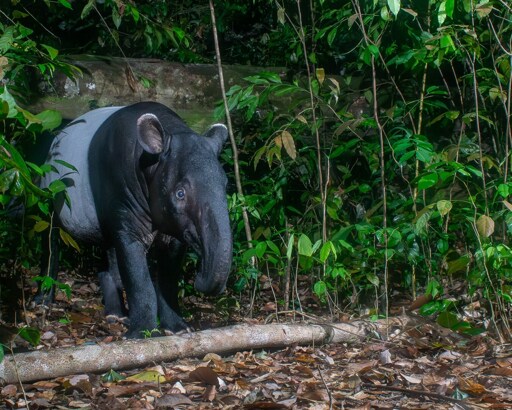
Asia’s only tapir species still remains understudied in Malaysia, researchers at the Wildlife Conservation Society say. Recent findings from Thailand suggest that some forest complexes there may hold more Malay, or Asian tapirs (Tapirus indicus) than previously estimated. However, across the border in Malaysia, experts warn that the endangered species faces an uncertain future, complicated by a lack of robust national population data and a persistent snaring crisis. On World Tapir Day, April 27, Mongabay asked WCS Malaysia researchers why this is the case. There have been very few reliable estimates of tapir numbers in Malaysia; one was published in 2012 and another in 2024. “It is always challenging to provide meaningful and realistic national figures for a large mammal species that is difficult to count, and the tapir is one that fits the bill,” Mark Darmaraj, WCS Malaysia country director, told Mongabay by email. Tapirs are notoriously difficult to count because, unlike a tiger with its distinct stripes, these black-and-white animals lack unique natural markings. Previously, researchers were able to use “bycatch” data from camera traps — images of tapirs captured on cameras originally set up for another species. They’ve identified unique individuals through a combination of scars, neck wrinkles and ear damage, said Shariff Mohamad, science and strategic communications manager for WCS Malaysia. Mohamad told Mongabay that while statistical models today are capable of estimating the population density of species without any distinguishing markings, these are difficult to implement because they require resource-intensive survey designs. Consequently, Malaysia still…This article was originally published on Mongabay
From Conservation news via This RSS Feed.