

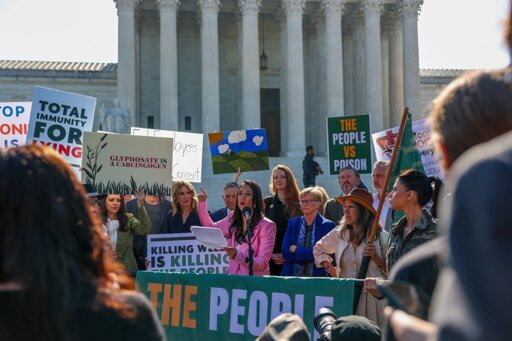
Demonstrators gathered in front of the Supreme Court Monday morning to call attention to a case with far-reaching implications for public health and the use of pesticides in agriculture. The case, Monsanto v. Durnell, centers on whether federal pesticide labeling laws preempt state laws that have allowed individuals to sue Monsanto (now owned by Bayer) based on its failure to warn users that its flagship weedkiller Roundup is linked to cancer.
Both the Environmental Protection Agency (EPA) and the company maintain the product is not carcinogenic and is safe when used as directed, but evidence pointing to its risks has been mounting.
The crowd of around 150 people chanted “People versus poison!” They held signs with slogans including “Round up the Criminals” and “Monsanto knew. They sold it anyway.”
“Inside that building, Monsanto-Bayer will be arguing for the right to poison us and not be held accountable,” Vani Hari, the activist known as the Food Babe and lead organizer of the rally, said. “They want to give us cancer and get away with it. We are here to make sure that does not happen.”
Since Bayer purchased Monsanto in 2018, the company has battled more than 100,000 lawsuits claiming Roundup and its active ingredient glyphosate cause non-Hodgkin lymphoma. In attempts to end the litigation, it created and began executing a five-point plan: It took glyphosate out of Roundup sold for lawn and garden use and began lobbying for state and federal legislation that would give the company immunity.
But number one on the list was always to seek a favorable ruling from the Supreme Court.
Now, what the justices decide will affect what kind of legal recourse is available to individuals harmed by pesticide exposure. Because the issue is also important to supporters of the Trump administration’s Make America Healthy Again (MAHA) agenda, it could also impact the upcoming midterm elections.

The Supreme Court heard arguments Monday in a case that could lead to the dismissal of tens of thousands of lawsuits against Bayer, the pharmaceutical and biotech giant. (Photo credit: Tasos Katopodis/Getty Images)
The Background
After decades of Roundup use, Missouri gardener John Durnell developed non-Hodgkin lymphoma and in 2019 filed suit against Bayer, claiming the chemical use was the cause. In 2023, a jury found the company had failed to warn him of the product’s risks and awarded him $1.25 million. The Missouri Supreme Court declined to hear an appeal, and last spring Bayer petitioned the Supreme Court to take it up.
The justices announced in January that they would hear the case, with arguments limited to the central question of whether an individual can sue a company for not warning them of risks if the federal government hadn’t required a hazard warning when it approved the pesticide’s label.
Specifically, the court would assess whether the Federal Insecticide, Fungicide, and Rodenticide Act (FIFRA) “preempts a label based failure-to-warn claim where EPA has not required the warning.”
Over the past several months, the Trump administration has taken a strong stance in support of Bayer. In a brief filed in support of the company, U.S. Solicitor General D. John Sauer said that federal law “vests EPA with responsibility to determine what pesticide warnings are necessary to protect human health and the environment.”
And the Supreme Court allowed the Trump administration’s lawyers to participate in opening arguments on Bayer’s behalf, though it rejected a motion from trial lawyers who asked to participate on the other side.
In advance of the hearing, pesticide companies, lawyers, former EPA employees, state and federal lawmakers, public health and environmental organizations, and groups representing farmers, farmworkers, and other agricultural interests filed more than 30 amicus briefs on either side of the case.
A group of the largest commodity agriculture groups led by the American Farm Bureau Federation and including the National Corn Growers Association and American Soybean Association, focused their brief primarily on what they said would be “an immediate, devastating risk to America’s food supply” if glyphosate were no longer available. (Bayer has threatened it will stop selling Roundup if its case fails in court, although other companies also make the product.) Without the chemical, the groups argued, yields will drop and farmers will use more toxic substitutes.
However, another coalition of organizations representing farmers, including the National Sustainable Agriculture Coalition, Farm Action, and the National Family Farm Coalition said in their brief that requiring companies to provide warnings won’t lead to the loss of glyphosate or any other pesticide, and that Bayer and its allies overstate the importance of the chemical, especially at a time when a high proportion of weeds have developed resistance to it.
These organizations, which represent a wide swath of farmers and farmworkers, said they “can assure this Court that interpreting FIFRA to permit state law failure-to-warn claims like respondent’s will not ‘threaten both the food supply and the economic viability of American agriculture.’”

The case has created tensions within the Make America Great Again movement, with the Trump administration supporting Bayer’s position. (Photo credit: Tasos Katopodis/Getty Images)
Inside the Courtroom
Those larger agricultural issues were barely present in the courtroom. Bayer’s attorney, Paul Clement, argued that federal law preempts state law, and that the Missouri jury’s finding was in conflict with federal law, since, by his reading, the company would have been in violation of the EPA’s labeling rules if it added a warning that hadn’t been approved by the agency.
But several of the justices came back repeatedly to the question of whether, even if EPA had registered a pesticide, that pesticide could be “misbranded,” a term that includes lacking an adequate health warning.
Justice Ketanji Brown Jackson brought up more than once the fact that the EPA is only required to assess the safety of a pesticide every 15 years and “lots of things can happen in science” in that time.
Similarly, Chief Justice John Roberts wondered if that in that time period, states might not be acting at odds with FIFRA—they might just be able to respond more quickly to new information.
When Trump administration Deputy Solicitor General Sarah Harris described the long process of EPA registration, Roberts responded by asking whether she was arguing that throughout that process, “states can’t do anything?”
When Harris said states had the ability to ban pesticides they didn’t want used within their borders, even if they were approved by the EPA, Justice Neil Gorsuch weighed in. “If that greater power exists, why doesn’t tort power exist?” he asked.
The questioning over timelines is relevant because in recent years, the evidence that frequent exposure to Roundup is linked to cancer has become much stronger, said Chuck Benbrook, a litigation consultant during the previous Roundup trials who has deep knowledge of the evidence presented. Benbrook said that new evidence has not yet been accounted for by the EPA.
More importantly, Benbrook said, during the Durnell trial in a lower court, the Missouri jury heard evidence that showed Monsanto withheld information from the EPA during Roundup’s registration process.
“The [Missouri] trial was about the fact that the information that Monsanto provided to the agency was not complete, and that there was an organized and systemic effort to shape how EPA applied the requirements of FIFRA,” Benbrook said.
That question did not come up in Monday’s oral arguments, but Benbrook said he hopes the final decision will include such details, as they have been provided in additional court documents.
Many of the justices seemed to be convinced by Bayer’s arguments that if federal preemption doesn’t apply, it could result in a state-by-state “cacophony” of conflicting warnings, with Justices Brett Kavanaugh and Elena Kagan both asking Durnell attorney Ashley Keller about the issue of “uniformity.”
In his rebuttal, Clement came back to the issue, saying that the varied warnings could be “worse than 50 states,” because in thousands of cases, juries could decide differently.
After the arguments concluded, it was still unclear which direction the justices might be leaning.

Bayer has had to face claims that the popular weedkiller Roundup, made by Monsanto, caused non-Hodgkin lymphoma. (Photo by Tasos Katopodis/Getty Images)
‘People vs. Poison’
While the rally outside was primarily a MAHA project, neither Secretary of Health and Human Services Robert F. Kennedy nor any of his deputies were present. Kennedy has largely backed the Trump administration’s recent moves in support of glyphosate, arguing they’re necessary to avoid disrupting the current food supply.
A few public health, environmental, and farm groups that disagree with MAHA on other fronts joined, including Farm Action and the Center for Food Safety.
While Hari had promised the “largest food movement rally America has ever seen,” only about 100 to 150 people attended. The small crowd did receive an oversized media welcome, and Hari and other MAHA collaborators present, including Kelly Ryerson and Alex Clark, have millions of dedicated online followers between them. Many of them explicitly called out the Trump administration for backing Bayer.
“When Donald Trump sends the Department of Justice to defend corporations against the will of the people, against the health of the people, we need to stand up and say this is not making America healthy again,” said Del Bigtree, the CEO of the anti-vaccination group Informed Consent Action Network, who is also a prominent voice within the MAHA movement. During her remarks, Hari told the crowd the Trump administration was responsible for the case making it to the Supreme Court in the first place, since it had urged the court to take up the case.
The only senator to speak at the rally was Senator Cory Booker (D-New Jersey).
“Today’s fight in the Supreme Court is one battle, one big battle in a larger war in this country to take back our food system for our people,” Booker told the crowd. “This is an issue that belies the failed politics of our present and calls our country to a greater moral imagination.”
House Representatives Thomas Massie (R-Kentucky) and Chellie Pingree (D-Maine), co-sponsors of an amendment to take legal immunity for pesticide companies out of the current farm bill draft, both spoke.
In her speech, Pingree said corporations shouldn’t be able to run to the Supreme Court or Congress for protection from liability. “They have the money,” she said, “but we have the people.”
Rebekah Alvey contributed additional reporting.
The post MAHA Rallies as Supreme Court Considers Pesticide Warnings appeared first on Civil Eats.
From Civil Eats via This RSS Feed.