

By Irene Zugasti — April 26, 2026
This weekend, I spent exactly 72 hours in Cuba. I landed in a city patched together with darkness, and took off from Havana. I left behind a very different scene, with thousands of twinkling lights that gradually transformed into a sea of light as I gained altitude. I will try to explain.
It is important to start by saying that Cuba is not a failed state. There is no chaos, looting, violent mobs, or anything of the sort in Cuba. I do not say this because I was only there for three nights, but because I have been monitoring the news from both sides of the media spectrum for months. Being in a place does not always guarantee you know it, and vice versa.
A failed state, according to political science, is defined by several characteristics, including the loss of territorial control and authority, the collapse of public services, and disintegration or balkanization. None of that is happening in Cuba: the state is not controlled by drug cartels, armed insurgencies, or paramilitaries (although that boat from Miami, crewed by terrorists armed with weapons, that was shot down a few weeks ago indicates that they are still trying). It is not El Salvador, and it is not Ecuador.
I hardly encountered any police or military personnel on the street, just ordinary people doing ordinary things. In downtown Havana, people walk around with their cell phones in their hands, something that could not be said of the centers of many other capital cities in the region. The movie theater is open and full, admission is regulated, and costs five pesos—you do the math. Music is playing, and there is still ice cream at Coppelia, although it is served a bit stale and a little melted. The airport is empty, painfully empty, but clean and well-staffed with workers idling because there are no flights to receive.
The hospitals are open and, with Soviet-style discipline, are coordinating the arrival of donated medicines from around the world to alleviate shortages. Exams are being held online, as are school classes, and teleworking is becoming the alternative amid fuel shortages affecting transportation. There are cars and bicycle taxis because the little crude oil available is distributed in an orderly fashion; it is not every person for themselves. The internet works almost all the time, and when it goes down, a group of kids explained some tricks to recover it or to use digital tools that are less sensitive to network outages, such as WhatsApp.
To block out the sun
About the blackouts. Another issue. Blackouts have become the symbol for those who want to see Cuba as a lost cause. I remember that in the Mercadona supermarket in my neighborhood in Madrid, the toilet paper ran out, and people hoarded cans of tuna and bags of potato chips during a blackout that lasted barely 12 hours. The roads were gridlocked. It is no wonder they laugh in Cuba when we tell them about it.
How can we not talk about the misery we witnessed during the pandemic, with some neighbors stockpiling liters and liters of bottled water, knowing full well they would leave their neighbors with nothing? Years of individualism and a “what is in it for me” culture had turned us into balcony police and selfish hoarders. In Cuba, there is a shortage of almost everything. What little comes in is scarce, of course, but decades of socialism guarantee that distribution will not be a chaotic mess with people trampling each other to get a ration.
Pepe, our guide, explains this perfectly, subsidized food ration book in hand. For decades, the state provided beans, oil, even wedding banquets and birthday cakes, meat, and milk—which are now scarce—at incredibly low prices, unthinkable in a market economy. The same is true for electricity and water, basic goods that are now at risk. Those eager to acquire them in order to become incredibly wealthy see this crisis as the ultimate opportunity. To do so, they need to expose and exaggerate the misery.
Is there garbage, the kind that worries Europe so much? In some streets, yes, there are piles of garbage, but in many others, especially in residential areas, there are not. Someone told me about a neighborhood initiative that plants flowers in ditches and vacant lots to prevent inconsiderate neighbors from dumping waste there instead of taking it to designated collection points. In Cuba, the same pile of garbage—the same photo and same angle—were enough for many newspapers to write about the collapse. What self-serving shortsightedness. Many countries in Southeast Asia are living landfills, and nobody calls them failed states. I do not even have to go that far: in San Diego, Vallecas, there are rats bigger than my dog when I take him for a walk, while the Salamanca neighborhood shines.
I will go back to the electricity issue: every Cuban uses a whole range of terms related to electricity, generators, meters, and other jargon that I am completely incapable of understanding. It is as if they have all suddenly become electrical engineers. When everything suddenly goes dark, poof, and the refrigerators stop whirring and cell phone flashlights start up, someone always throws in some word I do not know.
As far as I could understand, back in 2006 Cuba implemented a policy to decentralize energy use for diesel and fuel oil generators, creating “islands” of power throughout the country. This means that the supply, even in its scarcity, is managed to prioritize hospitals, public transportation, senior centers, and street lighting. I should mention that during the California wildfires a year ago, private firefighters selectively extinguished the blazes near their clients’ mansions. I do not want to go that far afield: in Madrid, 7,291 elderly people died in agony in nursing home beds because only those with private insurance were taken to the hospital during the COVID-19 pandemic.
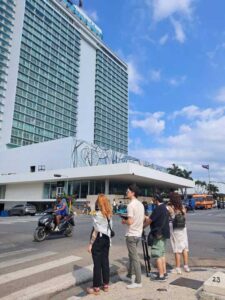
Havana, Cuba. Photo: Irene Zugasti.
And yes, of course I asked about Russian oil and Chinese solar panels. As for the latter, my friend Josué, an engineer working on Cuba’s energy transition, can surely explain it better. However, they are a key element of sovereignty, and Cuba has had integrating them into the National Electric System on its agenda for some time. The oil embargo has accelerated the process, but it is not a magic bullet. Lithium batteries are needed to store that energy, infrastructure needs to be modernized, and even then, fuel is still needed. The Cuban government told us that the famous Russian tanker that crossed the US embargo in March was a momentary relief, but what a relief it was. After its refinement—which took several days since it is not automatic—energy and crude oil began to flow that same Saturday, and it made a noticeable difference. That is why, when I looked out the window on the plane back, Havana and its surroundings were shining again, even if only for a little over a week… or until the next tanker.
Living at war
In war zones, people go on living. They go out, study, have sex, work, raise children, cry, dance, celebrate, or mourn their dead. I recently read in a book of chronicles from Gaza about a young man who started his degree during the medieval siege of 2024 and continued logging on to his classes online every day until an “Israeli” bomb took him down. In Ukraine, in 2015, we danced cheek to cheek at a concert in a city three kilometers from the front lines. In 1936, Madrid itself was a scene where young women brought snacks to the militiamen defending the University City, then returning home by tram.
Cuba is at war, a sadistic war that has lasted for decades and is now intensifying to make them suffer and to send us a message of cruelty that Cubans transform into a life of resistance. Resistance is exhausting, damn it. They know it, because obviously, they watch YouTube and the news, and they also look at the Instagrammers from Florida who tell them they will live better on the other side of the Atlantic.
Yet, it is not Cuba that is holding anyone back if they want to leave—leaving is perfectly possible, whether they will be willing to take you in is another matter. They also cannot promise you that things will get better, because that does not depend on them. “Do not blame the embargo,” a woman who ran a café told us, applauding a possible Trumpian invasion. It is impossible not to think that the damn embargo must have something to do with it when you see the empty hotels, the stranded taxis; when you cannot even use a credit card, open many apps that are banned by the US, or receive a suitcase with medical supplies because the United States prohibits importing them.
It is impossible not to think how different everything would be if those people—capable of recycling the unrecyclable, of illuminating the unilluminable, and of coloring the grayest things—did not have to live with a clamp on their throats. If they could buy medicine, import supplies, and receive tourists, remittances, and students. If they could send their doctors again and trade with neighbors without Washington locking them up and throwing the key into the sea.
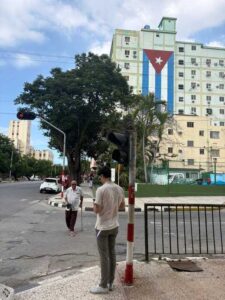
Building with a big Cuban flag mural. Photo: Irene Zugasti.
Trump’s threats overlap with reports of a military intervention plan that surface in the international press every few days. Cuba’s doctrine of peace, evident in its diplomatic practice, is light-years away from European bellicosity. However, taking note of recent events, Cuba has activated a defense plan in case Trump turns his attention to the island and grants Marco Rubio’s wishful thinking to attack. Cuba has well-developed contingency plans honed by experience with hurricanes and the Special Period in the 1990s. Its defense is based on a consolidated doctrine and a decentralized, territorial-based structure, located only 90 miles from the US, let us not forget. Its leadership is firm on this point: in the event of aggression, which they neither desire nor encourage—as most members of the United Nations acknowledge—Cuba will defend itself. That is their position.
Satisfy hunger
Believe me, it is not that difficult to write a neutral account of Cuba. I could have easily done without two of the three days I spent there. A stroll along the Malecón would suffice, and I would return with a piece, or many, brimming with testimonies about hunger, about satiety, about despair, and about the urgent need for change. The self-appointed guardians of progress, the progressive pundits, and the purveyors of bad news would applaud it.
If you put a microphone in front of many people, as we did, the mood ranges from the teenager clamoring for annexation to Miami to the elderly revolutionary sobbing with rage. Without resorting to stereotypes, there is a whole spectrum: the pragmatic taxi driver, the woman joking about the blackouts, the disagreeing couple, the jaded, the indifferent, the resilient, and the convinced. I could choose what and about whom to tell, and who to omit—whether to sensationalize the misery or the epic of the revolution—or I could expose them all and remain neutral.
At the end of the day, why am I writing this? Because testimonies and life stories are just that: a mosaic of experiences that help us understand a reality that is neither singular nor exclusive. Beyond that, I believe they are only useful if combined with analysis and data, with history and geography, and, above all, if one is honest about the perspective from which one writes and the position one chooses to take. There is always, always a position. Even among those who write “neither one nor the other.”
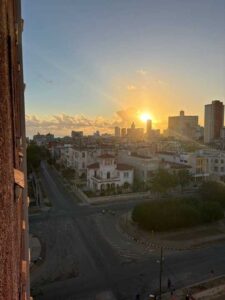
Sunset in Havana, Cuba. Photo: Irene Zugasti.
Some will say this text is partisan, biased, and blatantly sympathetic. I do not hide it: what should I say, and what boundaries should I respect? I am not particularly interested in those who, from their pulpits, revel in what they believe to be objective analysis, those who enjoy listing the flaws and the “buts” with a smug little smile. Of course, there is an emergency, and of course something has to be done, damn it. I say that something could start with the most obvious thing: demanding that those in power stop issuing statements and declarations and truly extend a hand to Cuba. That they stand up to the blockade. That Cuba, without the embargo, can live on equal footing with the rest of the world. And then, well, let them decide.
Believe me, revolutionary self-criticism works better in Havana than in Brussels. I am not saying anything new, but I do not read anything similar among those who, just by visiting her, already felt entitled to condemn her and to expose her filth, because that way they would remain untainted. I will not name them, but I know exactly who I will never want near me if wars or revolutions come.
Cuba—and I claim it as such, forgive me—is a country with nine million souls, but it is also a symbol. We have read about it, sung about it, and studied it. Some have set foot there a thousand times, while others will never do so, yet still love it. It must have done something right. Cuba reminds us that a handful of brave men—led by a Cuban and an Argentinian hiding in Mexico, trained by a Republican aviator in exile—changed the end of history into a beginning. If that is epic, then I claim it. They resisted an invasion of 1,500 men trained by the CIA (65 years ago this week) at Playa Girón. They taught literacy, provided education, and healed colonial wounds—for themselves and for millions of people around the world for over half a century.
OFAC Reverses Block on Venezuela’s Payment for Maduro’s Legal Defense in Lawfare Case
They have given art, they have given science, they have given politics, and they have given certainty to those who had none. They can continue to give so much, so very much, because they are practical, pragmatic, and courageous in management and innovation, despite all the system’s shortcomings—which I will not list here because I would not dare—Cuba still breathes an ethic, that of the new man and woman. That is what allows them to remain standing today, despite everything—despite the hunger, the war, the blackouts, and the damn blockade. I do not know what the future holds, but everyone who ever believed in all of this should have the decency not to abandon them, for the good of Cuba and for all of us.
Translation: Orinoco Tribune
OT/JRE/SF
From Orinoco Tribune via This RSS Feed.