

Iranian Foreign Minister Abbas Araghchi visited Russia on Monday, April 27, where he met Russian President Vladimir Putin and discussed regional and international developments focused around the US-Israeli war on Iran.
Araghchi arrived in Russia after concluding visits to Oman and Pakistan where he presented his country’s framework for a possible new round of talks with the US to find a diplomatic end to the war the US and Israel have been waging against his country since February 28.
Speaking to press at the St Petersburg airport upon his arrival, Araghchi affirmed that his visits to Oman, Pakistan, and Russia were part of Iran’s attempts to coordinate “with our partners on bilateral matters and consult on diplomatic matters,” also claiming Iran’s neighbors are its priority.
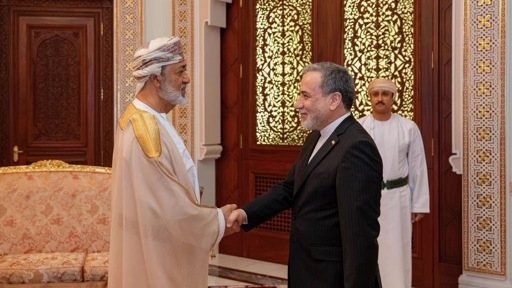
During his visit to Oman, Araghchi met the head of the state, Sultan Haitham bin Tariq, and other state officials on Sunday.
It was the first official visit of the Iranian foreign minister to Oman since the US-Israeli war began on February 28.
Oman was mediating between Iran and the US just before the latter, along with Israel, launched attacks on Iran, killing Supreme Leader Ayatollah Ali Khamenei and over 3,000 Iranians in around 40 days of bombings.
Strait of Hormuz is a shared responsibility
Noting that the US-Israeli war on Iran has affected the Persian Gulf region as a whole, Esmail Baghaei, official spokesperson of Iran’s Ministry of Foreign Affairs, said that the Araghchi’s visit to Oman was an attempt to undo the effects of the war on the region.
The visit was a sign that “Iran continues to place great importance to its relations with Persian Gulf states and remains committed to strengthening mutual trust and constructive cooperation,” Baghaei said.
Iran had accused several countries in the Persian Gulf region of providing their territory and airspace to the United States to help it launch attacks. Iran retaliated to US attacks by launching counterattacks on several US bases in these countries, which soured ties between Iran and countries in the region.
Araghchi also emphasized that during the visit the two countries discussed the fate of the Strait of Hormuz.
“As only Hormuz littoral states, our focus included ways to ensure safe transit that is to the benefit of all dear neighbors and the world,” Araghchi said on X.
Omani counterpart Badr Albusaidi echoed Araghchi’s concerns claiming “as littoral states, we recognize our shared responsibility to the international community and the urgent need to free the seafarers held for far too long. Much diplomacy is required and practical solutions to ensure lasting freedom of navigation.”
Read more: Iran says no talks with the US unless it lifts its naval blockade
Iran has restricted the movement of shipments through the strait following the US-Israeli war. The Iranian restrictions have affected the oil and other trade from the region, impacting a wide range of countries across the world.
Iran’s framework for talks with the US
Araghchi traveled to Islamabad after finishing his tour to Oman and met Pakistan’s army chief Asim Munir.
This was his second visit to Pakistan in two days. Araghchi was in Islamabad on Saturday as well when he had met with Pakistani Prime Minister Shehbaz Sharif, Munir, and others.
During his meeting with Munir on Sunday, Araghchi reportedly presented his country’s “workable framework” of talks with the US.
Though the contents of the Iranian proposal were not made public, quoting unknown US sources, Axios reported on Monday that it contains suggestions to suspend the nuclear talks for a while to focus on ways to open the Strait of Hormuz.
Iran has, however, repeated that there cannot be any talks with the US until it removes the “illegal” naval blockade it has imposed on Iran since April 13.
Araghchi asserted that though he has submitted Iran’s preferred framework for negotiations, he is yet to see any serious diplomatic move from the US.
Later, while in Russia, Araghchi said that “previous negotiations, despite some progress, did not achieve their goals due to American approaches, their excessive demands, and their wrong policies. Therefore, we need to hold consultations with our friends in Pakistan to review the latest development.”
A US delegation was expected to visit Pakistan on Sunday for talks with Iran. However, President Donald Trump announced the cancellation of the trip at the last moment, calling it a waste of time and money.
On Sunday, Trump also boasted about American leverage in the talks, claiming Iran has run out of options.
However, Iran dismissed Trump’s claims.
Mohammad Bagher Ghalibaf, speaker of the Iranian Parliament and head of its delegation for the first round of talks on April 11-12 said that his country has significant leverage in its standoff with the US.
The post Iran continues to push for diplomatic solution after second Islamabad talks fail to materialize appeared first on Peoples Dispatch.
From Peoples Dispatch via This RSS Feed.