

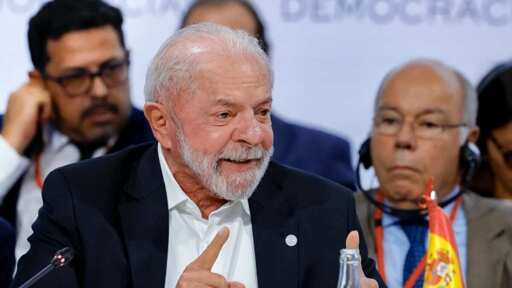
During a trip to Europe, the president of Brazil participated in the Global Progressive Mobilization’s (GPM) inaugural event in Barcelona, Spain. Speaking before an audience of thousands, including heads of state like Pedro Sánchez of Spain and Gustavo Petro of Colombia, Lula offered an analysis of the problems facing “progressivism.”
In highlighting the advances of the so-called “progressive camp,” Lula argued that “the left has failed to overcome dominant economic thinking,” paving the way for reactionary forces to gain ground in society.
<BLOCKQUOTE>The neoliberal project promised prosperity and brought only hunger, inequality, and insecurity. It caused crisis after crisis. However, we succumbed to orthodoxy. We have been responsible for the evils of neoliberalism. Left-wing governments win elections with left-wing rhetoric and practice austerity. They abandon public policies in the name of governability. We have become the system. Therefore, it is not surprising that the other side now presents itself as anti-system</BLOCKQUOTE>
What Lula calls “the Left” is, in reality, the bourgeois nationalist center-left, which governed Latin America during various economic cycles beginning in the 2000s. Importantly, this includes Lula’s own party: the PT (Workers’ Party).
Lula’s PT Has Paved the Way for the Far Right
The definition is crystal clear and the self-diagnosis is accurate: the PT (Workers’ Party) has long been part of the capitalist system and the dominant ideology. While the neoliberal Right was digging the abyss of dependency and backwardness in Latin America, the so-called “post-neoliberal” center-left managed the evils of neoliberalism with a supposed “human face.”
This is a fundamental reason why the Far Right continues to hold electoral sway in Brazil, with Flávio Bolsonaro even ahead of Lula in some polls.
In other words, during the commodities boom up until 2010, PT governments in Brazil made some concessions to the poorest sectors of the population in exchange for managing capitalism to benefit large domestic and foreign corporations. Following the end of the expansionary cycle — with the contraction of global trade in 2013 resulting from the slowdown in China and the reduction in dollar inflows — the PT began implementing a neoliberal austerity agenda that strengthened the rising Far Right.
In Brazil, this culminated in the 2016 institutional coup and the election of Bolsonaro. By “succumbing to capitalist orthodoxy,” Lula’s PT paved the way for ultraliberal alternatives that capitalized on the groundwork laid: pension cuts, precarious work, and the exponential expansion of subcontracting; extraordinary financial incentives for large landowners and financial capital (“bankers have never benefited as much as they did under me,” Lula said); a contraction in primary exports; and national subjugation.
Undoubtedly, Lula and the PT governments are responsible for implementing austerity in the name of governability. The Lula-Alckmin Broad Front government is a monument to the PT’s contribution to the strengthening of the Far Right. Geraldo Alckmin, who attacked teachers in São Paulo and was responsible, along with Fernando Haddad, for the repression of youth during the June protests, represents “neo-progressivism” within the government.
The parties of Bolsonaro’s base, including the Republican Party (led by Tarcísio de Freitas) and União Brasil, hold ministerial posts in the government. In São Paulo, Tarcísio has received financial benefits from the national bank to carry out his privatization projects. Agribusiness, a pillar of Bolsonarism and the Far Right, received the largest Harvest Plan in history — over 400 billion reais — from Lula’s government. Meanwhile, workers across the country face spending cuts.
The institution meant to serve as an ally in defending democracy in Brazil — the Supreme Court, particularly Justice Alexandre de Moraes, whom Lula helped empower as part of his strategy to counter the Far Fight — is now embroiled in serious corruption scandals, as highlighted by the Banco Master case. This situation has ended up fueling Bolsonarism once again. After all, the Supreme Court was a key and decisive actor not only in the 2016 institutional coup that ousted Dilma Rousseff of the PT, but also in Lula’s arbitrary imprisonment.
Sacrificing the Workers and Poor
For this alliance with the Right and the regime’s institutions to thrive, as the PT historically did, it is necessary to sacrifice the agenda of workers and the poor. Presenting oneself as the best administrator of capitalism implies reproducing the endless cycle of new right-wing movements, capable of carrying out economic and social attacks more swiftly than the PT.
We’ve seen striking examples of this. “Managing the scourge of neoliberalism,” as Lula put it, has a flip side: attacking the Indigenous peoples of the Upper Tapajós to allow an imperialist multinational, Cargill, to privatize the Tapajós, Madeira, and Tocantins rivers. This was halted by the class struggle of the Indigenous peoples and the workers of Pará against Lula, Boulos, and the right-wing forces that overshadow them. The Bolsonaro administration, for its part, brutally persecuted and repressed the Indigenous movement.
“Integrating into the system and succumbing to the dominant ideology” means that the population hears a certain social discourse — distinct from Bolsonarism — yet sees no meaningful improvement in their living conditions. In practice, much of the Bolsonarist economic agenda remains in effect, including labor and pension reform.
The rhetoric of confrontation with the Far Right seeks to “unite” class enemies into a single front to preserve the capitalist state, while containing and preventing any independent, left-wing solution. This reflects the PT’s classic effort to demobilize, pacify, and neutralize class struggle through its union bureaucracy.
This article was originally published in Spanish on April 24 in La Izquierda Diario.
The post At the Global Progressive Mobilization Conference, Lula’s Speech Was a Confession by a Neoliberal Administrator appeared first on Left Voice.
From Left Voice via This RSS Feed.