

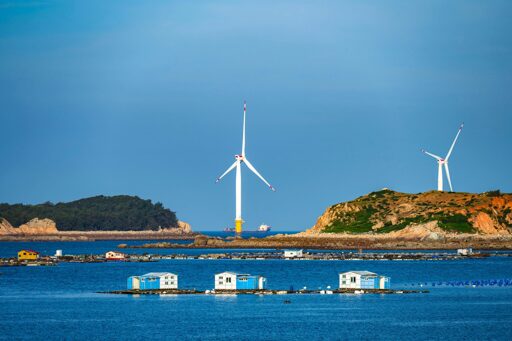
Winds sweep across the world’s oceans every day, and harnessing that largely unused resource has the potential to provide abundant, clean and reliable energy. Experts widely agree that marine wind could play a vital role in reducing fossil fuel reliance and tackling climate change, while also bolstering energy security. “The beauty of it is that the technology is tried, tested, proven, and has scaled,” says Amisha Patel, head of secretariat at the Global Offshore Wind Alliance. “This is not just about climate, it’s about having energy independence for many nations and regions as well.” Tapping into only a tiny fraction of that overall potential could reap gigantic benefits. A 2025 paper found that utilizing even just 1% of the global area suitable for offshore wind could produce roughly 20% of current global electricity demand, and cut carbon emissions by more than 2.3 billion metric tons annually. “Our key finding is that a relatively small fraction of suitable ocean area could deliver substantial climate and energy benefits,” Yi Wen, a lead author on that study with the National University of Singapore (NUS), told Mongabay in an email. But today, marine wind remains almost entirely untapped, with only around 15,000 offshore turbines producing just over 80 gigawatts of electricity, and another 150 GW of offshore wind farms under development. In 2024, energy generation from these turbines was sufficient to power around 73 million households. Wind turbines off Guishan Island, Zhuhai, China. Image by Squids Z via Unsplash (Public domain). To date, the…This article was originally published on Mongabay
From Conservation news via This RSS Feed.