

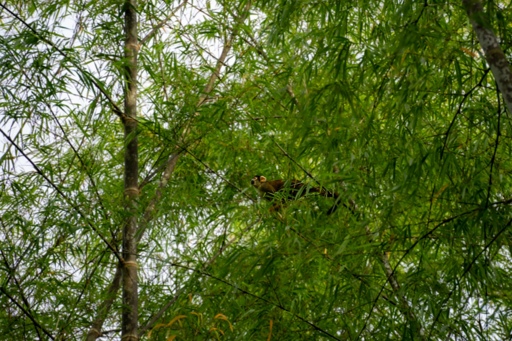
PICHARI, Peru — It’s nearly 5 p.m., and the bamboo grove is filled with children. In silence, they’re looking up in awe. The monkeys have arrived. They jump from stalk to bamboo stalk and skitter down trees, not approaching the humans below but sometimes pausing to stare back. Monkey sightings are rare in Peru’s Valley of the Rivers Apurímac, Ene and Mantaro, also known as VRAEM. Deforestation, much of it to make way for coca crops, has pushed wildlife to the margins of populated areas. But here, in the bamboo forest planted by Yuri Paredes just a few kilometers outside Pichari, VRAEM’s de facto capital, monkeys are coming back. For decades, illegal coca cultivation has dominated the region, clearing its primary forests and stripping the soil of nutrients. To restore local ecosystems, in the last three years Peruvian authorities have been counting on expanding bamboo plantations, which they say will also bring back wildlife and allow farmers to profit from the crop. Yet some farmers and experts remain critical. In 2023, PROVRAEM, a Ministry of Agriculture initiative for sustainable rural development in the region, launched the Bamboo Sustainable Development Project to help more than 2,400 local farming families and boost the industry. So far, it has spent approximately 16.7 million soles ($4.9 million) to plant nearly 1,300 hectares (about 3,200 acres) of bamboo. The agency hopes to extend the project for at least another three years. Paredes’s 6-hectare (15-acre) bamboo forest, the biggest of its kind in the region, has…This article was originally published on Mongabay
From Conservation news via This RSS Feed.