

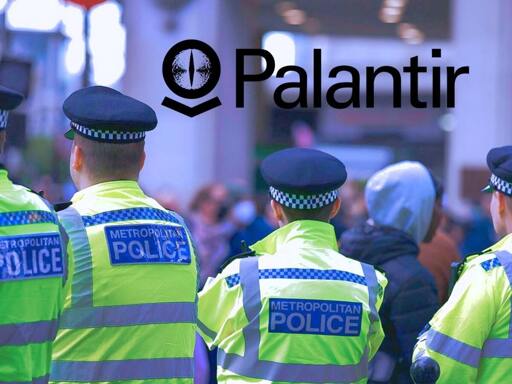

The Metropolitan Police Force is reportedly investigating hundreds of its own officers following the week-long deployment of an AI tool developed by authoritarian US tech firm Palantir.
The officers’ suspected offences range from working-from-home violations all the way up to fraud and sexual assault. Of course, this begs a very serious question. Namely, why on earth are we treating the Met like its fit to police the public when it clearly couldn’t police itself?
The news follows reports of the Met negotiating with Palantir to purchase AI for use in criminal investigations. This has led to criticisms from within the force about the genocide-enabling surveillance company potentially mishandling sensitive data.
Palantir currently holds £600m in contracts with UK public bodies. These have come under fresh scrutiny due to the company’s ties to the Epstein-linked ex-US ambassador Peter Mandelson. Global Counsel, a lobbying firm which works for Palantir, just happened to be co-owned by Mandelson.
The Police Federation objects to Palantir
On 24 April, the Canary reported that Palantir provided experimental AI to Scotland Yard with the aim of catching ‘rogue’ officers. A Met spokesperson explained that:
There is evidence to suggest a correlation between significant levels of sickness, increased absences or unusually high overtime, and failings in standards, culture and behaviour.
However, the Police Federation (the cops’ quasi-union organisation) called the AI “automated suspicion”. It stated that:
Officers must not be subjected to opaque or untested tools that risk misinterpreting unsustainable workload pressures, sickness or overtime as indicators of wrongdoing.
Much as we hate to say it, all of those points are valid, even when applied to cops. Any system which takes sick leave as an indicator of deeper failings will inevitably penalise disabled individuals.
Likewise, Palantir’s opacity regarding the precise ways in which it uses the data it gathers is a massive issue. True, we care about that fact a damn sight more when it’s applied to the public, rather than cops – but still.
Corruption, fraud and sexual offences
Palantir’s tool reportedly analysed data that were readily available to the Met. After just one week’s use, it highlighted extensive corruption – miraculously replicating statements made by people on the receiving end of Met violence for years.
Thus far, the AI investigation has led to the arrest of three officers. They’re alleged to have abused their authority for sexual purposes, misused police systems, and misconducted themselves in public office.
Again, this is quite unsurprising. On 8 January, Channel 4 reported that the Met Police had compromised public safety by failing to do proper checks on “thousands of officers and staff”. It added that:
131 of them, including two serial rapists, went on to commit crimes or misconduct.
Beyond these most-serious allegations, the Met indicated that fraud was the most common offence flagged by the AI. 98 officers are reportedly being investigated – and 500 more have received prevention notices – for:
abuse of the IT system that rosters shifts by police officers for personal or financial gain.
Among the Met’s senior officers, the AI flagged 42 chief inspectors and superintendents for false claims of actually being in the office. Likewise, a further 12 officers are under investigation for failing to declare that they’re Freemasons. 30 other officers’ membership of the organisation is suspected but unconfirmed.
Does this ‘build trust’?
A Met spokesperson stated that the force hopes the investigation will help to:
build trust, reduce crime and raise standards.
Along similar lines, Met commissioner Mark Rowley, said:
Criminals are constantly adapting how they use technology and policing has to keep pace, not just on the streets but within our own organisation.
This is the Met using technology, data and stronger legal powers to confront poor behaviour, raise standards and fix our foundations as our communities would expect.
The vast majority of our officers and staff serve London with dedication and integrity and rightly expect us to act firmly against those who abuse their position or undermine public trust, particularly in leadership roles.
By bringing together the information we already lawfully hold, we can identify risk earlier, act faster and be fairer and more consistent. Alongside new vetting powers, this gives us the tools we need to remove those who should not be in policing and strengthen culture for the future.
How exactly the Met believes that announcing it couldn’t even keep track of whether or not its senior officers were even turning up to the office would “build trust” is quite beyond us.
Likewise, we should also ask – did the force really need to hand over public money to Palantir to work this out? Is the Met so utterly incompetent that it can’t even keep track of the rapists in its ranks?
For the sake of reassurance, these were purely rhetorical questions. We haven’t suffered a sudden personality transplant here at the Canary. Likewise, we know why the Met hasn’t rooted out its own corruption.
Quite simply, corruption is an intrinsic part of the Met – and all forces like it. This Palantir tool is nothing more than security theater, a public show of goodwill that ultimately enables the Met to carry on as before. The police don’t need reform – they need abolition.
Featured image via the Canary
From Canary via This RSS Feed.