

One of the most revealing moments of the ‘loveless landslide’ that brought Labour into power in July 2024 was the count at Keir Starmer’s constituency in central London. At 3am, it was announced that Starmer had, as expected, retained Holborn & St Pancras – but his vote had been cut in half since 2019, largely because left-wing independent candidate Andrew Feinstein secured 7,000 votes, with the Greens going up by 1,300. Starmer looked ashen-faced as he declared victory. Minutes later, in neighbouring Islington North, there was another indication that the New Labour restoration had not gone entirely to plan, as Jeremy Corbyn, standing as an independent after Starmer kicked him out, routed the Labour candidate.
These shocks occurred because people were furious about Labour’s positioning on a host of issues – not just the genocide in Gaza, integral to Feinstein’s campaign, but also housing and healthcare – as well as the smears and wrecking tactics that Starmer’s faction used to sabotage the 2019 (and 2017) general election campaigns, regain control and justify waves of expulsions.
Back in 1999, Starmer’s ally and fellow Camden resident Peter Mandelson crowed that the left had “nowhere else to go” – but 2024 showed that was no longer true. The questions, instead, were: what should the new electoral home of the UK’s democratic socialists look like? Did it need a single vehicle, or a variety of localised ones? What would be best in Starmer’s constituency, where anger at Labour’s local, domestic and international policies was febrile?
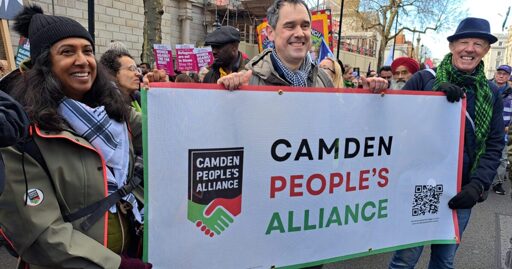
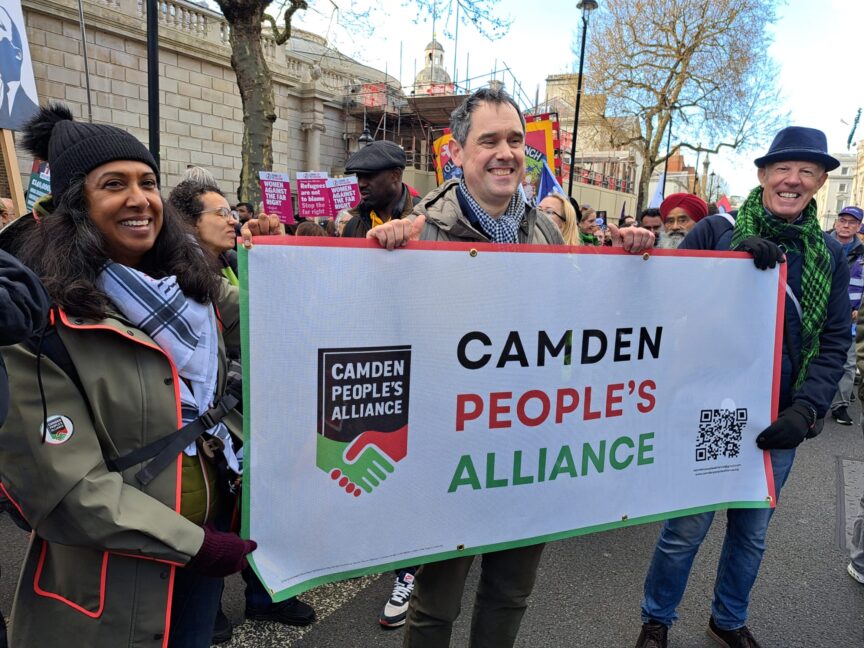
The answer may prove to be the Camden People’s Alliance (CPA), which grew out of Camden For the Many, a loose group of socialists formed to support the Feinstein campaign.
The group is standing six candidates in May’s local elections, in the Kings Cross and St Pancras and Somers Town wards, targeting the social housing and estates that, until recently, have made Camden safe for Labour. Most are former Labour members, as well as trade unionists and community activists, with plenty of experience: I spoke to the Kings Cross candidates – Joel Anderson and Paul and Shezan Renny (who are a couple) – about how and why they are fighting Starmer’s Labour.
“When Andrew [Feinstein] attacked Starmer’s majority, people felt an energy they hadn’t felt since 2017, when Corbyn destroyed May’s,” says Joel. “People were excited about participating in politics again – that energy had to go somewhere.”
In Camden, the Labour left “were never allowed to enjoy 2017,” says Paul. “The right were deselecting left-wingers in Camden council even before they got rid of Corbyn.” The right had even pettier ways to make the left feel unwanted: “Even when we went canvassing with them, we wouldn’t even be offered tea or coffee in the committee room,” adds Shezan.
This doesn’t surprise me, neither from my own experience of being made to feel unwelcome when canvassing for Labour in 2019, nor what I’ve heard about the party in the decade since Corbyn became leader. It made me wonder how much Joel, Paul and Shezan felt any personal animus. Besides headline issues around Gaza and Labour’s refusal to break with Conservative policy, it seems like everyone has their own reasons to want to tear Starmer down. In my case, it’s his cowardice over trans issues and his unwillingness to stand up for the arts, but the CPA candidates feel equally slighted.
“Remember his comments about the Bangladeshis?” says Shezan, referring to Starmer’s line at an election Q&A hosted by The Sun about “people coming from countries like Bangladesh [and] not being removed”. Paul adds that Starmer has repeated racist comments in trying to appease Reform, with the notorious “Island of Strangers” speech representing a point of no return for many ex-Labour voters.
“The last people who might have given Starmer a chance gave up in 2024,” says Joel. “The moment he said Israel had the right to commit war crimes in cutting off power and water to Gaza was crucial,” says Joel, not just because of the atrocities in Palestine, but because of the wider questions it raised. If Starmer and his party couldn’t stand against genocide, then what would it stand for? The bland, corporate nature of their election manifesto confirmed that not only was Labour disavowing socialism – it was also distancing itself from social liberalism.
All this has created considerable space to Labour’s left. “People see what Starmer says about Gaza and realise it’s their local MP, and that makes them aware of local and international issues at the same time, which makes Camden distinctive,” says Joel.
The revelations about Mandelson in the Epstein files, which led to his arrest outside his home opposite Regent’s Park, heightened the sense of global events being intertwined with this part of London – Mandelson remained influential in Camden, with most of its Labour councillors drawn from his faction. Mandelson’s protégé, Morgan McSweeney, used their Labour Together think tank to investigate and smear Feinstein and his friend Paul Holden, author of a book about Starmer entitled The Fraud, adding yet another layer of personal animus, but the CPA candidates are keen to keep the focus on issues that connect best with the electorate.
“There are two things on the ballot paper – housing repairs and Palestine,” says Shezan. She and the other five CPA candidates have signed the Palestine Solidarity Campaign’s councillor pledge, vowing to uphold the rights of the Palestinian people and ensure their council is not complicit in – and does not help to normalise – Israeli violations of international law.
“Labour are telling people that Palestine is nothing to do with Camden,” says Paul. “Camden’s pension funds invest in Israel”, putting money into Lockheed Martin, Elbit Systems, BAE and Israeli companies involved in illegal settlements, arms production and surveillance, “but more broadly, you expect people to have a moral compass”. (Especially, I point out, given Starmer’s much-vaunted background as a human rights lawyer.)
“There’s a huge rift between elites – politicians, businesspeople and journalists – and everyone else,” says Joel. “We’re seeing the genocide in real time, and they aren’t, because they’re choosing not to. I don’t think we’ve had that level of polarisation before.”
“We’ve written to Labour councillors asking them to support motions on Palestine and they haven’t replied, even if they’d privately expressed concerns,” says Paul. “They used to respond – now they don’t,” adds Shezan.
Joel says he’s never met anyone who valued Starmer as a local MP – another stark contrast with Corbyn, much loved in Islington North. Shezan adds that on the doorstep, people often complain not just about Starmer’s absence – which is a little more understandable now he’s prime minister – but that of the council.
It wasn’t certain that CPA would be best placed to fill the void, given the changing state of the left after the 2024 election. They chose the name and decided to stand council candidates, but amidst constant speculation about whether Corbyn would form a new party, CPA held intense discussion about whether they would affiliate. They decided to wait and see what happened – prudent, given the disheartening implosion of Your Party and especially Feinstein’s decision to resign and Your Party’s threats to sue him over the transfer of membership data and donations. Bridges are being built – Corbyn is joining Feinstein at a meeting on Camden and the global context during the campaign – but CPA remains unaffiliated with Your Party.
At the same time, Zack Polanski turned the Greens into a left populist party along the lines of Corbyn’s Labour, picking up many ex-supporters. Now, the Greens have many more members than CPA, but the 2024 result suggested Feinstein’s movement was better placed to pick up voters in certain parts of Camden. So, CPA are telling supporters in other wards (such as mine, Regent’s Park) to vote Green, while the Greens are endorsing CPA candidates in Kings Cross and Somers Town, agreeing not to run anyone there.
There are two huge local issues on which CPA are campaigning. One is parking, as most of the employment in Kings Cross and Somers Town is for delivery or taxi drivers – an issue on which these workers might instinctively not trust the Greens.
The second is housing. Somers Town has a long history of housing problems: after the clearances in Westminster and Shoreditch, Bethnal Green and Whitechapel, the worst slums in London sat between the Kings Cross and Euston railway stations. Driven by the philanthropic zeal of Father Basil Jellicoe, the St Pancras House Improvement Society built several high-quality modernist estates, which then formed the backbone of Labour’s vote (and which, in its current form, enabled me to live in the area). These were supposed to reduce inequality and housing security, but over the last decade, and especially since the pandemic, homelessness in Camden has been horrific: the tent village on Euston Road, across the road from Meta’s London HQ, has been so large for so long that it has become national news after a 32-year-old man died on the site. Paul and Shezan volunteer with Camden Street Kitchen, and have received little support from the council, despite an average of one person a month dying on the borough’s streets.
Housing forms a big part of CPA’s manifesto, launched at a rally outside the People’s Museum of Somers Town on 12 April. It calls for a council-led building programme using public investment, with 100% of homes for council rent, opposing the sale of homes on public land and pushing for rent controls. CPA will prioritise the maintenance of Camden’s ageing housing stock, and expand housing options for the homeless, guaranteeing accommodation for rough sleepers in severe weather.
As well as Labour, the Liberal Democrats, the Conservatives and Reform, CPA are up against the National Housing Party, who put ‘No More Refugees’ on the ballot paper as well as their campaign leaflets. To oppose this scapegoating, CPA aims to produce a ‘people’s budget’ based on community need, invest in education and free school meals, support marginalised groups and migrants, and divest from complicity in human rights abuses in Palestine and elsewhere.
At the rally, Feinstein introduced five of the six candidates, saying: “Societies should be judged by how they treat the most vulnerable, and that’s what we want to bring back to Camden.” They shared their backgrounds: Somers Town candidate Raqhib Islam talked about his community work in Euston and his hopes of working on a larger scale through the council; Abdul Majeed said he decided to stand after years working in a secondary school, seeing children come in with no money after no meals, with some being homeless at weekends. There was a cheer as James White, a Green candidate in Holborn and Covent Garden, stated his party’s support for the CPA after Feinstein announced the co-operation as “a different way to do politics, without factionalism and division”. Sue Vincent, a former Labour deputy leader of the council, caused a stir by endorsing the Greens in Holborn, making the front page of the Camden New Journal – although Mandelson’s response to the left finding somewhere else to go was not reported.
There was a brief shower that reminded everyone of the role of the weather in British election campaigns, contrasting that feelgood summer of 2017 with the miserable trudges through the cold and rain in December 2019. The sun soon returned, and the crowd headed into Kings Cross and Somers Town.
As with Feinstein’s campaign in 2024, the council candidates have found people initially to be suspicious, but once they see the issues on which candidates are campaigning, locals open up and often pledge their support. Not being part of a formal party – and thus not thinking of themselves as politicians – has gone down well on the doorstep and around the street stalls that CPA has held in the area for months. “Canvassing is enjoyable, which isn’t always the case,” says Shezan, “People aren’t happy with Labour, and often start off by saying that all politicians are the same, but we give them leaflets with our key points and they realise we’re not.”
Joel adds that they often ask Camden residents what they want to talk about, rather than turning up with a prepared statement. The candidates are keen to emphasise the joy of democratic participation, from the granular process of winning over individuals on the doorstep to fundraising events such as the one CPA have planned at Thenga Cafe on 30 April, with Camden resident Alexei Sayle doing stand-up with Just Jokes Not Oil, and Robert West leading protest songs. Local artists have been interested too: Matthew Collings is donating a drawing of the candidates to show his support.
There is a sense of everyone involved taking positives from the 2017 and 2024 elections, which used Corbyn and Feinstein’s demonstrable record of supporting local and international causes to motivate campaigners and win over voters, turning the animosity that they all harbour towards the political establishment into something enjoyable and hopeful. Two years ago, Feinstein and Camden For the Many halved Starmer’s majority from a standing start – over the next few weeks, the CPA hopes to turn two years of patient organising into a change of council on 7 May.
“People have every right to be fed up with politicians because they’ve been lied to – Starmer’s entire political career has been built on lies. But I’m an eternal optimist because of my time in South Africa,” says Feinstein, who was elected in the country’s first elections after the collapse of apartheid after years of involvement with the African National Congress.
“It’s been far from perfect, but we got rid of one of two legislative racist systems on the planet, and you can’t feel anything but optimism if you’ve experienced that. I moved to Camden 25 years ago and found people were just as optimistic. We’ve been canvassing for weeks and haven’t seen many others on the streets. We’re in uncharted political waters, no one knows what’s going to happen, but I’m incredibly glad and proud that we’re here, trying to show a different way of doing politics.”
Even though I can’t vote for Camden People’s Alliance in Regent’s Park, it all felt exciting to me – and interviewing for this piece inspired me to finally join. It made me feel like the opposition to Starmer and all he represents could grow significantly, and getting CPA councillors elected along with some Greens might just be the start.
From Novara Media via This RSS Feed.