


By Jane Banfield, World BEYOND War, April 27, 2026
I’m a social media user. You likely are too. In today’s fast-moving society, platforms like Facebook, Instagram, Tiktok, and X seem the best way to interact with like-minded others, connect with friends and keep in touch with loved ones overseas. Yet, like me, you may worry about the influence social media has on society. You may be considering deleting your account.
A new “Peace Trolling” project may present a favourable alternative. In contrast to the actions of trolls who deliberately post inflammatory comments, my vision is to normalise active nonviolent responses. Rather than feel fearful about the subversion of the collaborative principles which have guided civil society, we can utilise social media platforms as opportunities for nonviolent connection on a vast scale, conduits for world unity.
We humans naturally connect. Babies are born with a collaborative instinct yet socialised to argue, to take sides, to see themselves (and others like them) as right, to judge others as wrong. We come to accept these learned behaviours as normal, yet they fail to keep us safe; instead they disconnect us, particularly now that these social norms are leveraged by social media designers. Wrongness of others drives us to engage, algorithms strategically amplify existing tensions, echo chambers affirm polarised views — but is there another option?
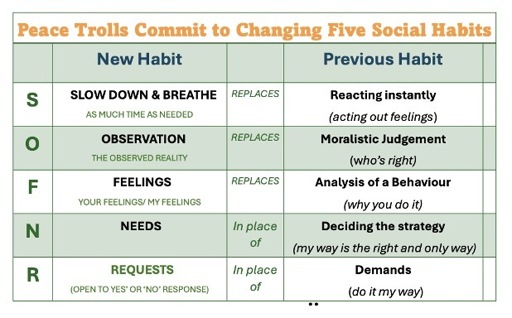
For several years, I have been trialling how to actively infect social media threads with nonviolence. My vision is that a grassroots online movement can restore collaboration and human empathy as the basic principles for social media engagement. Whatever their belief and however hostile their expression, I choose to honour commenters on social media, using a SOFNR orsoftener’ style of engagement derived from the nonviolent communication research of Marshall Rosenberg.
I like to choose the most incendiary commenter I can find! These are actual examples of how after 3 or 4 interactions back-and-forth responses soften:
- John (Political debate Facebook) “I’m the same. I don’t even know that we see things differently. You seem to want the same things I do.”
- Red Robyn (Vax debate Twitter). “I just found this person. And whilst I may disagree with her on division being a bigger issue than disease, I’m going to try to do better. We could do with more peace spreading here.”
- Slippery Gaming (Twitter). “Thank you, sorry I wasn’t nice. I grew up on social media (that’s my excuse) so could do with some softening around the edges!”
My nonviolent responses also impact readers:
- Ruth (Facebook). “You are role-modelling some good stuff – thanks for reminding me that it is possible to refute a point with grace.”
Focusing on fundamental feelings and needs changes me too. As I drop my judgements, I hone my ability to think, speak and act from the values I espouse as a Quaker.
Social media wasn’t on George Fox’s radar when he enjoined us to be “patterns and examples […] in all countries, places, islands, nations” four hundred years ago. Yet I sense Peace Trolling can enable today’s Quakers with busy lives to respond to this call to answer that of God in everyone. Our empathic nonviolent response to a stranger’s provocative Facebook comment while we wait in a supermarket queue or our reply to a particularly challenging comment on X while dinner cooks are surely direct engagements with the divine.
So how does someone begin to Peace Troll? Let’s follow David, a friend who longs to humanise social media threads where a leader they respect is being verbally pilloried.
This January 2026 actual post by NIGEL FARAGE, Reform party leader, about the Green party leader, “ZACK POLANSKI is a lunatic.” The 772 comments in the thread include Nigel C. “There all lunatics in The Green party.”(sic); Rhian L. “He really is. Get the broccoli gone”; and Steve B. “Correct! That guy is seriously unhinged and dangerous.”
David selects Steve B and briefly checks his profile to discover a 45 year-old male with family and a pet dog, who with 4K of posts seems unlikely to be a bot. David will use the SOFNR habits to respond: .
S – slows to take time to breathe deeply, using self-empathy to acknowledge personal feelings and what unsatisfied need may lie underneath. Before going further, reminding themselves of the Peace Trolling premise that however expressed, a comment is simply ‘the best way at that moment that person could find to meet their need.’
O – seeks to recognise the point the commenter is trying to articulate;
F/N – guesses fundamental feelings and unsatisfied need(s) which led them to say what they did;
R – finally, making a request if appropriate.
David writes his reply. He seeks to honour Steve B by his respectful restatement of the point Steve seems to want to make. It seems appropriate to guess Steve’s feelings and needs and to finish with a request so this is David’s response to Steve’s comment that “[Polanski] is seriously unhinged and dangerous“:
“Steve B. I’m curious about your comment. I sense you long for wisdom in our political leaders. I do too. I’m guessing you are fearful that if he is elected, Polanski’s policies could harm you and your family. Would you be willing to share one Green Party policy that concerns you in this way?”
David may interact with Steve several more times. If all goes well either or both may shift their viewpoint a little and confidence in the humanity of those who seem different may grow. Others reading the thread may also be changed, reminded how empathy and integrity can be part of the discourse.
Imagine the impact when ten peace trolls engage within a single thread. Or what if ten thousand peace trolls across a nation’s online political arena grow a culture which expects people will be “seen” and differing needs acknowledged. This then is the vision: to grow a community of micro-peacebuilders. A growing community who collaborate, swap learnings, reach out for support when interactions get tough, encourage each other.
Perhaps there is a parallel with Early Quakers. They too challenged accepted social norms of behaviour. We are no longer called to address landlords as ‘thee’ or to refuse to doff our hats yet in online spaces we can refuse to argue and instead ground ourselves in active nonviolence. We can show up with integrity in an increasingly virtual world, more visible as Quakers.
Social media doesn’t have to be the aggressive forum it appears today. Remember when it first appeared how we envisaged enhanced connection with loved ones and wider forums for discussion? As Quakers we are enjoined to be patterns and examples in all places wherever we may come. As this second quarter of the 21st century unfolds, is Peace Trolling a way to keep hope and the spirit of the divine alive?
If you are curious about becoming part of a collaborative Quaker group to try out peace trolling for yourself and build confidence peace trolling together, then do contact me at connectingcheerfully@gmail.com or here.
The post Peace Trolling appeared first on World BEYOND War.
From World BEYOND War via This RSS Feed.