

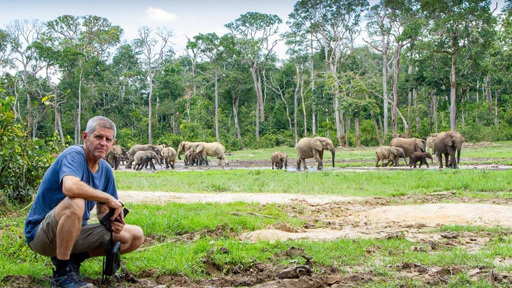
Luis Arranz arrived in Africa in 1980 with little more than a degree in biology and a determination to work in the field. Without contacts or a clear path, he drove south from Spain in a small Citroën 2CV, crossing the Sahara over several weeks and repairing the car as it failed along the way. The journey is unusual. The work that followed is uncommon in its form and duration: more than four decades spent managing protected areas in Central Africa. His career has taken him through Equatorial Guinea, Angola, and South America, but it is in Central Africa that it has largely settled. He has led or helped run parks including Monte Alén, Zakouma, Garamba, Dzanga-Sangha, and now Salonga, often remaining in each for extended periods. That continuity has shaped his approach. He tends to describe conservation less in terms of design than of execution—what can be maintained over time, and what cannot. Photo courtesy of Luis Arranz This perspective runs through a series of conversations that took place in forests, villages, and vehicles across the Central African Republic and the Democratic Republic of Congo in March 2026. Arranz is skeptical of the emphasis placed on planning processes and external analysis. He returns instead to implementation. “We know what we have to do,” he says, referring to the distance between written plans and what can be carried out in practice. Much of the work, in his account, comes down to transport, communication, and maintaining teams across large and difficult…This article was originally published on Mongabay
From Conservation news via This RSS Feed.