

It’s an odd thing to wake up on a Monday after a weekend in which someone tried to assassinate the president of the USA, and feel absolutely nothing about it.
As far as I know, the Washington Hilton doesn’t specialise in mogadon-laced mojitos. So, odder still to spend your Sunday reading reports of the gunfire at the hotel’s ballroom on Saturday night, only to find the press – many of whom were present at the White House Correspondents Dinner taking place at the time – going through the motions of reporting with all the passion of an ambien-zombie on a 2am fridge-raid.
Meanwhile, online, people went berserk, pumping out oceans of theory on the basis of camera angles, slow-motion presidential micro-expressions and the alleged shooter’s slim LinkedIn profile.
And maybe that’s what’s behind the detachment with which we encounter what ought to be a pretty big deal. We’re not dead inside (yay). But we’re drowning in meaning, smothered in significance, much of it deliberate, and from every angle. A glance across a coffee shop from a stranger? A gunshot across a ballroom from a danger? Bro, everything is romantic.
It used to be that when people fired guns at presidents, it really mattered. The assassination of John F. Kennedy in 1963 had an impact that’s lasted generations. Politics, law, books, films and even fashion have all been touched by the short seconds, caught in infinitely-replayed grainy black and white, in which history really happened. Who did it, and why, remains the subject of lively speculation.
And that’s despite the fact that Kennedy was killed in a busy decade for political violence: Martin Luther King, Malcolm X and Kennedy’s brother Robert were all gunned down in the years that followed. Yet the proximity of those killings to each other didn’t seem to deaden the import of any.
Fast forward almost two decades to 1981, when then-president Ronald Reagan was shot in the ribs, also at the Washington Hilton hotel where he’d just given a speech. There, the motive of shooter John Hinckley Jr was clear – and clearly nuts. A psychotic fixation with the actress Jodi Foster led him to believe that killing a president would earn him her affection. He was, in his own mad way, in search of significance.
And that, folks, is the nature of romance as a genre. Not love or happiness, but heightened states of meaning. Take one person or two, and douse them in significance. A raised eyebrow, a lowered glance, a crinkled smirk: meaning, meaning in every twitch. It’s the heightened state of constantly working things out, in which every gesture, word and contact is ripe for endless interpretation.
Now multiply that from two people to billions, and smear it across broadcasters and billionaire-owned algorithmic platforms. Welcome to the mid-2020s, where everything is romantic.
There have now been three single-shooter attempts on Trump’s life in less than 24 months. The first, a whisker-close gunshot in July 2024, generated powerful campaign imagery, rampant conspiracy theories and the belief among many on the US christian right that Trump’s survival was a heavenly intervention, marking the man for the White House.
The second, just two months later and less dramatic, had much less of an impact but still rattled a nation. But now, nearly two years on, when a third would-be assassin has had yet another go, the market for attention is far more saturated. Even the president can’t seem to get excited. “I thought it was a tray going down,” he breezily described the gunshots to reporters just 90 minutes after the event, “I’ve heard that many times, and it was a pretty loud noise, and it was from quite far away.”
That’s how hard it is to achieve cut-through in a climate clouded with meaning.
In this year alone, the Trump administration has kidnapped one country’s leader, and killed another’s, while bombing bridges and schoolgirls. A third country is being suffocated by an ongoing US naval blockade. A fourth – this one an ally – was threatened with invasion of its territory. Just a few weeks ago, the president promised the annihilation of an entire civilisation, pledging to bomb it back to the stone age.
Meanwhile, on the US’s own streets, masked militias snatch people – including children – for shipment to concentration camps. Those who intervene have been gunned down in the streets. And as extrajudicial killings of those in small boats in the Caribbean and Pacific continue, so do allegations that the government is suppressing the most damning parts of the Epstein files.
That’s a decade of events in a single semester. It’s matched in its pace by White House communications. Trump has broken all records for televised press interactions, averaging 1.9 events per day in his first three months. Likewise administration officials now regularly command our attention to rant at the press, lionise illegal war and threaten US allies.
It’s an administration made for TV, one that could have been written by Ryan Murphy. The first few episodes? You can’t look away. “Watch it,” you tell your friends, “It’s crazy.” But by the tenth you’re exhausted, confused and probably drunk.
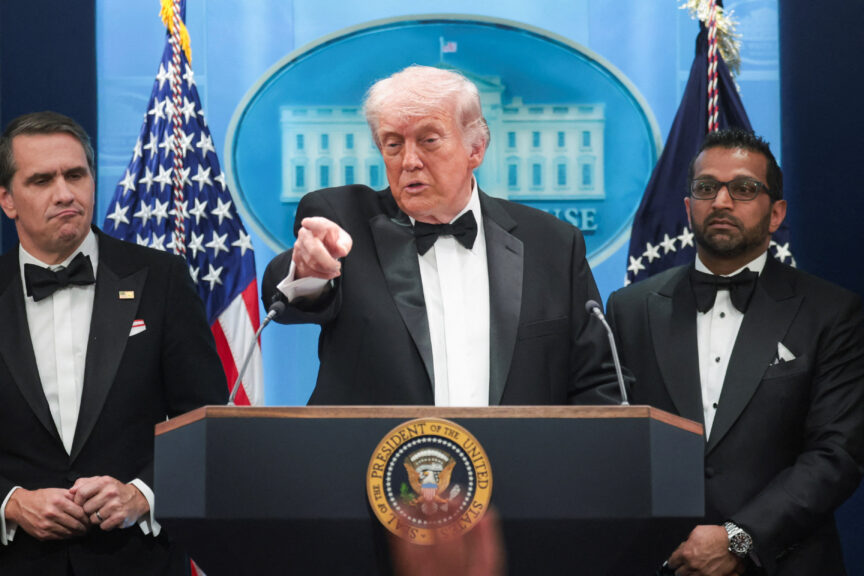
Even the images that emerged from the Hilton bear a woozy air of unreality. Mentalist Oz Pearlman perched between the president and first lady Melania, revealing the name of press secretary Karoline Leavitt’s unborn child on a scrap of paper. A distraught Erika Kirk – widow of Charlie Kirk, slain last year – wearing almost a wedding dress, bustled away. And in the aftermath, war secretary Pete Hegseth doing a tight-jawed robocop.
The zone, as they call it, is not just flooded. It’s sunk without a trace.
From Novara Media via This RSS Feed.
Why’d you delete it?