

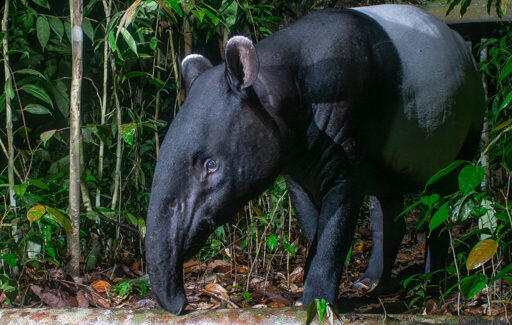
Described as “gardeners of the forest,” tapirs help maintain healthy ecosystems by dispersing seeds and landscaping the vegetation. Yet they remain underfunded for research. All four tapir species — the Asian (Malayan) tapir (Tapirus indicus), Baird’s tapir (T. bairdii), the lowland or South American tapir (T. terrestris) and the mountain tapir (T. pinchaque) — are currently listed as vulnerable or endangered on the IUCN Red List. They face mounting pressures from habitat fragmentation and loss, hunting, and climate change. In honor of World Tapir Day on April 27, we highlight recent Mongabay stories from the frontlines of tapir conservation. New light on Asian tapir strongholds in Thailand In Thailand, researchers used “bycatch” data from camera traps to identify critical refuges for the endangered Asian tapir. Mongabay’s Carolyn Cowan reported in Feb 2026 that the study led by biologist Wyatt Petersen analyzed archived photos from camera traps originally intended to monitor bears in the Khlong Saeng–Khao Sok Forest Complex between 2016 and 2017. From the photos, the researchers identified at least 43 individual tapirs and estimated a population density of six to 10 individuals per 100 square kilometers (16-26 per 100 square miles). This suggests the forest complex could hold up to 436 mature tapirs, a figure significantly higher than previous estimates for Thailand and Myanmar combined. While the researchers warn these numbers must be interpreted with caution, the findings underscore the importance of protecting intact forest strongholds for the species’ long-term survival. Indigenous guardians protect the ‘Sacha wagra’ in Colombia…This article was originally published on Mongabay
From Conservation news via This RSS Feed.