

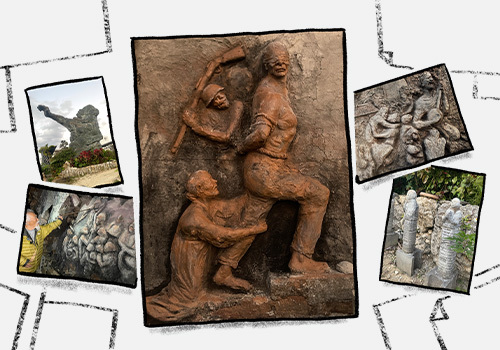
The Twenty-Sixth Art Bulletin (April 2026)
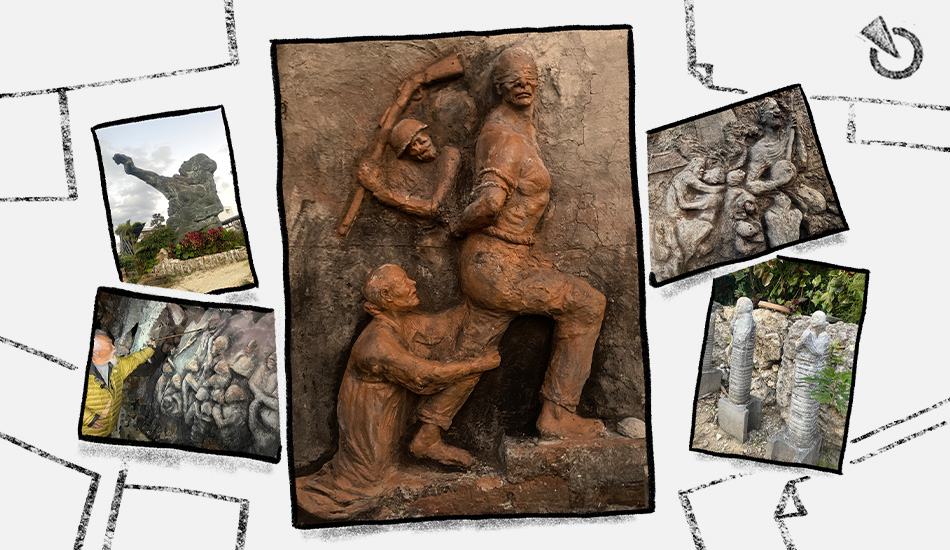
Listen to Okinawan rapper Kakumakushaka, Okinawan jazz singer Takako Gibo, and Japanese rapper Kinoko Beats sing about war and peace from Okinawa to Palestine in Japanese, English, and Uchinaguchi (an indigenous Luchuan language).
| Ikusa yu nu NuwatiMiruku yu nuIyarichun Nakuna yuu kuninga**Nuchi du Takara | After the war is over When the world of Miruku (peace) comes Do not repeat this sorrow Life is a treasure |
| – Okinawan ryūka, a traditional lyric poem, traditionally attributed to King Shō Tai (尚泰), the last king of the Ryukyu Kingdom. |
On the forested path leading to Chibichiri Cave in southern Okinawa, small stone figures stand among the roots of banyan trees. Hip-high and solitary, their heads are slightly bowed, with hands folded in prayer. Moss and lichen have begun to claim them, as if the forest were slowly absorbing them into itself. Coming out of the cave, I noticed the figures more clearly than I had on my way in. They seemed to stand as silent witnesses or guardians, placed there to remember the dead and to warn the living. But what are they warning us against?
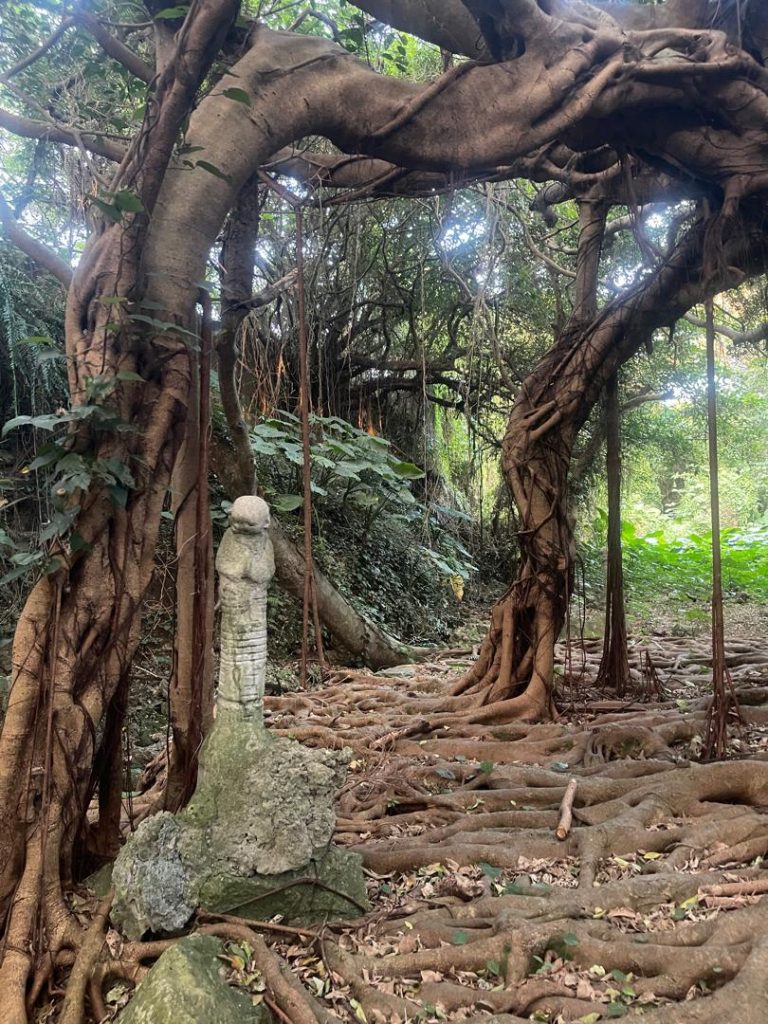
Sculptures by Kinjo Minoru at Chibichiri Cave.
On 2 April 1945, the day after US forces landed on Okinawa, approximately 140 civilians – mostly elders, women, and children – hid in this cave. More than eighty of them were driven to suicide after the Imperial Japanese Army told them that the approaching US soldiers were ‘red devils’ who would rape and torture anyone they captured. As subjects of the Emperor Hirohito, surrender was not an option – death was preferable to the shame of being taken alive. In a neighbouring cave, however, everyone survived because two people who had lived in Hawai’i and could communicate with the US soldiers hid there. It was the Japanese army’s suppression of truth and dissemination of lies that took the lives of those in Chibichiri Cave. For the next three decades, none of the surviving villagers spoke of this tragedy, which continues to haunt the community to this day.
Walking from the caves to the surrounding village of Yomitan, I was greeted by a towering statue that rose above the quiet village road – a woman with her right arm outstretched towards the sky and her head raised, as if resisting the violence descending upon her. With her left arm, she holds four young children close to her body. At her feet, I encountered the same solitary stone figures, standing among the gravel and weeds like a procession. They guided us along a path to a courtyard, where we were met by large relief sculptures and an elderly white-bearded man seated in a plastic garden chair.
We Are Ryukyuan, Never Japanese
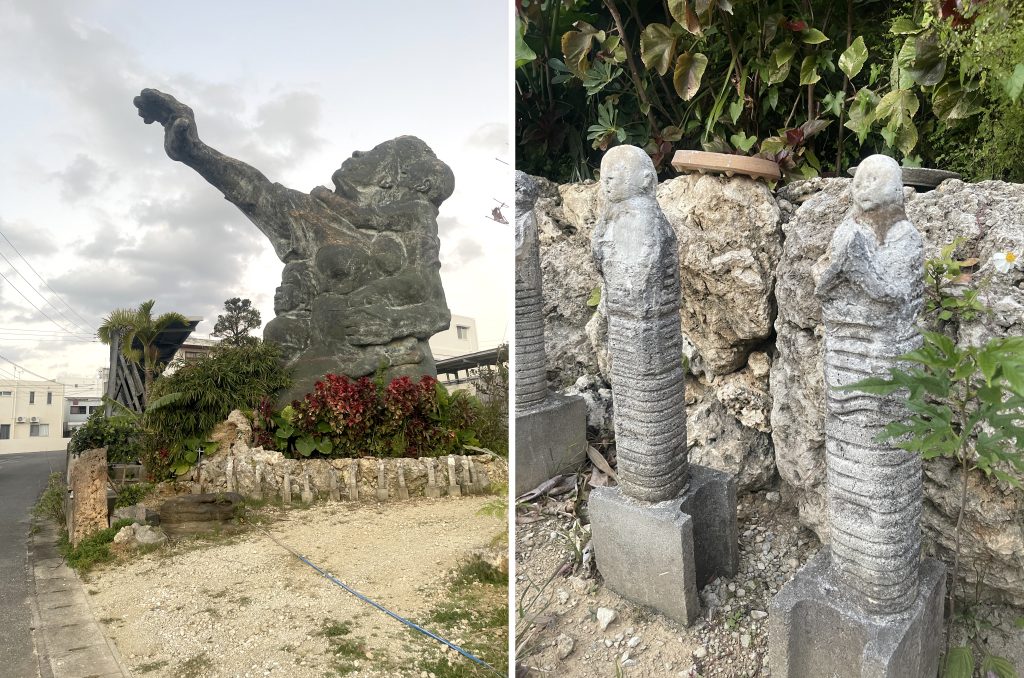
Entrance to Kinjo Minoru’s workshop.
Kinjo Minoru (金城実) is eighty-six years old. Born in 1939 on the small island of Hamahiga, Kinjo lost his father in 1944 during the Second World War – or the World Anti-Fascist War – before he had the chance to know him. Kinjo has spent decades building a monumental body of sculptural work that tells the haunting stories of Okinawa before, during, and after the 1945 Battle of Okinawa, one of the bloodiest campaigns of the Pacific war. The works are made of concrete, plaster, and metal armature – the same construction materials used daily at Henoko to build yet another US military base. Kinjo uses them to reclaim what those bases were built to make people forget. The surfaces of his work are rough, porous, and unfinished, not because the artist lacks refinement but because the history his work carries is itself still unfinished, raw, and contested.
In the open-air gallery in Kinjo’s workshop, you encounter relief panels that stand about a story tall. Almost life-size figures of civilians, soldiers, mothers, and children emerge from the wall in high relief, leaning toward you as if to tell their story. They are a material metaphor for what Kinjo understands as his people’s condition: embedded within a history they did not choose, pushing against it, not yet liberated from it.
Kinjo guides us through the panels himself, pointing with his wooden cane, narrating each scene.
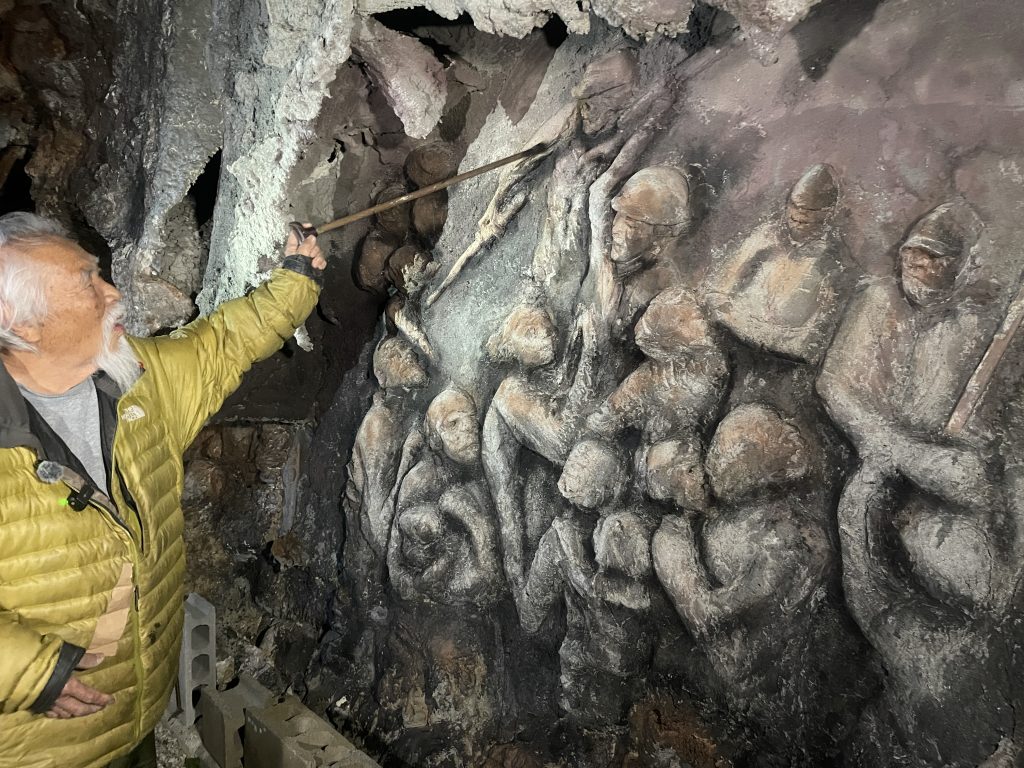
Kinjo Minoru with his art etched into Chibichiri Cave.
‘Why would a mother kill her own daughter?’ Kinjo asks, standing before a panel in which the bodies of women and children are intertwined so tightly that it is impossible to tell who is protecting whom and who is killing whom. He continues, ‘Why would a brother kill his younger brother? You should ask that question. Why did it happen only here in Okinawa, not in mainland Japan?’.
His answer cuts to the colonial root. For over five hundred years, the Ryukyu Kingdom governed these islands as an independent state with its own languages, cultures, religions, and diplomatic relations – trading across East and Southeast Asia, maintaining tributary ties with China, and developing a civilisation distinct from Japan’s. In 1879, the Meiji government forcibly annexed the kingdom, deposed its last king Shō Tai, and remade the islands as Okinawa Prefecture, the southernmost, poorest, and most expendable territory of a rapidly industrialising empire. What followed was systematic cultural suppression designed to erase Ryukyuan identity and produce loyal imperial subjects.
The Meiji government installed a new governor, Matsuda Michiyuki, and brought in educators from mainland Japan to remake Okinawa’s schools as instruments of imperial assimilation. However, the Meiji government refused to establish universities in Okinawa despite establishing them in every other prefecture. ‘Why?’ Kinjo asks. ‘To control us’. The mass suicides at Chibichiri were not aberrations – they were the logical outcome of a colonial education that had spent decades teaching Okinawans to die for an emperor who had never treated them as equals. ‘We are Ryukyuan’, Kinjo defiantly tells me. ‘I am never Japanese’.
Despite this harrowing history, some Japanese politicians today claim there was no military coercion behind the mass suicides in Okinawa, while others deny Japan’s wartime atrocities, including the Nanjing Massacre that took 300,000 Chinese lives in mere weeks. Kinjo’s sculptures stand as memory and material refutation: a rough and heavy history that resists being smoothed over.
An Island That Cannot Be Swallowed
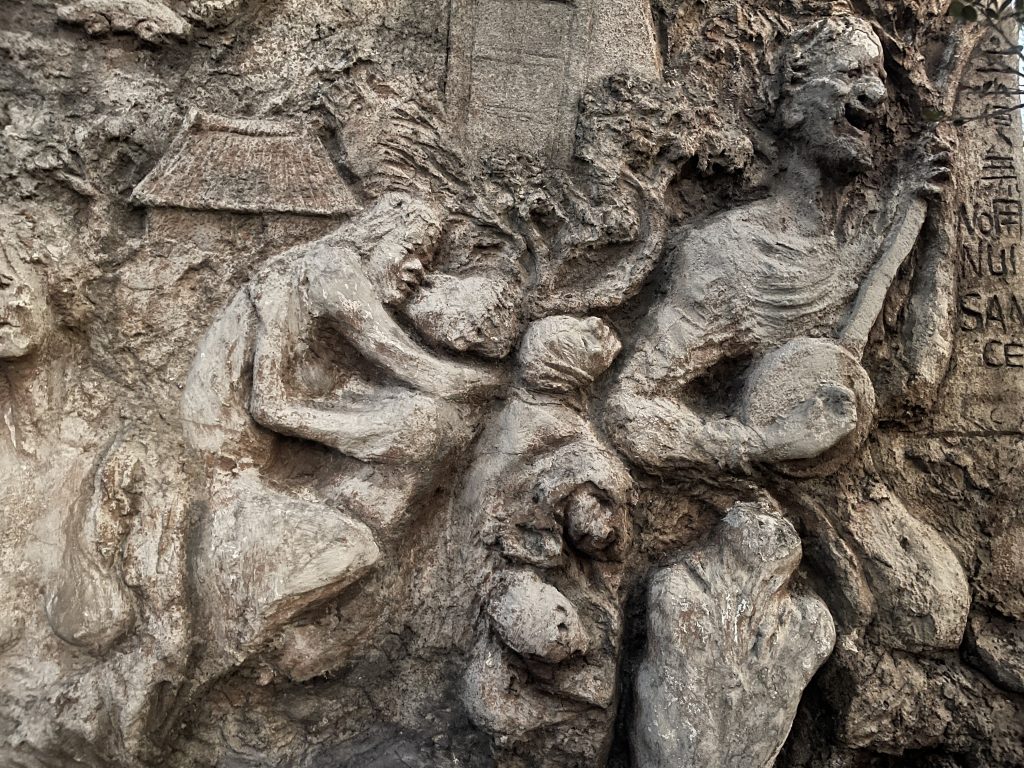
Detail of Kinjo Minoru’s artwork.
Today, Okinawa makes up just 0.6% of Japan’s landmass, yet it hosts roughly 70% of all US military facilities in the country. Seeing the prefecture firsthand, one quickly realises that this is not a matter of isolated bases; it is a permanent military occupation of everyday life. Fences cut off coastlines, fighter jets shatter the soundwaves, and entire communities are hemmed in by infrastructure built for war.
The same island, sacrificed as a battlefield in 1945, is being prepared as a frontline once again, with China painted as the ‘devil’ in a New Cold War. There are new missile deployments, evacuation plans are being drawn up, joint US-Japanese military exercises are underway, and a new US military base is actively being built in the Okinawan village of Henoko. This is all despite three decades of majority opposition from Okinawans, expressed through referendums and daily protests led by elders of the affected communities and organised in grassroots movements including No More Battle of Okinawa, which hosted Tricontinental’s visit.
Despite the brave instances of resistance, Kinjo watches this occupation with the impatience of someone who has seen too much patience. ‘Okinawan people are too quiet, too gentle’, he told me during our visit. ‘They should get angrier. If [the US and Japanese militaries] want to use Okinawa, they should treat us like human beings’. But he does not despair. ‘As [long] as I live, it may be difficult, but the next generation – I’m sure they will stand up for resistance’.
‘Okinawa is small’, Kinjo said. ‘But you cannot swallow a needle’.
From Okinawa’s Caves to Chongqing’s Bunkers
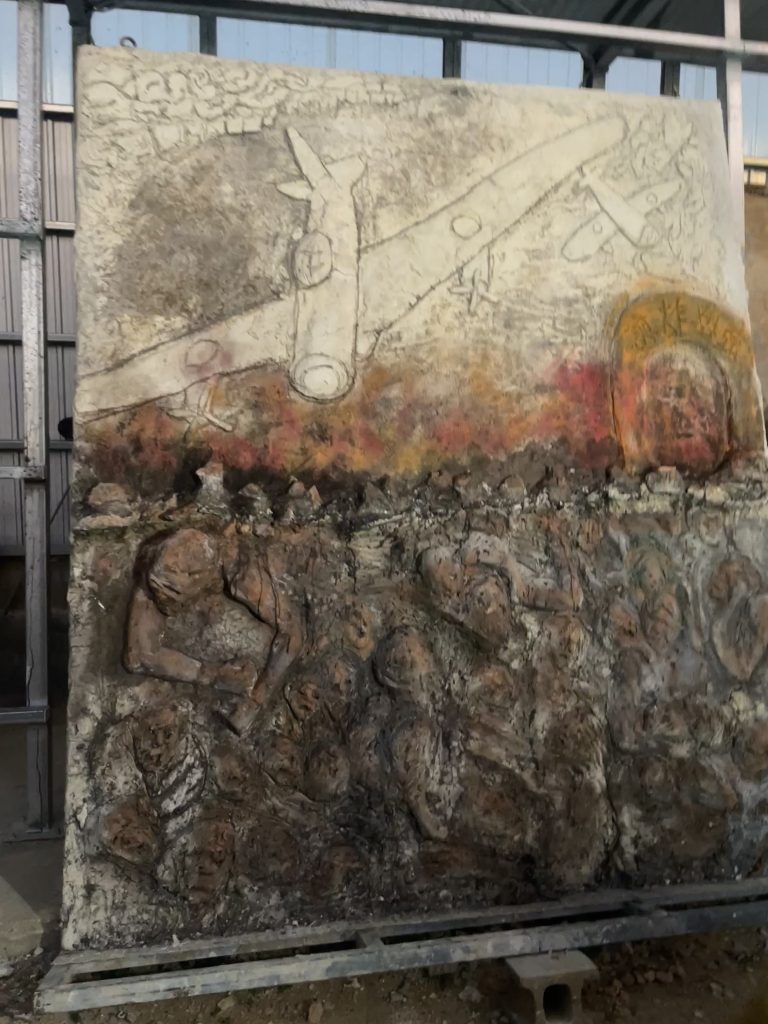
Kinjo Minoru’s artwork depicting the bombing of Chongqing.
One panel in Kinjo’s workshop deserves special attention: it was made in collaboration with artists from Chongqing, China, who travelled to Okinawa to work alongside him. During the World Anti-Fascist War, the Japanese military subjected Chongqing to years of strategic bombing, particularly between 1938 and 1943, killing thousands and driving the population into caves and bunkers carved into the city’s hillsides. Two peoples on opposite sides of the same imperial war, both sheltering in caves, create art together eight decades later.
The resonance deepens when Kinjo shares a remarkable story that connects both peoples’ histories of resistance. In October 1962, at the height of the October Crisis of 1962 (known in the West as the Cuban Missile Crisis), US Air Force crews in Okinawa received orders to launch thirty-two nuclear-armed Mace B cruise missiles at targets across Asia including Beijing, where I live. The launch officers on the ground questioned the order and refused to proceed. That the artists of Chongqing and the sculptor of Okinawa now build something together – hands shaping the same concrete, carving the same history from two sides – is not merely symbolic. It is a living refusal of the war that nearly destroyed them both, and of the New Cold War that threatens to do so again.
Don’t Cry – Study Your Own History
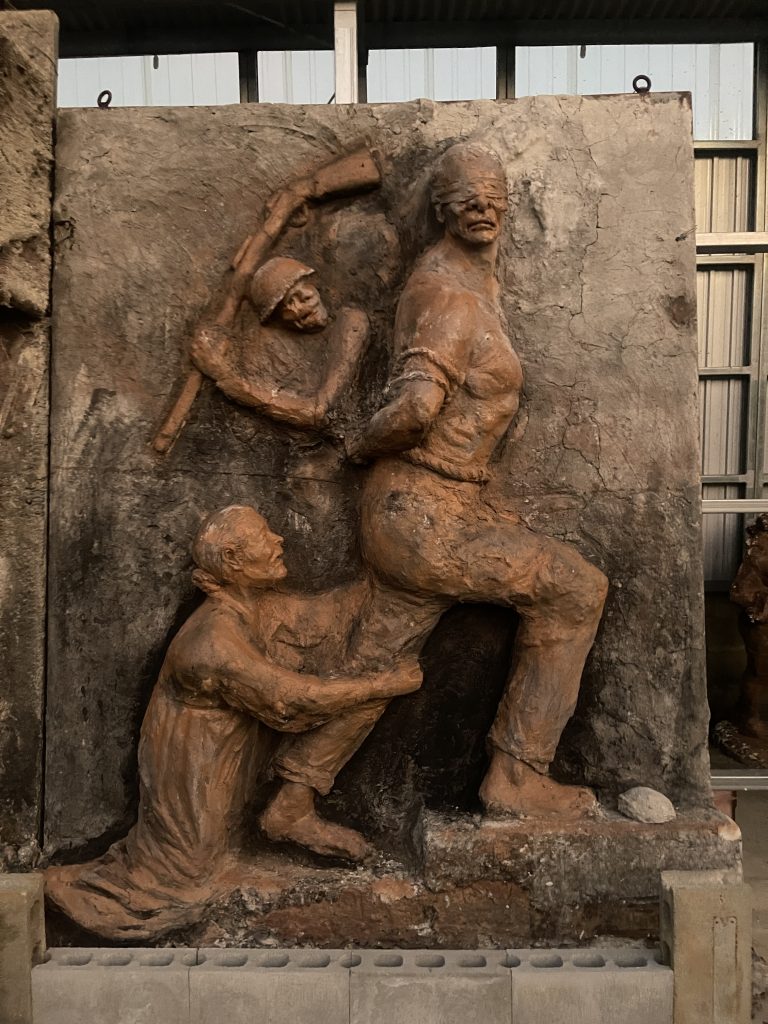
Kinjo Minoru’s artwork about the Battle of Okinawa.
Kinjo’s parents married at eighteen. After his father was killed in the war, his mother never remarried. She cried every year on 23 June, Okinawa Memorial Day. One year, Kinjo told her, ‘Don’t cry. I am not sad my father died. It was a time like that. Everyone suffered. One out of four was killed in the Okinawa war. This is not a day for crying. It is a day to study your own history: Okinawan history’.
This is what Kinjo Minoru has done with his life. Transforming mourning and anger into sculpture – pressing the forms of the dead into concrete so that the living cannot pretend they were never there. His workshop is not a bourgeois gallery. The sculptures sit in the open air, weathering like the island itself, visited by students, international guests, and old friends who come to see his work and hear his stories.
But the question is no longer only about 1945. Kinjo clearly sees what is happening now. Seventy per cent of Okinawa’s young people, he notes, do not know what Japan did across Asia during the war – in China, in Korea, in Southeast Asia. ‘Maybe they wouldn’t support the prime minister’, he says, ‘and the media talks about China as a threat’. The same machinery that once convinced Okinawan mothers to kill their own children – militarised education, manufactured fear, and the suppression of historical knowledge – is being reassembled today around the ‘threat’ of China. Okinawa, once again, is being prepared as the sacrifice zone. But Okinawans like Kinjo continue to remember – and resist.
| Tinsagu nu hana ya, chimasaki ni sumiti**Uya nu yushi gutu ya, chimu ni sumiri | The balsam flower dyes the fingertips A parent’s teachings dye the heart |
| – Tinsagu nu Hana (てぃんさぐぬ花, Balsam Flowers), Okinawan folk song. |
Warmly,
Tings Chak
Art Director, Tricontinental: Institute for Social Research
PS: Join us on 30 April, the 51st anniversary of Vietnam Liberation Day, for a webinar to launch ‘Hands Off Asia!’, the International Peoples’ Assembly campaign against US militarism across the region.
From | Tricontinental: Institute for Social Research via This RSS Feed.