

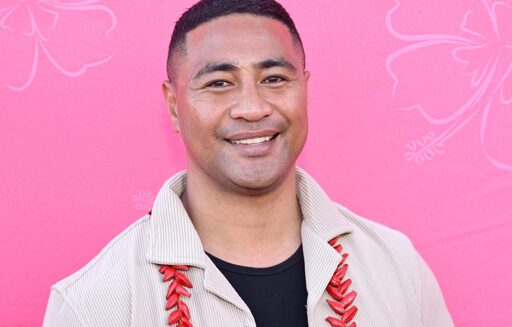

Beulah Koale and his wife, Georgia Otene, came home to Aotearoa after living in Hawai’i for several years, so their boys could be closer to their Sāmoan-Māori roots and culture. Pictured with Xavier, Isaac and Mason. (Photo supplied)
We’ve been following Beulah Koale’s acting career for more than a deca**de — including when he landed his first big role in a Hollywood movie in 2017, and then followed that up by joining the core cast of the long-running TV series Hawaii Five-O*.*
More recently, since he and his wife decided to return home with their boys, he’s starred alongside Anapela Polata‘ivao in the hit movie Tinā, and is busy working on back-to-back theatre productions. Dale caught up with him as he was riding the bus home.
Kia ora, Beulah. You have the distinction of being born on the day that a church was opened in Ōtāhuhu. So all your people were in their church finery at Middlemore Hospital?
Yeah, I think everyone thought it was the second coming of Jesus!
The doctor asked my mum what my name was gonna be, and it was my uncle who said: “Well, he was born on the day that this church is open, and our community is celebrating. So he’s going to be named after the church: Beulah.” Which is found in the Bible and means married to heaven or married to God.
You’ve been the leader of your family for a long time now, as a result of your dad leaving somewhat out of the blue. Might you talk with us about that — how that made you feel as the oldest son of six, and why you’re determined for that to never happen in your whānau as you raise your kids.
My father left just when I started a breakthrough in America with this dream that I had to be an actor. It was super weird, because my dad was my hero my whole life. I wanted to be just like him, and he taught me great lessons. And then one day, he went to work and didn’t come back, and broke my family’s heart. Mainly broke my mum’s heart.
I’ll never forget the conversation with him over the phone. He said: “You guys pay the mortgage. Good luck.” And I was like, all right, I’m gonna prove this guy wrong.
I was determined to break the cycle. To make sure that I was successful in my career, that my family was successful in terms of who they were as people, and that my siblings weren’t like your typical Island family, where they didn’t talk about feelings and didn’t talk about what was going on. I made sure that we always confronted each other about how we felt, and didn’t just throw stuff under the rug.
I just wanted to change the whole narrative of how a family operates. We’ve broken the mould, and that was all because of my father breaking my mum’s heart. I’ll never do that to my wife. I know what that looks like, and I know what that costs.

“I just wanted to change the whole narrative of how a family operates. We’ve broken the mould, and that was all because of my father breaking my mum’s heart.” Pictured: Beulah and Georgia. They met in 2013 and married in January 2019. (Photo supplied)
Was he a violent man?
Yeah, he’s violent. He’s alcoholic. But if I think about it now, he just didn’t have the guts to be a man. And to me, that’s about addressing what’s going on deep down inside. Talking about how you’re feeling. But instead of having a conversation about it, he would just turn to alcohol or violence, whether it be verbal or physical.
Sometimes, I catch myself in the mirror, and I look like him, and it pisses me off. But I can’t help that. It’s my blood. And you know, even though I don’t like my dad, I still love his family. I can’t deny that’s my bloodline as well. His father, my grandfather, Aumaleasulu Koale, was a great man. So I’ll never deny that side of my bloodline because my grandfather was someone that my uncles and my father should have tried to be like, but they didn’t. So I’ll do that for them.
Tell us a bit more about your granddad. What was it you loved about him? Is he still with us?
No, he passed away when I was about 16. He was a man who grew up in Sāmoa, and he was a provider. He was a hunter-gatherer. He was a guy that, whenever something was on, he would go hunt, he would go fish, and he would provide for the family.
One of my favourite memories was of him watching Māori TV. He’d always watch Māori TV, especially Hunting Aotearoa. That was our favourite show. He would sit there and tell me all his hunting stories. And it brought out this side to me, because my grandpa was real stubborn and real staunch. He was a man’s man, and when he watched that show, the storyteller in him would come out. He’d tell me about his scars and why his fingers were crooked, and how you provide for the family.
I love hunting now. I love fishing. It’s definitely connected to those memories of my grandfather, and making a connection with him.

My grandfather was a great man. He was a hunter-gatherer. He was a guy that, whenever something was on, he would go hunt, he would go fish, and he would provide for the family.” Pictured: Beulah in Sāmoa visiting his grandfather’s grave. (Photo supplied)
You grew up in Ōtara, and it could have gone either way. The hood’s pretty tough, but you were able to break out because you had this schooling. But what would you say of many of your cousins, friends, and colleagues who still struggle to find their feet?
Yeah, I did make it out of the hood, but I don’t like that sentence, “making it out of the hood,” because I’m unapologetically Southside and Ōtara. I’m a Hollywood actor now, and I’ve been successful because I’m unapologetically Southside.
So even though I “made it out”, those sides of me and those traits are great because it’s made me who I am. I had a tough upbringing, but I was protected by a lot of the people from Southside. They saw something in me, and they never wanted me to go down the wrong path.
There were many times where I could have, and a lot of times where I tested the waters, but I was always guided back by someone or something, to not stray that way. I’m thankful to certain people in my community for that. And because of that, I love being Southside. So yeah, my superpower is that I’m a South Auckland kid.

The dream of any Island boy is to buy a house for their mum, says Beulah. Pictured: The Koale ‘āiga, including mum Lakena Valoia, who’s holding one of her mokopuna. (Photo supplied)
You could live anywhere, though. I suppose you’ve been tempted to live in Hawai‘i or somewhere else in the States, but you came back home. And I get the feeling that one of your greatest achievements was to be able to unite your whānau, to sell the whānau home and buy a bigger whare for your mum and your brothers and sisters. That must have been an amazing thing to do.
Any Island boy’s dream is to buy a house for their mum. Me and my brothers put our money together and bought Mum a new house. Sold the house of 32 years, which kind of broke her heart because it held so many memories.
But we wanted to start a new chapter for the next generation, for my nephew and nieces, for my kids, and to give my mum what she deserves. A house that works, a house that’s nice, and they can just fill it up with the love that was in the last house anyway.
Is it a big place with six bedrooms or something, bro?
It’s five bedrooms, five bathrooms, so it’s pretty big.
It’s just up the road from where you guys grew up?
Yeah, it’s up near the point, you know, where everyone goes up, and they can see the 360 view. Near the tōtara up on the hill. Literally a minute from our last house. But it’s in a spot where me and my brothers used to sit on our deck as kids and say: “Bro, imagine if we got a house up there.” And now we’ve done it. I love that word “imagine”. “Imagine” is a powerful word.

Beulah joined the drama club at Tangaroa College so he could skip three other classes on Mondays. “I was the vice-captain of the 1st XV, and I was like: ‘Boys, guess what we’re doing on Monday. We’re gonna skip all these classes!'” Pictured here with Fasitua Amosa, in Victor Rodger’s play Black Faggot, which played to standing ovations at the Edinburgh Festival in 2014.
Let’s talk about theatre companies and youth. We know that a lot of our Pasifika rangatahi already have an inherent ability to perform, be part of groups, music, hip hop, etcetera. But it was cultivated somewhat in your time at Tangaroa College. Who would you like to mention who was in your corner, who saw something in you?
It started off with David Riley. He was an English teacher who started a drama club because he wanted the kids to have something different. There were no arts in the school other than music.
So he started a drama club. If you joined, you got to skip three other classes on Monday. I was the vice-captain of the 1st XV, and I was like: “Boys, guess what we’re doing on Monday. We’re gonna skip all these classes!”
Then Massive Theatre Company came through, and I met Sam Scott, who’s the artistic director for Massive. And still to this day, even with what’s going on in the world funding-wise, Massive Theatre Company runs free holiday workshops every school holidays for youth.
And that’s where I joined. It was down at OMAC (Ōtara Music and Arts Centre). I remember just walking into this room and seeing kids from all over Auckland come into my hood in Ōtara to do this theatre thing — and they’re all looking each other in the eyes. And I remember thinking to myself: “This is weird. Why are kids looking each other in the eyes?” Because where I’m from, that means we’ve gotta have a fight.
So I walked out. I walked to the bakery, and I was like: “That’s not for me.” But I just don’t like giving up. So I had a cream doughnut, made myself happy again, and said: “I’ll just go back into the room, and I’ll finish the day because I’ve got to finish what I started.”
So I walked back into the room, looked everyone in their eyes, found this theatre thing, and never left. Just moved up in the ranks of Massive, got an agent, TV commercials, short film, all of that stuff. I didn’t go to any school. Just joined the school of acting through experience, learned from job to job, and found out that I had a gift for this thing.
I used to think everyone could do acting. I’d invite my friends to join, and I wondered why they couldn’t do it. I was like: “Bro, just feel it and do it. It’s that simple.” And they couldn’t do it.
I’ve interviewed David Riley many times. Had him in the studio. And I take my hat off to David. He was driven by wanting to get books for young guys to read, and he’s written 60 books now.
I got a bunch of these books that I read to my kids at home. He’s changed so many people’s lives. And I’m so glad he’s writing now, because being a teacher, you’re helping out, you’re doing a lot for others, and he’s never really done anything for himself. So to see him write a bunch of books now and follow his dream, you can’t help but be stoked.
That first opportunity that you got in the States is an amazing story. Here you were from Ōtara, next thing you’re in the States. Somebody saw something in your eyes, if I recall. They thought you had a look about you that they were after. And even though you weren’t an experienced actor, they desperately wanted you. Just recount that a little bit for us, would you mind?
I was doing a theatre company show for Silo, my first ever one. My dad had just left us a week or so earlier. I was working a whole bunch of jobs to try and pay the mortgage, and I was living with my girlfriend on the North Shore. She’s now my wife. At the end of the pay week, I always had $50 to my name. And that’s what paid for food.
And then this audition came through for a DreamWorks movie. Long story short, they looked at 1,200 people all over the world, and they found little old angry Beulah who was in New Zealand. I almost didn’t do the audition, because it was going to cost me $50 to do the tape. I had to eat noodles for that week.
But I used the audition just to let out this pure venom that was in me because my dad had just left, and I couldn’t give two craps about the audition or the role. So I walked into the audition and just spat out what I needed to spit out, walked away and didn’t think anything of it.
And then all the way over in Los Angeles, someone in DreamWorks saw it — Jason Hall, actually, he wrote the movie — and he goes: “I want him.” And then he had to talk to Steven Spielberg and all of them to convince them. Because I wasn’t a star, I was a nobody. They’re like: “He’s not gonna put bums on seats.” And Jason was like: “No, I want that kid. He’s got the thing.” And he fought tooth and nail, because there were a lot of people who didn’t want me to do it.
And after that, I got offered a role on Hawaii Five-0. To me, that’s God. If you do good, if you try hard, even if you’re in the pit of the pits, you never know what the next step will be. That’s why I’m a big believer in just trying to make it through.

Beulah in the 2017 film Thank You for Your Service. His performance was hailed as “excellent” and “heartbreaking”, and Variety said he was the “most poetic thing” about the film. His performance landed him a role in the core cast of the TV series Hawaii Five-O.
You’ve played roles in movies and TV, and you’re very much an experienced actor now. Tell me how you face the challenge of temporarily occupying someone else’s personality.
Someone asked me early on: “Why do you play rugby?” And I was like: “To let out what I need to let out, like anger. And to physically hurt someone, or physically hurt myself.” And that person said: “Well, with acting you can let out anger, joy, sadness, happiness, and all these other feelings.”
At Massive Company, we have something we call “using from the real”. Whatever acting I do, I just use from my own life, the bad stuff and the good stuff.
So it isn’t me embodying someone else’s character. It’s me finding pieces of my life and my heart, and using that as the first seed, and then adding information and research and building a character from there.
At the heart of it, the character comes from me. Every character that I play is a piece of me. Acting gives me a chance to play different versions of myself, or talk to different bits of my soul that I don’t really tap into. And that’s good and bad, because I’m only learning now, at age 34, that I need to set up exits for myself. I never did that before. I was all in, and whatever the repercussions were afterwards, psychologically, spiritually, mentally, I was just going to have to face it. And because I was using a lot of real stuff, I didn’t know that I was destroying my soul.
So, it’s only recently that I figured out that I need a safer way to exit plays or shows or TV shows or jobs. Even as experienced as I am, you’re always learning. That’s what I love about this job, that you never figure it out. Until the day I die, I’ll never figure out the craft of storytelling.

“Whatever acting I do, I just use from my own life, the bad stuff and the good stuff. So it isn’t me embodying someone else’s character. It’s me finding pieces of my life and my heart, and using that as the first seed.” Pictured: Beulah in Silo Theatre’s A View from the Bridge, showing at the Q Theatre in Auckland until May 3.
When you think of young kids coming through, 14 or 15, they’re in Ōtara, not realising that within them is this skill, this storytelling ability and creative performance that they could well utilise. What commitment do you sense is appropriate from you to them? I know 34 is young to be a mentor, but you’ve had a chunk of experience here.
I try to tell people in my community that the thing that holds us back is belief. We’ve been dealt a tough hand, but we can flip that negative into a positive and use it to tell stories like I do, or in music, or whatever. Use that as a fuel.
My ultimate goal used to be to get an Oscar, get a little piece of trophy. I’ve been to those parties. I’ve met those people, and a lot of them were sad and empty, and they’re chasing something that isn’t really there.
But I had a conversation with myself, and I said: “You need to change your goal, because once you get that trophy, it ends, and then you’re not gonna push.” So now my goal is to push as far as I can as a Polynesian actor in the world, and get as successful as I can, so that for the next generation, it’s not so hard for them.
So the more I work and the more they see someone from their community who looks like them succeed, the more they can know that they can do that too. And that’s my goal.
Because when I was coming up, there was no one helping me, and I refuse to be that person who doesn’t help the next generation. I want to share my knowledge with everyone — especially if you’re from South Auckland and you’re Polynesian or Māori. So I’m gonna start up an acting course in Ōtara, and teach a bunch of people from our community, and get more versions of me out there.
When you look back at your body of work, which stretches back 16 years, what are some of the standout opportunities, and who helped you to grow in confidence?
David Riley was obviously one. If it wasn’t for him, I wouldn’t have started it. Sam Scott from Massive Company — she’s what I call my sensei. People like Anapela Polata‘ivao, who is directing the show that I’m doing right now. Pua Magasiva was my hero growing up. Nathaniel Lees. These are all people who are great at their craft and have the X factor.
And, bro, honestly, I’m gonna thank myself, because there were a lot of times when there was no one, when you start from nothing. I remember the feeling of just going: “How do I even do this? Where do I start?” And just trying to figure it out.
And I say that because I hope that another person out there, if they read this, can see that sometimes you just need to believe in yourself. Believe in yourself and keep pushing. If you’re looking externally for motivation, it’s not gonna go far. But if you look internally, you’ll find that fire that no one knows that you have.

“Sometimes you just need to believe in yourself. Believe in yourself and keep pushing. If you’re looking externally for motivation, it’s not gonna go far.” At a rehearsal for Silo Theatre’s A View From The Bridge. (Photo: David St George)
You’ve got some Solomon Islands and Tuvalu connections. Have you visited these places?
My mum is from the Solomon Islands, and they’re migrants to Sāmoa. My grandfather is from Tuvalu, but my dad is from Sala‘ilua in Savai‘i, in Sāmoa. Most of my life, I was just calling myself Sāmoan. I knew I was Tuvaluan, but I didn’t know I was also Solomon Islands. Hopefully, I get to play some roles where I can learn more about my Solomon Island side and tell stories about that.
Do you have any ambition to be a writer and to tell stories in that way rather than to be an actor?
Yeah, 100 percent. I’ve written a couple of plays with Massive Theatre Company, and I want to write some TV shows and films. I’m learning how to write, direct and produce films.
I want to add another name to the names I put down: Miki Magasiva. He’s taking me under his wing and teaching me how to tell stories. He wrote Tinā, you know, the number five film of all time in New Zealand. I wanna do what he’s doing. He’s my idol. He’s a director, producer, filmmaker, and he tells our people’s stories. So I want to go on that journey with him and not just be an actor. We need more of our people controlling the story and the narrative, for the betterment of our people.
I believe Tinā was pretty much self-funded by Miki.
Pretty much.
He was hoping that it would be well received, and it was. But in this caper, you need to back yourself.
Yes, a million percent. Miki’s a prime example of that. Sometimes you can have the best story, and you can have everything aligned, and you shot it perfectly, but no one will watch it. But sometimes, and I think this is the beauty of our art, sometimes you just strike gold. And you don’t know how you’ve done it and when it will happen, but it just happens.
Tinā was one of those moments, one of the greatest moments I ever had in my career. Hopefully, it’s not the last time that I strike gold in the industry. Hopefully, I can do it again.

Beulah says Tinā was one of the greatest moments of his career. Pictured: Beulah, Georgia, and their sons Xavier, Isaac, and Mason at the premiere. (Photo supplied)
Beulah, I can hear some people there with you. Is there someone wanting to get hold of you?
No, no, I’m just on the bus.
You’re on the bus?
I’m talking to you, and I’m on the bus, yeah.
You could be driving around in a limousine. How come you’re on the bus?
With the price of petrol, I ain’t driving around on my own gas. And I like finishing rehearsals and just jumping on the bus. It helps turn the brain off.
What are you working on, bro?
I’m doing this show for Silo theatre company called A View from the Bridge, which opened on April 9. It’s on for about a month down at Q Theatre in the city, and it’s been directed by Anapela Polata‘ivao, who’s Tinā in the film.
It’s an Arthur Miller play from the 1950s, Italian-American, and we’re doing all the bells and whistles — accents, everything. And yeah, it’s pretty exciting, and it’s a classic. I’ve never really worked on a classic or Shakespeare kind of play, and I guess that’s what it kind of feels.
I’m the lead in this play, and that’s a mission. But I’m learning so much, man. It feels like I’m going back to the dojo and learning things that I didn’t even know were there in the craft. That’s what I love about my job.

Beulah, with his youngest son, Mason, in his best role. (Photo supplied)
(This interview has been edited for length and clarity.)
A View From The Bridge is playing at the Q Theatre, Rangatira in Tāmaki Makaurau until May 3.
Beulah is also rehearsing for Auckland Theatre Company’sSons of Vao (June 18 to July 5), again directed by Anapela Polata‘ivao and written by Vela Manusaute.
The post Beulah Koale: Unapologetically Southside appeared first on E-Tangata.
From E-Tangata via This RSS Feed.