

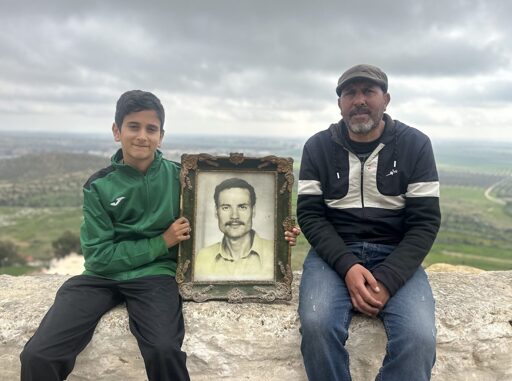

“Haane Manahi remains forever in our hearts and in my family’s memory,” says Nizar Chhoubi (right), pictured with his son Youssef, and grandfather Salah (in photograph), whose life was saved by a Māori Battalion soldier, Sgt. Haane Manahi, during World War Two. Their story is now part of a feature film directed by Tearepa Kahi.
A new film, Sgt. Haane, depicts the heroism of Lance Sergeant Haane Manahi (Te Arawa, Ngāti Raukawa) at the Battle of Takrouna in Tunisia, North Africa, in World War Two.
As writer-director Tearepa Kahi discovered when he first visited Takrouna last year, Haane is still remembered and revered there by one family, 83 years later.
Here’s Atakohu Middleton with the story.
In March last year, writer and director Tearepa Kahi and camera operator Richard Curtis made a three-day trip to the ancient Berber village of Takrouna in Tunisia.
To help the art department build the film sets for Sgt. Haane back home, they wanted to collect some pictures of the pinnacle that Lance Sergeant Haane Manahi and his men captured in 1943, a remarkable feat that won a key victory for the Allies.
It was Ramadan, when observant Muslims fast during the day. Tearepa, who is Ngāti Paoa and Ngāti Hine, was happy to follow the locals and eat only after dark. But his local fixer convinced them that it was fine for them to eat during the day and that the local people, Indigenous Berbers, always appreciated extra income. He set off to find someone in Takrouna to cater for them.
He found Nizar Chhoubi, who lived with his wife and children on Takrouna peak, in a crumbling stone house that had been handed down through the generations. They scraped out a living, using a donkey to fetch water from a well on the flat and serving tea and traditional Tunisian bread to tourists.
By that time, Tearepa had almost finished writing the script for Sgt. Haane, and thought he had the story locked down.
It focuses on three days in April 1943, when Lance Sergeant Haane Manahi, played in the film by Alex Tarrant, led a small band of 28th Māori Battalion soldiers, all cousins, in a hand-over-fist climb up a 180-metre vertical cliff to capture the fortified pinnacle from Italian and German soldiers.
Over three days, Haane fended off a counter-attack, survived fierce hand-to-hand fighting, took several hundred prisoners, and carried the injured and dead back to base while under heavy fire.
When Tearepa met Nizar, the two communicated through the fixer. Nizar, now 50, told him that Haane — “Maan Hanne” to him — saved the life of his grandfather, Salah, and his family. Haane, he said, was a hero to several generations of his family, and the story had been passed down to him, told and retold to keep it alive.
Tearepa was astonished. He had no idea that Haane remained in local memory. That he should meet someone with such a profound connection, he recalls, “was unplanned and unbeknownst to all of us”.
He asked a few sceptical questions and found that Nizar “had extraordinary command and detail of these stories. He had the type of detail that went beyond the written word, that bore the characteristics of first-hand accounts.”
Tearepa quickly hired a camera, microphones and a translator, and he and Richard captured Nizar retelling, in Arabic, the story of the Kiwi soldier to Youssef, now 12, the youngest of his three sons with his wife, Rabeb, 40.
“They ended up becoming a big part of the film, but also, in a way, altering the trajectory of the story,” Teareapa says.
This storytelling is mirrored back in Ōhinemutu, Rotorua, beside Haane’s grave, where Haane’s mokopuna Anaru Grant tells his son Haane why his namesake was known as “tangata wehi kore” — a man without fear.

Haane Manahi photographed by George Bull in 1943.
‘The word sergeant isn’t good enough’
After I saw a preview of the film, the story of Haane saving a Berber family on a dark night 83 years ago stayed with me.
In the Māori world, whakapapa — those from whom we descend — is central to our individual and collective identity. We keep our ancestors alive by talking about them, singing about them, carrying their photos to events, applying the lessons they taught us, and then passing them down to our own tamariki.
It seemed so profound to me that an Indigenous family whose whakapapa had been saved by Haane Manahi was keeping him alive by sharing stories, as we do, and I wanted to know more about that family. So I got online and tracked down Nizar Chhoubi. I knew that Nizar probably spoke French, as I do, so after getting his Whatsapp number, I messaged him.
Nizar answered my message straight away. The first thing he wrote, after “Salut” (Hi), was: “Haane Manahi is always in our hearts and in the memory of my family.”
Nizar told me he isn’t keen on taking part in films — and many have been shot in the area, with its olive groves, mosques and stone buildings. But he felt comfortable telling his family story to Tearepa on camera.
“It was a matter of trust, and when a trustworthy man appeared, I told him the whole story, without leaving anything out.”
Nizar takes his role as the keeper of his family’s Haane Manahi story very seriously.
“He is a legend. He will always remain in our hearts and in my family’s memory.”
He says his grandfather always called Haane “General Maane Hanne” and, in our conversation, Nizar does, too. “The word sergeant isn’t good enough.”

Alex Tarrant plays Sgt. Haane Manahi in the film. (Image supplied)
In early 1943, Nizar recounts, Salah saw trouble coming and stashed supplies in the depths of a cave system beneath the peak of Takrouna. When German and Italian troops took the area, Salah and his family, numbering 10, retreated into the cave. But they were trapped when German soldiers dug in outside, and would have been shot if they had shown themselves.
After 21 “terrifying” days, Salah heard a commotion. Haane and his men, advancing in the dark, were attacking the German position. As Salah approached the entrance of the cave, he heard an unfamiliar language. He went outside and met a compassionate Haane.
“General Maan Hanne protected my family in front of that cave,” says Nizar. “He ate with my family. He respected my family.” Then, he “drank a little water and told my grandfather to stay there, leaving a Māori soldier with him. The general climbed the rest of the mountain, my grandfather said, as if he were engaged in a race against time. But Saleh understood that the general wanted to eliminate the Nazis before dawn.”
Haane also left them a machine gun for protection. Nizar still has the barrel, which he will eventually give to his sons. “Thanks to him, nothing happened to my family. That is why I was determined to learn everything about the general from my grandfather.”

All that remains of the Spandau machine gun that Haane Manahi gave Salah is this rusting barrel, here guarding the Chhoubi family herb garden on Takrouna.
The Victoria Cross that wasn’t
Tearepa admits that when he was approached to tell Haane’s story by Dr Donna Morrison, Haane Manahi’s great-niece, he wasn’t keen. The tale had been well traversed by a 2007 documentary and a 2011 book, both of which covered its highs and lows.
The high was that Haane’s bravery and leadership at Takrouna was recommended for a Victoria Cross (VC), the top British award for valour, by three generals and a field marshal: Bennett, Freyberg, Kippenberger, and Montgomery. A witness, British General Brian Horrocks, described what Haane did as “the greatest feat of courage I ever witnessed during the war”.
The low is that an unidentified War Office official downgraded the VC to a Distinguished Conduct Medal, with no explanation provided. Haane’s descendants remain hurt by the snub. It’s hard not to conclude that colonial prejudice fed the decision.

Nizar Chhoubi outside the cave that sheltered his ancestors during the war. Just as Haane Manahi’s family have kept his story alive, so Nizar has handed it down to his son, and local children. “I don’t glorify war at all, but it creates heroes who remain etched in our memory.”
Haane, a taciturn man, wasn’t interested in chasing a VC after he returned home. But following his death in a 1986 car crash, supporters began a campaign to have it reinstated. So far, this has been unsuccessful.
But Tearepa hadn’t reckoned on Donna’s determination. She is driven by the dream that one day, Uncle Haane will get what he’s owed, and to that end, earned a doctorate in 2023 for a detailed historiography of his story. Donna wanted that story on the big screen, too, to ensure his valour and the injustice that followed were understood far and wide. Over five months, many cups of tea, and Donna’s cheese scones and plum crumble, Tearepa listened to her.
The tipping point, says Tearepa, came the day he met Donna’s moko, Haane, named after his famous ancestor. Tearepa realised that the tale he wanted to tell wasn’t about the forces that denied a war hero his VC. It was about the “ongoing whakapapa of the story, the power of memory, and the connection and responsibility that we have to keep memory alive. Haane’s story didn’t start and finish in 1943, or when he returned home — it continues beyond his passing.”
Donna says there are no plans yet to approach King Charles about the VC. The next steps will be a collective Te Arawa effort. But she knows that Charles is “his own man” and might be the key to change. She believes the film, coupled with her PhD, “provides a compelling reason for decision-makers to pause, reflect, and to consider the weight of evidence that has been presented”.

Dr Donna Morrison, left, co-produced the docudrama with Reikura Kahi, Tearepa’s wife, and Selina Joe. Anaru Grant, right, is part of the film, shown in its opening telling his kids about their famous Koro Haane.
Taking Haane back to Takrouna
Donna and Tearepa both have unfinished business. Tearepa wants Nizar and his family to see Sgt. Haane, and is hoping to get it to a film festival in Tunis, the capital of Tunisia, in December. For some years now, he adds, there have been discussions but no decisions about placing a memorial for Haane Manahi at Takrouna. Some sort of permanent remembrance “is a dream that lives in Nizar’s heart . . . If that can come to pass, that would make me very, very happy, too.”
Nizar told me that if he had the means, he would erect something himself to remember Haane. Since he met Tearepa a year ago, he and his family have had to abandon their disintegrating home atop Takrouna, like so many of their former neighbours. They were the last to leave, and now live in a nearby town.
Nizar misses his old home on the peak, where the stories of his ancestors and the man who saved them inhabit every stone, cave, and crevice.
“I go up there every day,” he writes. “I can’t leave.” His message ends with a crying emoji.

Nizar Chhoubi at his old home on Takrouna, looking over the ancient olive groves: “Our house was at a strategic position, and the Nazis wanted it.” This picture was taken in March 2025, when Tearepa Kahi and camera operator Richard Curtis visited Takrouna. (Photo supplied)
Dr Atakohu Middleton (Waikato, Pākehā) is E-Tangata’s arts editor. She is a journalist whose lengthy career has included outlets as diverse as Radio Waatea*, theGuardian(UK),* theNew Zealand Listener*, theSunday Star-Times, and theNew Zealand Herald. She lives in Tāmaki Makaurau. Her book*Kia Hiwa Rā!, on Māori journalism in Aotearoa, was published in 2024.
Sgt. Haane opens nationwide on Thursday, April 30, you can watch the trailer here:
The post The Māori war hero still held in Tunisian hearts appeared first on E-Tangata.
From E-Tangata via This RSS Feed.