

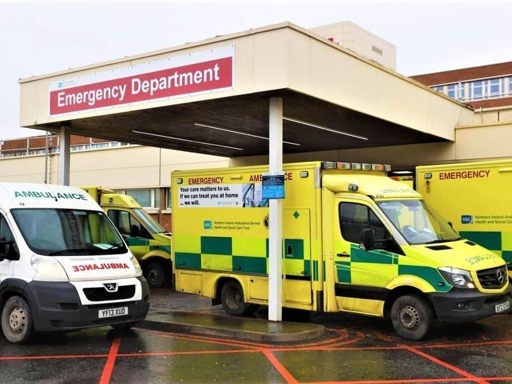

The Royal College of Emergency Medicine (RCEM) has decried the dire state of the north of Ireland’s emergency departments (ED). The RCEM said the new figures released by the Department of Health (DoH) about A&E units show:
…the worst four and 12-hour performance for Northern Irish EDs for any quarter on record.
In a statement, they continued:
The stats, which cover January–March 2026, showed that almost a quarter (23.5%, or an average of 12,309 patients per month) of all major ED attendances waited more than 12 hours before being discharged, admitted or transferred. A decade ago, only 1% of patients waited this long.
Meanwhile, less than a third (30.5%) were in and out of the department within the target of four hours.
The Department of Health’s targets stipulate that:
95% of patients [be] either treated and discharged home, or admitted, within four hours of their arrival in the department; and no patient… should wait longer than 12 hours.
Horror of patients left to wait for days in A&E
Perhaps the most shocking statistic is the RCEM’s citing of:
…a truly staggering 1,280 patients [who] waited more than two and a half days.
That means often very ill and exhausted people sitting or lying in corridors for sometimes 72 hours and more before they are admitted to a ward. In fact:
More than 400 (449) admitted patients waited more than 3 days in the ED in January alone.
6.7% of people simply leave the ED before they’re treated, due to the appalling wait times.
The RCEM’s north of Ireland’s vice chair Dr Sara McGurk said:
The state of our emergency care system is utterly horrifying.
She continued:
These patients [waiting for days] are being put at risk of deterioration, or even death, by this overcrowding of departments. Meanwhile, the patients who can pass through, or be discharged from, our departments within four hours are now firmly in the minority.
It is becoming difficult to even perform the basics of emergency care with overcrowding as bad as it is. Things are dire and, as the data shows, the worst they have ever been.
The RCEM’s Dr Michael Perry urged Stormont to act. He said when speaking to the BBC’s Good Morning Ulster programme (segment starts at 1:36:50 mark):
Problems in A&E [Accident & Emergency] are symptoms manifesting themselves because of [issues in] the wider network.
He continued:
I’m not here saying A&E needs all the money to fix things. It has to be distributed across the system because if we improve community care, waiting lists, timely access to specialists in hospital, social care and discharge, a lot of the problems we’re seeing manifested in our departments will be actually eased a bit.
Doctor calls for Stormont to intervene as Westminster withholds funds
Perry called on Stormont to pass a three year budget which he said would:
…improve things, it would allow a plan to be put in place to tackle this rather than stumbling on through the same permacrisis year after year.
Finance minister John O’Dowd put forward a draft budget in January 2026, but Stormont is yet to reach agreement on passing it. Ministers within the Northern Ireland Assembly have been pushing Westminster for additional funding. Thus far the Labour government has granted a £400 million loan. They will also provide an extra £380m over three years. Obviously, the second sum will largely go towards simply paying back the first.
The Treasury’s response to recent pleas for more money has been an unashamedly neoliberal review that suggested hammering average earners with regressive measures. These included water charges, raising rates (the equivalent of England’s council tax) and cutting public sector pay.
Perry also lamented the effect the A&E disaster has on staff, saying:
The nursing staff turnover that we have in our departments is vast and is largely to do with the environment they work in.
This creates a vicious downward spiral in which insufficient staffing leads to worsening conditions, and those worsening conditions lead to even more staff being driven away. Perry spoke of the moral injury endured by heroic healthcare workers:
We talk about moral injury and I’ve had staff with me who have tried to deliver the best care they can and because of the environment something adverse has happened. All we’re asking for is the capacity to do our jobs.
The concept of moral injury entered wider public consciousness during the COVID pandemic. It refers to the psychological distress endured when someone is forced to violate their own moral code. It was routine during the pandemic for healthcare staff to be forced into saving just one of two desperately ill patients.
Proper pandemic management and healthcare resourcing by the Tory government would have prevented them being put in this cruel position. Six Counties healthcare workers are now having to make those same choices again.
Patients dying in A&E are the human sacrifice capitalism demands
Anyone familiar with A&E in the north of Ireland will know that at times it isn’t far from the apocalyptic scenes shown in the sci-fi film Elysium. That film is set in 2154 and is meant to show the United States as essentially a failed state with a tiny oligarch class and crushing poverty for everyone else.
The north of Ireland isn’t even a proper state — it’s a strangled, dysfunctional appendage of de-developing Britain. A region that should rightly be part of a united Ireland instead suffers instead under partial autonomy, and endures the ritual humiliation of going to Westminster with a begging bowl.
Even then, Stormont is up against a Labour government captured by oligarchs, in a society where 50 families hold more wealth than half the population. An intelligent alien coming across this ‘civilisation’ would be puzzled by what it saw. It might consider it strange that the people living on this group of islands seemingly see it as correct to murder hundreds of thousands of people so a billionaire can have another yacht, or a 3,000th house.
Of course, most of us don’t actually believe that, we’re just subject to an economic system that ensures psychopaths rise to the top and make these decisions. The north of Ireland is simply an acute case of the intersection between empire’s legacy and late-stage capitalist reality. Those being left to die in A&E are the human sacrifice these beasts demand as they continue limping on.
Featured image via the Canary
From Canary via This RSS Feed.