

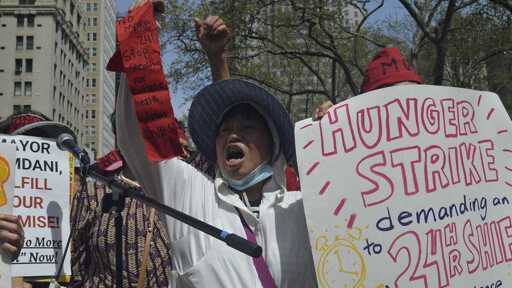
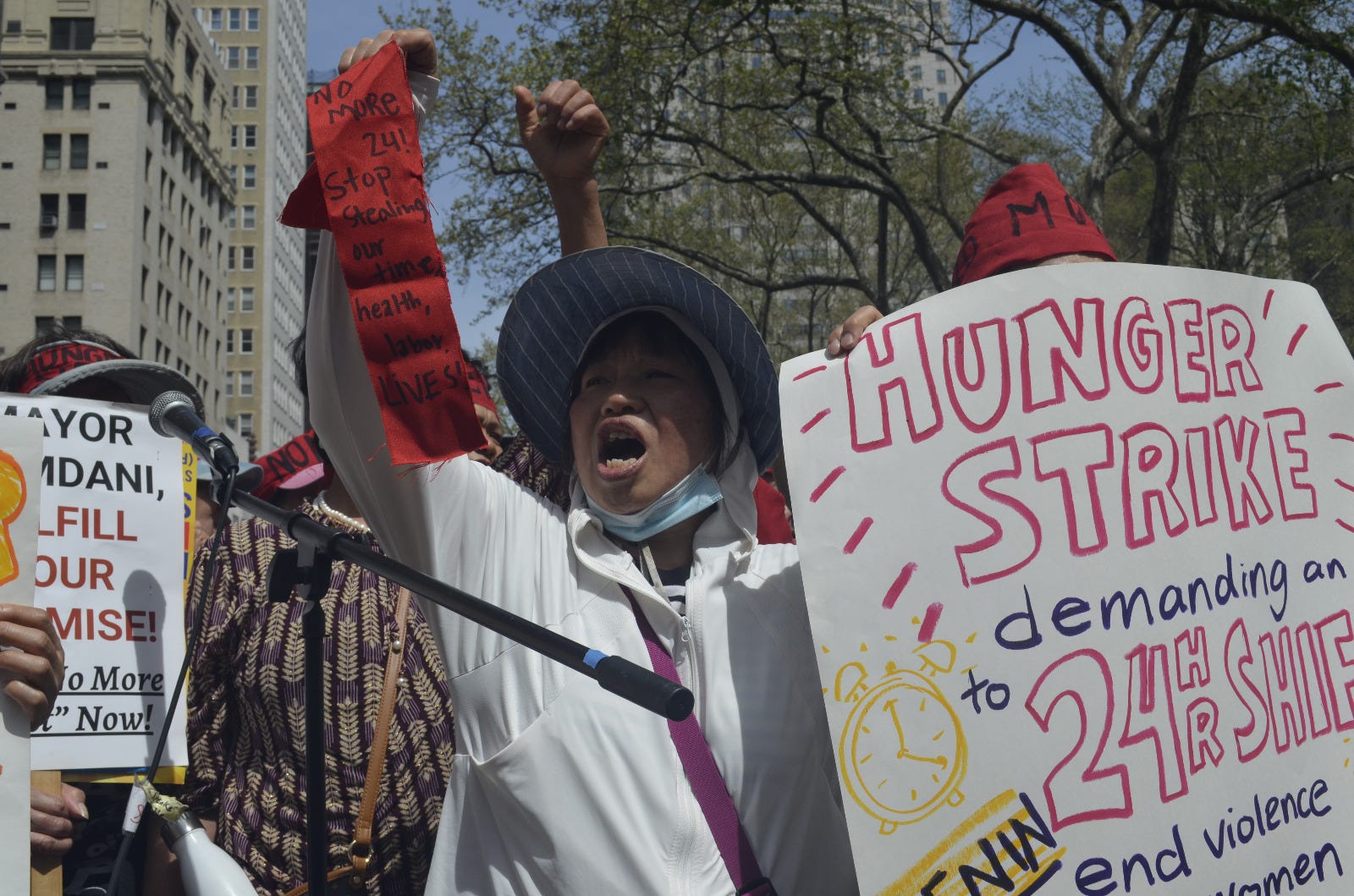
There’s a pretty important and controversial labor fight happening in New York City right now over whether home health aides can be made to work 24-hour long live-in shifts while only being paid for 13 hours.
A bill is making its way through the New York City Council, that would prohibit homecare agencies from assigning workers shifts longer than 12 hours and require workers give written consent to work more than 56 hours a week. The bill’s opponents have pointed out that NYC doesn’t have any authority over the private insurance companies that administer Medicaid and decide who gets assigned 24-hour cases. Disability advocates oppose the bill claiming ending 24-hour shifts would force them into nursing homes. Homecare workers have announced a hunger strike at City Hall starting on Thursday, April 16th. Some good news coverage can be found at Documented NY.
I think this is an important topic for DSA because
-
This is a fight led by low-wage, immigrant women, a critical fraction of the “multiracial working class”. They also occupy a strategic place in how care is delivered.
-
This fight is the symptom of a long crisis of long-term care in NY, which is funded by Medicaid but administered by private businesses. Trump’s Medicaid cuts and the takeover and centralization of NY’s huge self-directed homecare program by a private equity company are sending this system off the rails.
-
Progressives in New York City are split over this fight; NYC-DSA is likewise split too. Some of this falls along the predictable reformist vs radical faultlines, but also New York’s disability community is freaked out about losing access to care, and with it their independence and freedom.
-
Finally, how do we attack the structures of capitalism? If you are one of the millions marginalized by capitalism, what strategies are available to you? How should socialists relate to demands that don’t have a “quick fix” or easy solution?
Background and History
A carve out in NYS Labor Law for homecare companies allows them to assign aides to work 24-hour live-in shifts but only pay them for 13 hours. It is a relic from when care workers were working women taking care of family members or domestic servants to take care of rich families’ elderly and disabled relatives and not considered part of the working class with rights. It’s also a product of a modern, neoliberal long term care system that makes private profit off Medicaid.
Home health and personal care aides are the largest and fastest growing occupation in New York State (600,000+). Although a wage parity law has steadily increased hourly wages (now at $19.65), median salary is just $38,000. Homecare agencies top the NYC Comptroller’s “Wall of Shame” for wage theft.
Only about 13,000 people qualify for live-in care. Live-in cases are disproportionately assigned to recent immigrants, especially from China, Haiti, Francophone West Africa, and Central America (who are least likely to be able to refuse them). Some aides report working 96 hours straight or spend 5 days on-call for 24 hour shifts. Homecare became more difficult during COVID, when most aides were left to take care of patients without much support from agencies or the government. After Covid, Eric Adams responded to an influx of migrants by blaming and stigmatizing immigrant communities themselves.
In 2013, home health aides working for Chinese-American Planning Council (CPC, a huge social services organization; officially “not-for-profit” but with millions of dollars of downtown real estate; it runs one of NY’s largest homecare agencies) approached three interrelated worker centers in Chinatown about filing a wage and overtime complaint with the Labor Department; Ain’t I A Woman Campaign, National Mobilization Against Sweatshops, and Chinese Staff & Workers Association were founded by garment workers, veterans of the 1982 Garment Strike, restaurant workers, and construction workers disaffected by unions that protected white workers’ wages and their relationships with employers by excluding Asian, Black and Latino workers.
Their union, the Labor Department, and the Courts
The Labor Department ruled that the specific HHAs who sued CPC were owed wages and overtime but did not issue an opinion on live-in shifts generally. Other homecare workers from other agencies began to file their own wage complaints and lawsuits and joined the campaign.
Later in 2013, CPC signed a union contract with 1199SEIU. When workers brought 24-hr complaints to 1199, the union told them it did not believe CPC owed them overtime. It also told workers that their contract prevented them from suing CPC and instead they would have to go to arbitration (between the company that they claimed was stealing from them and the union reps and lawyers who say their complaints aren’t valid). So began a decade of buck passing and bureaucratic obstruction; some of it chronicled on Ain’t I A Woman’s website.
In 2015 the NY Supreme Court and a Federal Court found that CPC workers are entitled to overtime pay, but the arbitration agreement between CPC and 1199 gave the judge an excuse to stay the lawsuit. The NY Labor Department illegally dropped more than 100 workers’ cases and issued an “emergency rule” exempting agencies from paying wages for all 24 hours “to preserve the status quo, prevent the collapse of the home care industry, and avoid institutionalizing patients who could be cared for at home” A court ruled this was illegal, prohibiting 24-hour cases, but was overturned by an appeal court. The latest ruling says workers don’t have to be paid for all 24 hours unless they record skipping sleep and meal breaks. The agencies consider this a victory.
In 2022, 1199 announced that arbitration had concluded. Forty-two union agencies put $30 million into a fund to cover claims made by 100,000 current and former homecare workers. The agencies and 1199 called it “historic” and the issue was finally put to bed. However, workers only received $250 in compensation, claims before January 2017 were excluded, workers who had sued their agencies were barred, and many union HHAs were unhappy. In 2023, thirty-three lawmakers signed a letter pressuring the Labor Department to reopen aides’ cases (including most of DSA’s state delegation: Zohran Mamdani, Phara Souffrant Forest, Marcela Mitaynes, Sarahanna Srestha, Emily Gallagher.)
Stalled Legislation
In 2019 and again in 2021 and 2022, State Assemblyman Harvey Epstein and State Senator Roxanne Persaud introduced bills in Albany that would have split live-in cases into two 12-hour shifts or and limited required working hours to 50 hours a week. Those bills died in committee and never reached a vote. 1199 opposed the bills and said it wouldn’t support legislation unless it was tied to additional Medicaid funding in the state budget. Governor Kathy Hochul refused or couldn’t increase the Medicaid budget. Downstate politicians, like Gustavo Rivera, feared losing influential friends and donors from the homecare and insurance industries. Upstate politicians felt no urgency or pressure because most live-in homecare cases are in New York City.
Unable to move things in Albany, workers shifted their focus to New York City Hall. In June 2022, Chris Marte, a city councilman for Chinatown and the Lower East Side, introduced a bill banning splitting 24 hour shifts. Because it had the support of a majority of City Council, Adrienne Adams, council president, blocked the bill from coming up for a vote for almost a year until, again, it died. 1199, CPC and other agencies, and a host of State legislators, all opposed the bill on the grounds that it needed to be addressed by the State Government.
Rank and File Momentum
Court cases, DOL complaints, bills in Albany and NYC are backed up by energetic protests led by home health aides. Ain’t I A Woman, NMASS, and CSWA frequently march on CPC and other homecare agencies and the NY Labor Department. Home health aides did a week long sit-in at 1199’s headquarters in 2022. In 2023, when the City Council president prevented the No More 24 bill from being voted on, workers led monthly protests at City Hall culminating in a hunger strike in March 2024.
The small openings they won over the years through court cases and vocal protests when blocked by the union and DOL brought in more home health aides in other communities and other parts of the City- a new workers center opened in Flushing, Queens; AIW does canvasses in Crotona Park, South Bronx, Jamaica, Sunset Park, Coney Island, etc.
There’s also a growing community of allies, especially students and young people around the Lower East Side. A flyer for a 2024 May Day protest lists some of the campaign’s supporters: DSA members, workers organizing unions through EWOC, retirees from DC37, 1199 and other unions, the Lower East Side’s progressive Democratic club. By loudly staking out the moral high ground, home health aides are gradually winning a segment of New York City’s rank-and-file activists even while Left and progressive institutions and leaders remain lukewarm or resistant to the campaign.

Two Strategies: Mediating or Provoking the Crisis
Why is 1199 so opposed to closing the 13-hour loophole and ending 24-hour shifts? It is currently backing a bill to protect homecare workers rights to overtime in the Washington, DC City Council. It has definitely acted cynically and parochially, but 1199 is not simply a business union. Historically, it was founded by Black and Puerto Rican hospital workers excluded from the New Deal. More than any other union, it is responsible for establishing New York City’s multiracial social democracy. Beginning in 1987, it led the fight for home health aides to win the right to have a union and collective bargaining, which culminated in 1991 with two strikes and 6,000 people marching on City Hall. More recently, the union won a set of wage parity laws that permanently set homecare wages above the minimum wage.
The Ain’t I A Woman Campaign and 1199 both agree on a strategy that centers the government as the main focus of struggle: changing the laws and using NY’s labor and health departments to change conditions for homecare workers. They end up opposed to each other because 1199 sees its power coming from its ability to mediate between employers and the government. A contract with the League of Voluntary Hospitals & Homes, which covers over 80,000 workers, gives 1199 real influence within the Democratic Party which it uses to leverage relationships with policymakers. The Hospital Association’s president and the Governor are regular speakers at 1199 rallies. This strategy delivers on Medicaid reimbursements and wage parity, but advocating for dramatic structural changes, which might threaten the employers’ business model or create a budget crisis for the governor, threaten the political relationships at the core of the union’s strategy. 1199 can bring 15,000 union members to Albany but it can’t be a disruptive force in Albany.
Neither can the social services non-profits. This year it’s Legal Aid’s turn to publicly oppose the No More 24 Bill, even though it won a court order to reopen 24-hour wage claims in January. The nonprofits may want social justice but they’re responsible for running NY’s privatized social services.
The Ain’t I A Woman Campaign, on the other hand, has learned that they only get heard when they provoke a crisis for the people in power. New York’s long term care system is built on top of homecare workers’ crisis of hyperexploitation and overwork. The 13-hour loophole is the squeaky wheel that keeps the Medicaid budget under control even if it’s morally bankrupt. When push comes to shove, it has always been the wrong time and wrong place to deal with it.
If the New York City Council passes the No More 24 Bill it will create a crisis. Agencies would be caught between the law and the insurance companies that distribute Medicaid money. It could cost $460 million to split live-in shifts, it will be hard for the City to foot the bill, the state will have to be pressured to step in and make a hard choice of finding money somewhere else in the budget, raising taxes, or reforming how homecare is delivered. The government, which has for years ignored homecare workers’ demand in favor of urgent things like giving $850 billion to the Buffalo Bills, has the crisis of unpaid care work thrown in its face.
Of course, that crisis would also be felt most personally by elderly and disabled people who depend on homecare and could be pushed into nursing homes without it.
Disability Community Threatened
On April 13th, disability rights groups, especially the Independent Living Centers, authored a letter calling on city council members, council president Julie Menin, and Zohran to withdraw support for the No More 24 Bill, calling it “a reckless attempt to play “chicken” with the state government.”
The letter goes on:
“If passed and signed into law, Intro. 303 would lead to a complete destabilization and collapse of the home care system, leaving not only those who require 24-hour live-in services in peril but all people who require care and home care workers who provide the care. Intro. 303 does propose a delay in the implementation of the 12-hour restriction with the expectation that the State will respond with appropriate funding in its Fiscal Year 2027-2028 budget—an unlikely scenario.”
The letter also states:
We all recognize the onerous conditions some home care workers face. Every worker deserves a decent wage for every minute they work; every worker deserves to have the choice of when and how long they work; every worker deserves the full protection of the law.
The solutions they propose are stricter documentation of home health aides’ hours and for NYC to be more rigorous in enforcing penalties against wage theft and worker retaliation. All things NYC is already doing and they recognize they’re inadequate. They admit live-in homecare workers don’t get paid for the hours they work; often don’t have the option to refuse shifts. They don’t believe the State government will move on the issue soon. We are presented with a stark choice: clients’ freedom or workers’ rights, and you can’t have both.
The disability community is legitimately afraid that they are going to lose access to care and be forced into institutionalization; not just because of the No More 24 Bill. Earlier this year the State consolidated management of CDPAP, NY’s self-directed homecare program, into one company, the private-equity backed Public Partnerships LLC. The program was sprawling, more than 250,000 people were enrolled with 600 agencies acting as fiscal intermediaries. The State and PPL rushed and mishandled the transition. Clients and workers were kicked out of the program with little explanation, PPL threatened clients with accusations of fraud, CDPAP became much more faceless and harder to navigate, and many people felt like the State steamrolled over their concerns.
Far worse is the Trump Administration’s “One Big Beautiful Bill Act” which gutted medicare and medicaid across the country. The bill cuts federal funding to New York’s budget by $10 billion annually, concentrated especially in Medicaid and SNAP. Another $13 billion in healthcare cuts indirectly hit the State budget. The OBBBA also requires state governments to pay to cover the gaps in SNAP caused by federal cuts; for NY that’s another $1.4 billion a year. Cuts, new work requirements, and restrictions on immigrants will throw 1.5 million New Yorkers off health insurance and Medicaid.
OBBBA cuts and the CDPAP take over are making long term care’s long simmering crisis boil over. New York started prioritizing homecare over nursing homes in the 1990s because it’s supposed to be cheaper. Homecare agencies don’t have to pay for real estate or maintain facilities, therapists, nurses and other skilled jobs can be contracted out. Above all, you can get away with paying homecare workers very little. But homecare has still become very expensive for the State. In 2021 NY spent $13 billion on homecare; this year it will spend $25 billion. The CDPAP program cost about $2.5 billion in 2019, but in 2024 it cost $9 billion.
Taking on Insurance Companies
Some progressives, including Caring Majority (an organization of homecare clients), Legal Aid, policy wonk types, propose that instead of the No More 24 Bill, workers should fight to get rid of the Managed Long Term Care Plans. These are 25 or so insurance companies that NY contracts to administer Medicaid, introduced by Andrew Cuomo in 2012. In response to the CDPAP consolidation and the No More 24 protests, State Senator Gustavo Rivera introduced the Home Care Saving and Reinvestment Act, which would return NY to a fee-for-service model where the state government directly reimburses healthcare providers.
These groups are correct that MLTCs are a big obstacle to transforming long term care. They need to be thrown out of New York. Many MLTC plans are subsidiaries of giant insurance companies: Anthem, Centene, Molina. They make $722 million every year, all of it sucked out of Medicaid. They decided how many Medicaid hours are authorized to a person. They use their power to pressure agencies to pay workers less, steal wages, and limit care. Many people recognize them as villains and a campaign against MLTCs could bring together homecare workers, their clients, a portion of homecare agencies, and drag along 1199’s leadership. The growing long term care crisis makes dramatic changes more possible.
But a campaign against MLTCs avoids the issue of 24-hour shifts. Medicaid administered under a fee-for-service model would be more accountable to worker, client, and public pressure, but homecare will still rely on time-intensive labor and hyperexploitation. The 13-hour loophole would still exist and it would still cost half a billion dollars to close it. Albany won’t find the money without a sense of urgency and pressure around this issue specifically.
DSA’s Organizing Tasks
Long term care and the broader healthcare system rest on (mostly) women providing unpaid care work, and especially the hyperexploitation of women of color. It’s also the thing that allows the Trump Administration to take a chainsaw to Medicaid and Medicare. There is no “quick fix” that doesn’t cause a headache for City and State governments, only working people organized to advance their own interests against a hostile system.
Ending unpaid homecare work isn’t unheard of. SEIU 775 in Washington State won overtime rights and backpay for 6,000 homecare workers in WA’s self-directed care program. That fight made Washington kick out the company that administered its homecare program, and the campaign caused a political crisis.
For more than 10 years a segment of homecare workers in New York have been agitating against the 24-hour workday, often alone and in opposition to the government, the courts, and the progressive institutions that are supposed to be on workers’ side. 24-hour shifts are only in the public eye now because they forced the issue. They are able to do this because it is their labor that keeps the long-term care system going. By calling attention to the obvious moral injustice of 24-hour shifts, they create a crisis for people in power. Disruption is one of the only tools available to oppressed and marginalized people.
The fight is theirs and continues with or without us. We in DSA have to recognize our own organizing tasks.
The other constituency who have the power to transform long term care are the people who receive and depend on that care to preserve their independence. The healthcare system also runs on their exploitation- rationing care and robbing recipients of their agency through a faceless bureaucracy. One crucial organizing task is to rebuild (or build for the first time) a connection between homecare workers and homecare clients; this requires a recognition that workers’ demands against unpaid work are legitimate and urgent.
The other organizing task for DSA right now is to build solidarity with homecare workers.
A legislative campaign against MLTC is necessary but cannot succeed without homecare workers leading it. DSA cannot substitute itself, good policy, or well-meaning activists for working class self-activity because we don’t reproduce the healthcare system. Unpaid work is the thing that shapes their lives, just as the fight to preserve independence shapes the lives of their clients. A campaign against MLTC has to be able to internalize those issues into its own core and fight for them in the here and now.
From The Socialist Tribune via This RSS Feed.