

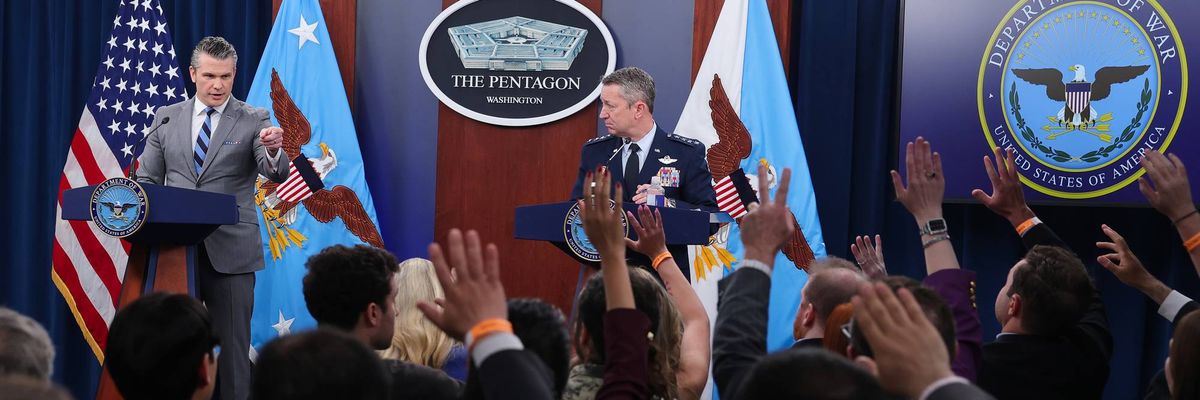
Pentagon Secretary Pete Hegseth lobbed his latest threat against the American press during a briefing on Friday, telling reporters to “think twice” about publishing stories containing classified information—a common journalistic practice that has brought to light mass surveillance, war crimes, and other government abuses.
Hegseth said Friday that the Pentagon takes “leaking very seriously here” and blasted reporting based on leaks containing classified information as “incredibly irresponsible and unpatriotic.” He went on to “encourage members of the press to think twice about the lives they’re affecting when they publish things in their publications like the New York Times.”
Q: I’m with O’Keefe media group. Earlier this week, James O’Keefe published a story on a department of army nuclear chief who revealed top secret national security information to a stranger he met on a dating app. Will you defer him for termination and prosecution?
Hegseth: He… pic.twitter.com/P9o6cweW2i
— Acyn (@Acyn) April 24, 2026
Hegseth’s Pentagon—and the Trump administration more broadly—has been aggressive in attempting to curtail press freedoms, particularly amid the US war of choice in Iran. President Donald Trump said earlier this month that his administration would attempt to jail journalists who reported leaked information pertaining to a US fighter jet recently shot down in Iran.
Last month, the Pentagon temporarily barred press photographers from media briefings on the war because Hegseth’s staff was reportedly displeased with “unflattering” pictures of the Pentagon chief.
The Pentagon has also attempted to force journalists to promise not to publish or even solicit information that the department has not specifically authorized for release—with violators forced to surrender their press passes. A federal judge has blocked that policy and rebuked the Pentagon earlier this month for attempting to reimpose the policy with insubstantial changes.
Seth Stern, chief of advocacy at Freedom of the Press Foundation, noted in a recent column for The Intercept that “the Pentagon’s legal filings imply that reporters who don’t follow the rules risk more than their press passes.”
“The government argued that although journalists may lawfully ask questions of ‘authorized’ Pentagon personnel, ‘a journalist does solicit the commission of a criminal act, and that solicitation is not protected by the First Amendment, when he or she solicits … non-public information from individuals who are legally obligated not to disclose that information,’” Stern wrote. “The government’s argument would have turned countless Pulitzer-winning national security reporters into criminals.”
“The Trump administration is barging through the door the Biden administration left wide open, when, despite warnings from First Amendment advocates, it extracted a plea deal from WikiLeaks founder Julian Assange on Espionage Act charges for obtaining and publishing government records, including about Iraq war crimes,” Stern added.
From Common Dreams via This RSS Feed.