

Bullets:
Blockades of the Persian Gulf are a boon to the American oil and gas industry, with exports of fossil fuels hitting all-time records.
Governments worldwide have concluded that their dependency on fossil fuel imports – from anywhere – constitutes a grave national and economic security risk.
The long-term solution for countries is to electrify their economies via clean tech, renewables, and nuclear and to shift away from fossil fuels.
But that means exchanging one dependency for another, as the Chinese enjoy monopolies on the technologies, materials, and expertise in solar and wind power.
With few alternatives, even countries closely allied with the United States now look to China, who alone can quickly build and export the crucial technologies at scale.
Inside China / Business is a reader-supported publication. To receive new posts and support my work, consider becoming a free or paid subscriber.
Report:
Good morning.
There is an new energy race underway, between electrification and fossil fuels. China is the world’s dominant producer and exporter of the technologies and hardware for power generation from renewable sources, while the Persian Gulf and North America are the primary suppliers and exporters of crude oil and other fossil fuels.
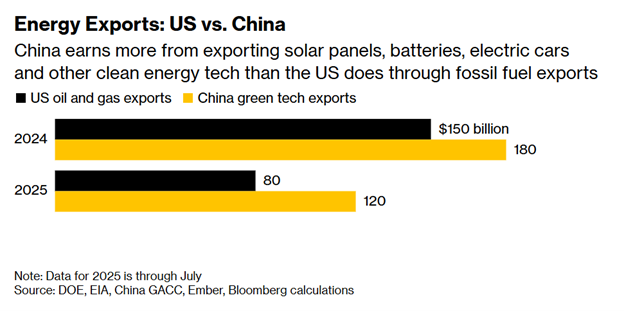
Before the war on Iran, it was Chinese exports of those clean energy technologies that were slowly taking over markets. Last August, those exports hit a record, with $20 billion shipped. These data for 2025 are through July, so seven months in to the year, and China’s exports of clean energy tech were $120 billion, plus another $20 billion for August. Through July, the US shipped $80 billion worth of oil and gas. What’s more, those exports from China were booming, even while solar energy costs on a unit basis were falling. Solar equipment and panels are falling in price.
It’s a different world today, just 10 months later. Oil prices are soaring, because of the closure of the Strait of Hormuz. And so oil tankers that ordinarily would be filling up in the Persian Gulf are sailing halfway across the world to get supplies from the United States. Exports of American crude oil will hit new record highs this month, as over 70 supertankers are enroute to ports in Louisiana and Texas. The President said that the US navy blockade of Iran’s blockade of the Strait of Hormuz is a great opportunity for the American oil and gas industry, and even more so because American households are also paying a lot more for fuel.
In theory, two million barrels a day outbound Iran to China would be cut off—assuming the tankers aren’t just going around – which in itself would drive global prices higher. And then 20% of the world’s daily demand of oil and LNG are stuck behind Iran’s blockade, so all this is demand that needs to be satisfied from elsewhere.
Last year, on average, 27 supertankers per month bought crude from US ports. There are 70 very large crude carriers on the way right now. That translates to 5 million barrels a day of export for this April, and another record in May. Last year US exports were 4 million barrels a day, so it’s a 25% jump in exports, by volume. Also, those exports now come at a far higher price, per-barrel. Exports of refined products will also rise, from 3 million barrels of gasoline, jet fuel, and diesel.
It good to remind ourselves that just a tiny handful of countries in the world are self-sufficient in energy, and the United States is not one of those countries. Last year the United States imported 6.2 million barrels a day, primarily from Mexico and Canada, because of how the North American refinery industry works to process sweet and heavy grades of crude.
Two takeaways here then, that even with those booming exports hitting records of 5 million bpd, those are still below US imports of crude, and those prices are also going up. Jet fuel and diesel markets are also in shortage, even in the United States, and trucking companies are responding by slowing down their driving—which lengthens delivery times—or parking their rigs completely. Airlines are raising ticket prices, grounding places, and the Trump Administration is already promising to bail out Spirit Airlines because of the shortage of jet fuel.
The United States produces around 13 million bpd of oil, but most of that production is already under contract. And any increased production from oil fields hits a bottleneck at seaports, which are already at full capacity and can’t load any more or any faster than they already are. So prices are going up for everyone, even in the United States and in other energy producing countries. It’s a world market, and the world doesn’t have enough.
The long-term answer to this crisis, for governments across the world, is to move away from fossil fuels as soon as possible. But the obvious issue there is that they are just trading one dependency for yet another. In the European Union, policymakers shifted their supply chain for energy from Russia, to the Persian Gulf states, and now they can’t get it at all.
They now realize that their industrial economies, their modern way of life, is wholly in the hands of others because they are powered by fossil fuels that come from somewhere else. Asian economies were faced with the same problem. The Ukraine War didn’t involve them at all, but the energy shock was global, practically, and drove inflation rates higher:
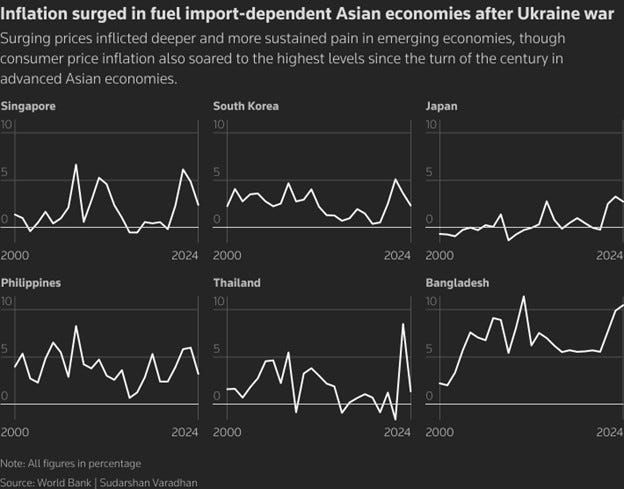
The fallout from War on Iran is much worse. But let’s look back at how two of those countries, Pakistan and Bangladesh, responded to the high prices following the Ukraine War. Pakistan had a “solar revolution”, while Bangladesh signed contracts for Liquefied Natural Gas from Qatar. Now those shipments are stuck, Qatar declared the contracts null and void because of the war, and Bangladesh needs to buy LNG on spot markets, at twice the price as two months ago. They cut working hours and public spending “to stabilize the energy situation”, as Bangladeshi supply chains have been blown up from the US-Israeli war on Iran.
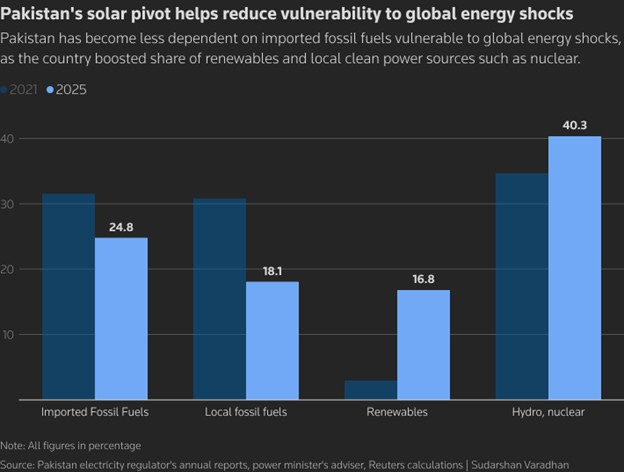
Pakistan is in a much better spot. That solar revolution there is less than three years old, and Pakistan cut its dependence on imported fossil fuels from a third, to just a quarter. Pakistan has not had to buy any natural gas on spot markets, and the country is an object lesson on how to bullet-proof their economy from the volatility in fuel prices and supply disruptions. This is the change in just four years, with big drops in both imported and domestic fossil fuels, while renewables jumped to about 17% of their energy mix, and combined with hydro and nuclear supplies more than half of Pakistan’s energy demand:
All that was possible by virtue of Pakistan’s tight partnerships with China. In 2024, Pakistan bought 16 gigawatts of solar panels from China, compared to under 5 GW in 2023. By the middle of last year, total cumulative imports were 36 GW of solar, which is three fourths of Pakistan’s total power generation, mostly from rooftop and small-scale solar. Coal was also added to the mix, and high imports of Chinese lithium batteries allowed for storage. For many households in Pakistan, this marks the first time they enjoy uninterrupted power. At the national level, large wind and solar projects were built.
That all is compelling to other governments, who can’t buy energy from Russia, can’t get shipments past the Iranian and American navies, and are waiting for their supertankers to get back from Houston. Clean, domestic energy sources are obvious solutions, long term. But there is no getting around the China dependency problem: China alone can supply the technologies and materials, at scale, and quickly.
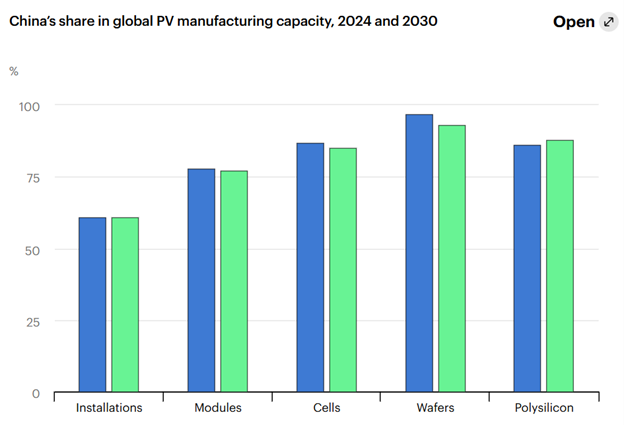
China’s global share of solar photovoltaic equipment is far larger than the rest of the world, combined. The blue bars are 2024, and the green are the 2030 forecast, from the International Energy Agency. Modules, solar cells, wafers, polysilicon—today and in the future, China will be the global source of more than three fourths of it. For overall production, it’s over 90%:
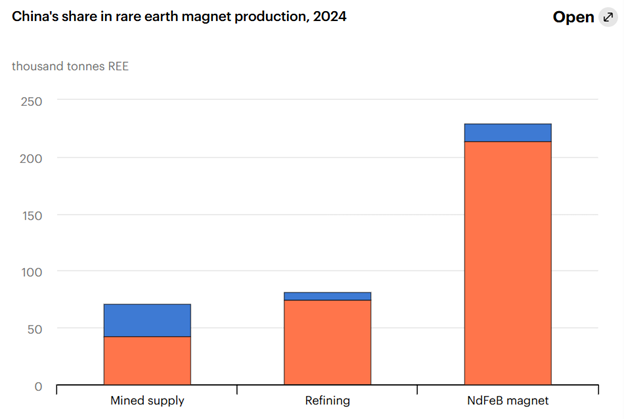
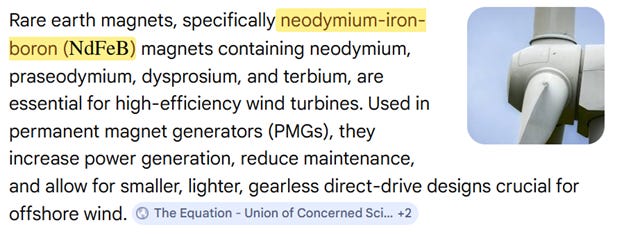
There is also nowhere to hide from China, when it comes to wind power, and the rare earth magnets that go into turbines. This chart is magnet production from 2024, orange is China, blue is everyone else not China:
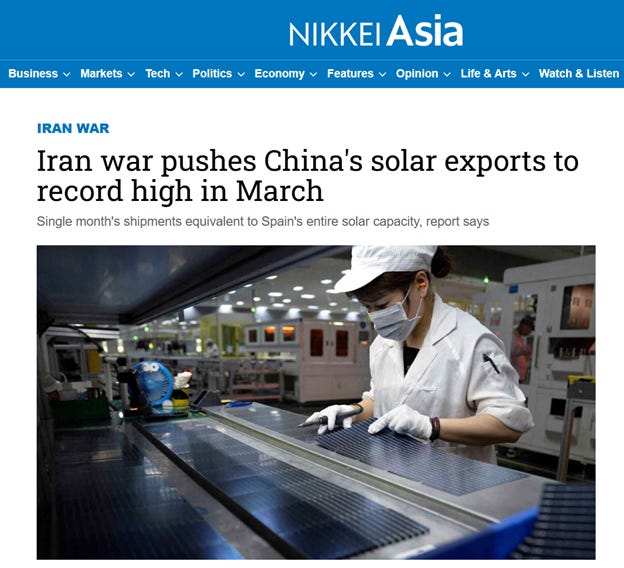
Pakistan and China are partners in clean energy, and as a result are two of just a few countries in Asia who are not flopping around, scrambling for new foreign suppliers. China also has big investments in Spain, which is also better insulated from the energy crisis, compared to other countries in the EU. Spain’s solar power industry is the second largest in Europe, but just in March alone, China’s solar equipment exports—in a single month—was equal to Spain’s total installed capacity of solar.
Across the EU, energy import costs jumped by 22 billion Euro in just six weeks. The war in Iran reminded everybody that they are exposed to risks beyond their control. So even NATO countries are booking flights to Beijing. Germany, Spain, the UK, Finland, Ireland:
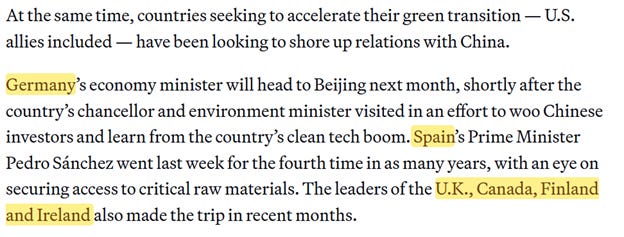
That’s a big change too. Wasn’t that long ago that officials from the EU were flying here to tell the Chinese that they had too much capacity. Now they are flying back, and China’s “overcapacity” is the only thing that can save them.
Be Good.
Resources and links:
Bloomberg, China Is Beating the US in the Battle for Energy Export Dominance
https://www.bloomberg.com/news/articles/2025-10-05/china-s-clean-energy-exports-are-beating-us-fossil-fuels
IEA, Renewables’ global growth, driven by solar PV, remains strong amid rising headwinds
https://www.iea.org/reports/renewables-2025/executive-summary
China and Pakistan strengthen renewable energy ties with strategic agreement
http://en.ce.cn/Insight/202502/18/t20250218/_39295559.shtml
China’s green investment in Pakistan: Solar dreams, debt shadows, and the politics of a rapid transition
https://globalvoices.org/2025/12/18/chinas-green-investment-in-pakistan-solar-dreams-debt-shadows-and-the-politics-of-a-rapid-transition/
Reuters, Iran war exposes cost of Asia’s fossil fuel reliance
https://www.reuters.com/sustainability/boards-policy-regulation/iran-war-exposes-cost-asias-fossil-fuel-reliance-2026-04-16/
Reuters, Europe’s response to the Iran war energy crunch
https://www.reuters.com/business/energy/europes-response-iran-war-energy-crunch-2026-04-22/
Escape route from Iran energy shock leads to China, US allies find
https://www.politico.com/news/2026/04/20/iran-war-china-beijing-global-clean-energy-dominance-00880124
Reuters, Bangladesh cuts working hours to save energy amid Middle East crisis
https://www.reuters.com/sustainability/boards-policy-regulation/bangladesh-cuts-working-hours-save-energy-amid-middle-east-crisis-2026-04-03/
Wall Street Journal, U.S. Oil Blockade Is Set to Boost American Exports—and Prices at the Pump
https://www.wsj.com/business/energy-oil/u-s-oil-blockade-is-set-to-boost-american-exportsand-prices-at-the-pump-005e1a70
Oil Price, Tanker Fleet Heads to Load U.S. Oil as Middle East Supply Crumbles
https://oilprice.com/Latest-Energy-News/World-News/Tanker-Fleet-Heads-to-Load-US-Oil-as-Middle-East-Supply-Crumbles.html
Reuters, Trump administration nears $500 million Spirit rescue as Iran fuel shock hits airlines
https://www.reuters.com/business/trump-administration-nears-deal-rescue-spirit-airlines-wsj-reports-2026-04-22/
Nikkei, Iran war pushes China’s solar exports to record high in March
https://asia.nikkei.com/spotlight/iran-tensions/iran-war/iran-war-pushes-china-s-solar-exports-to-record-high-in-march
Chinese jet fuel and the myth of energy independence
US crude oil exports decreased by 3% in 2025 despite higher production (+3%)
https://www.enerdata.net/publications/daily-energy-news/us-crude-oil-exports-decreased-3-2025-despite-higher-production-3.html
Petroleum & Other Liquids, Imports by Country of Origin
https://www.eia.gov/dnav/pet/pet/_move/_impcus/_a2/_nus/_epc0/_im0/_mbblpd/_a.htm
How much oil does the US import, and why?
https://www.afpm.org/newsroom/blog/how-much-oil-does-united-states-import-and-why
Inside China / Business is a reader-supported publication. To receive new posts and support my work, consider becoming a free or paid subscriber.
From Inside China / Business via This RSS Feed.
You must log in or # to comment.