

Behind the Dominican Republic’s assault on Haitian water sovereignty stands an Israeli Occupation apparatus – arming border forces, training police, and designing a thirty-year plan to control the island’s water supply.
Joshua Reaves Charmelus
Bismillahir Rahmanir Raheem
For years, Haiti’s border with the Dominican Republic has become increasingly militarized. The Dominican Republic constructs an island-spanning border wall, staffed entirely by Dominican troops and military police, to control the flow of people and goods to and from Haiti. Central to this conflict is the resource of water: The Dominican Republic and Haiti share a watershed. The island’s rivers and lakes supply both countries with water for irrigation and drinking, but years of conflict and environmental degradation have made accessing shared waterways a contentious issue between nations.
Dominican president Luis Abinader has presided over an increasingly anti-Haitian set of policies at the border – including mass deportations of Haitian immigrants and large deployments of soldiers to the borderlands. But this is not just a conflict between neighbors. Powerful, international interests have used the crisis as an opportunity for profit and political leverage across the island. In particular, the contentious border between Haiti and the Dominican Republic itself has been engineered by Israeli Occupation megacorporations and diplomats.
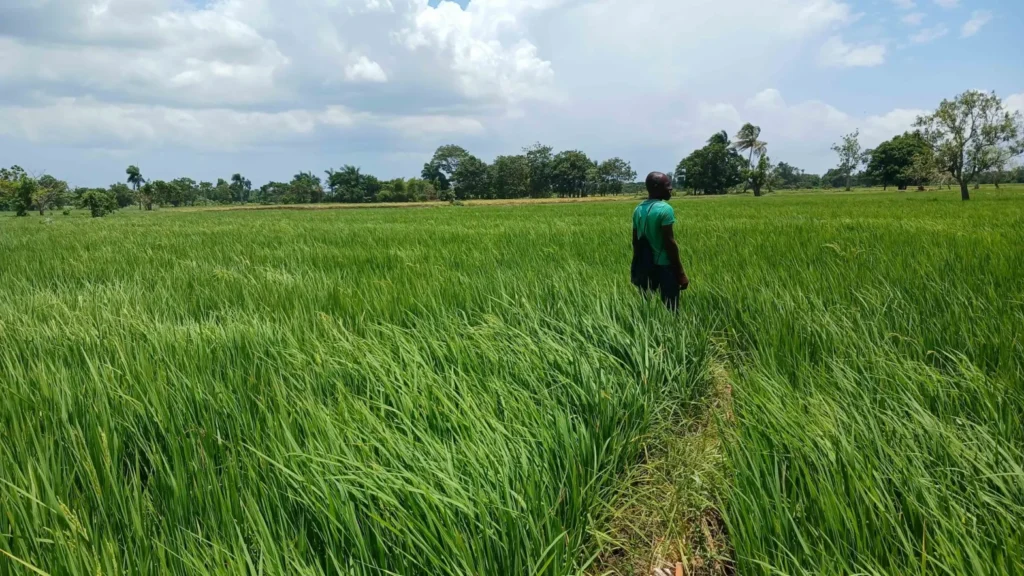
A farmer in the rice fields in the Maribaroux plain
The tense relationship between the Dominican Republic and Haiti goes back to both countries’ founding. After freeing themselves from French slavery in 1804, Haitians crossed over the colonial border into the modern-day Dominican Republic to end colonial rule and declare independence. The Dominican planter class staged a coup d’etat in the mid-1800s, declaring an independent Dominican Republic that aligned itself with its former colonial master and European interests.
Today, these border conflicts have created long-standing tensions over land and water for both Haiti and the Dominican Republic’s shared territory. At Dajabon River in northeastern Haiti, a struggle for water access underscores the shadowy operations of the Israeli Occupation’s national water company.
Dajabon River, otherwise known as ‘massacre river,’ has a deep history in the web of Dominican-Haitian relations. The river was the site of Dominican dictator Rafael Trujillo’s infamous anti-Haitian massacres throughout the 1930s. Situated at the border, the river has recently become one site of crossings of Haitian immigrants into the Dominican Republic, where Dominican immigration police routinely arrest and deport suspected Haitian migrants. In 2023, disputes at the river led the Dominican Republic to close and militarize the border crossing; crossings remain militarized to this day.
Haiti and the Dominican Republic have a framework for dealing with such conflicts. In 1929, Haiti and the Dominican Republic agreed to a ‘Treaty of Peace, Friendship, and Arbitration’ to manage disputes and share resources. The treaty, following a 1777 treaty between former colonial powers France and Spain, establishes the Dajabon River as a border between the DR and Haiti. Article 10 of the 1929 treatyexplicitly calls for arbitration between Haiti and DR at Dajabon on the issue of water: “because rivers and other watercourses arise in the territory of one State and flow through the territory of the other or serve as boundaries between the two States, both High Contracting Parties undertake not to carry out or consent to any work likely to change the stream of those or altering the product of their sources”. The Dominican Republic defended its unilateral decision to close the border at the 78th United Nations General Assembly, wherein the Dominican president accused Haiti of treaty violations with Haiti’s construction of a canal at Dajabon.
The canal at Dajabon is a first-of-its-kind project. While the Dominican Republic has ten such canals on the Dominican side of the Dajabon River, for the purposes of irrigation and potable water, Haiti has none. Lack of irrigation has turned the soil on the Haitian side of the border arid, and exacerbated the island-wide food crisis. To combat this, Haiti launched a project constructing a canal in Ouanaminthe, along the Dajabon River.
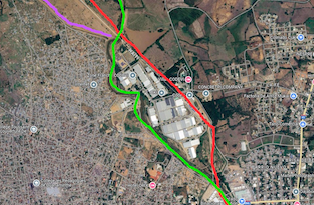
Image of the Dajabon border area. The red line is the Dominican border, the purple the projected canal.
The project was first pioneered by a combination of Haitian civil society, farmers, and engineers from Haiti’s department of agriculture. In compliance with the 1929 treaty, Haiti went to the Dominican Republic to discuss sharing the water of the Dajabon River. Designed in 2011 by the Cuban state engineering company DINVAI, the canal would be Haiti’s first-ever extraction from the river. However, in spite of the Dominican Republic having ten such canals within its own territory, the Dominican government refused each time: in 2013, 2015, and 2017. Undeterred, the Haitian project moved forward in 2018, but was halted in 2021 following the assassination of Haitian president Jovenel Moise.
This did not stop the Haitian people. In August of 2023, a grassroots movement of workers – volunteers, farmers, diaspora donors, and community members – arrived at the construction site.
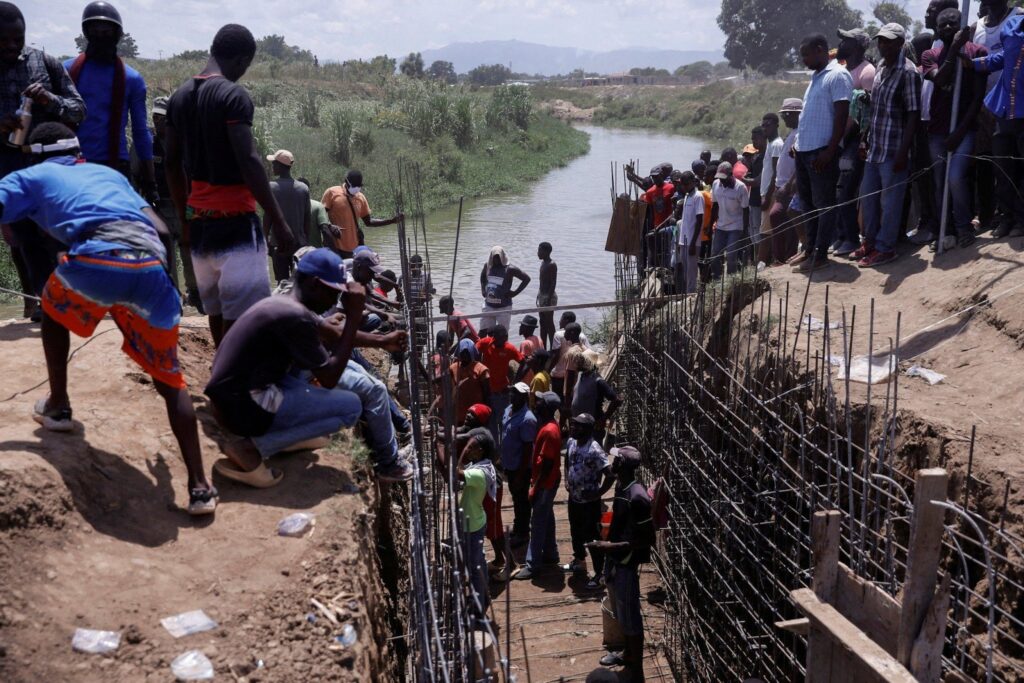
Haitian volunteers work on the Ouanaminthe canal.
Dominican response came swiftly: The Dominican Republic launched a project to dam the river in Dominican territory in September of 2023. This dam directly bypasses the 1929 agreement between DR and Haiti, giving the Dominican government a unilateral instrument to enforce its will. If Haiti does not comply with the Dominican government’s directives, the DR can completely shut off water access to Haiti. During the dry season, the river flows 4.2 cubic meters per second, Dominican extractions already total 3.22, and the Haitian canal adds 1.5, meaning total withdrawals would exceed the mean dry season flow entirely. The dam gives the DR a chokehold precisely when water is scarcest.
Haitian farmers were undeterred by border closings and the dam’s construction, and the Haitian grassroots coalition completed construction on its canal in 2024. The project was lauded by Haitian writer Edxon Francisque, claiming that it is “beating all expectations in record time.” The project has sparked economic growth, increasing local farmers’ incomes by over 35% since its completion, and providing home-grown rice to Haiti’s embattled food system. In spite of intense Dominican pressure, the project became a resounding success for the Haitian people’s food and water sovereignty.
Haitian writer Maismy-Mary Fleurant describes the Dominican response to the canal as an example of ‘hydro-hegemony,’ heavyhanded use of force to control natural resources: “If the international custom and the fundamental principles of the international right to rivers and lakes provide for an equitable, reasonable and non-harmful use of common water resources, it turns out that many States that share an international watercourse want to establish a hegemony in their use of the resource for their own benefit, to the detriment of others taking advantage of their geographical position, their economic, political or military power, or even the appropriation of a historical continuum in a logic of first user-owner (Duhautoy, 2014).”The project’s specifications are a clear violation of this international right.
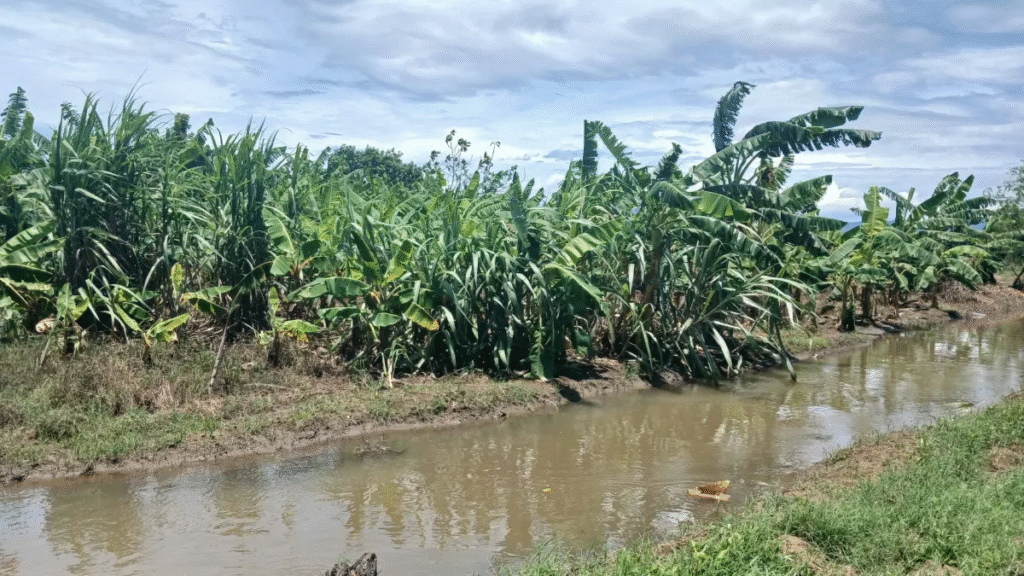
Excess water in the banana fields of Dajabon’s plains
There’s only one problem: the Dominican Republic shares a watershed with Haiti. Unilateral actions on one side of the island’s ecology can have drastic effects on the other side of the island. And the pretext for the DR’s operation is not collaboration, but control.
While this was happening, the Dominican Republic negotiated with an Israeli Occupation-run water corporation to design the future of the Dominican Republic’s water access. Regarded as a ‘first-of-its-kind deal,’ the Israeli Occupation corporation has negotiated a contract that is unusual both in its scope and its implications across the region. Mekorot is an entity wholly owned by the Israeli Occupation, not a private engineering firm; its contract with the Dominican Republic is also an act of diplomacy on behalf of the Zionist state.
The scope of Mekorot’s contract is also unusual. In other countries, Mekorot has negotiated smaller-scoped agreements for desalination, wastewater management, and other water-supply concerns. In the Dominican Republic, Mekorot is responsible for the whole-systems development of Dominican water systems. This includes a thirty-year master plan for Dominican waterways, desalination, wastewater, and civil/government water access. Also irregular is the scope of confidentiality for a public water contract. Several Dominican civil society groups challenged the government’s agreement with Mekorot in court. The legal challenges revealed that the proposal came directly from Israeli Occupation diplomats to the Dominican government, bypassing any bidding process entirely and violating Dominican law. As a result, the contract is in jeopardy, but it is not the only one that the Dominican government has negotiated with Israeli Occupation parties.
This contestation has not stopped collaboration between DR and the Israeli Occupation on the issue of water at the Haitian border. At the southern border, in the Pedernales province of the Dominican Republic, the Israeli Occupation announced in 2024 its donation of a massive water filtration system at the El Banano river to supply Dominican troops at the Haitian border.
However, water is only one element of militarized cooperation with the Israel Occupation at the Dominican border. Zionist military technology and training loom overhead. For the past six years, the Israeli Occupation has offered extensive military cooperation to the Dominican Republic’s brutal anti-Haitian military and police units. In 2019, Israeli ambassador Daniel Biran offered military technologies – including drones, satellite surveillance, and other undisclosed technologies – explicitly to combat Haitian migration.
In November of 2020, the Israeli Occupation Embassy conducted a joint training operation between Dominican national police and special forces of the Dominican military. Further, the Dominican government’s notorious Military Police have been trained and equipped with Israeli weapons. The Israeli regime’s history of selling weapons to the Dominican Republic stretches back decades, wherein Israel reportedly sold weapons to dictators Trujillo and Balaguer, even after the Dominican Republic’s crimes against the Haitian people were exposed to the world. Together, these agreements constitute a security partnership that has deepened significantly under Abinader, placing Israeli Occupation military infrastructure at the heart of Dominican border enforcement against Haiti.
What is happening at the Haitian border, at Dajabon, is nothing short of water apartheid. Both the Dominican Republic and the Israeli Occupation know this from experience. Mekorot has been repeatedly condemned internationally for its practice of draining Palestinian waterways – the Dominican Republic’s plan to do the same coincides exactly with the country’s contract with Mekorot. In addition, the Zionist regime is providing technology, training, and arms to the Dominican Republic with the aim of influencing Dominican border policy. This is more than mere diplomacy – the Israeli regime is exporting apartheid to the Dominican Republic, in a coordinated attempt to assist and profit from the Dominican Republic’s ‘hydro-hegemony’ in the region.
As both Dominican and Haitian grassroots organizations challenge the Dominican military establishment’s hold over resources across the island, the Israeli Occupation works across diplomatic channels to strengthen the Dominican government’s strong-armed tactics. Diplomacy is legally required under both international law and the framework of the DR and Haiti’s 1929 treaty – but while Israel arms, backs, and trains one side for a brutal border confrontation, diplomatic resolution remains out of reach.
Beyond the legal implications of one country weaponizing its water supply against others, the strangulation of a neighbor’s water is a moral problem. In the Holy Quran, water is described as the foundation of all life. “And We have made from every [living] thing water,” Quran 21:50.
Water is a sacred resource to be treasured and shared with neighbors, not hoarded for the sake of greed and manipulation. The Prophet Muhammad SAW once said: “The best charity is giving water to drink.” Ali RA embodied these beliefs during a battle against Muawiya. When Ali’s forces seized a critical well prior to a battle, Ali RA allowed the enemy’s forces to drink from it. Even with one’s enemies, water is meant to be shared.
Joshua Reaves Charmelus is a husband, writer, and grassroots internationalist. He uses political and historical analysis, photography, and speculative fiction to practice the unity of study and struggle that his political ancestors modeled.”
From Vox Ummah via This RSS Feed.