

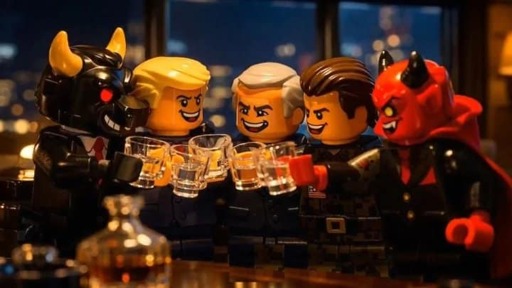
At times, the war between the United States, Israel, and Iran seems to be fought less on the battlefield than in the realm of perception. What the diplomatic cables released by POLITICO reveal is not just a temporary deterioration of Washington’s image, but something deeper: a growing asymmetry in the ability to shape the global narrative, where Iran is gaining unexpected advantages through the intensive use of a digital ecosystem based on artificial intelligence.
Far from classic propaganda, Iran’s communication strategy combines speed, adaptability, and a keen understanding of local audiences. Memes, AI-generated satirical videos, and social media campaigns not only challenge U.S. actions but also ridicule its leaders, eroding their symbolic authority. The case of the “Lego”-style videos produced by the firm Explosive Media — which garnered millions of views before being taken down — illustrates the extent to which humor and digital aesthetics can become effective political weapons.
This approach contrasts with the rigidity of the U.S. communications apparatus. According to the cables, Washington’s embassies have been instructed to limit themselves to repeating official messages, with no leeway to adapt content to local contexts. In a saturated and dynamic media ecosystem, this lack of flexibility amounts to a tactical retreat. Moreover, the internal climate under the Donald Trump administration—marked by centralized decision-making and an emphasis on loyalty—has fostered caution and even paralysis among diplomats, weakening the ability to respond in real time.
The impact of this communication gap is evident in three key scenarios: Bahrain, Azerbaijan, and Indonesia.
In Bahrain, a historic ally and home to the U.S. Fifth Fleet, the Iranian narrative has succeeded in sowing doubts about Washington’s commitment to Gulf security. The perception that the U.S. prioritizes the defense of Israel over its Arab partners has gained traction, amplified by social media that portray the U.S. military presence as a risk rather than a source of protection. The absence of an effective counter-narrative has allowed these ideas to take root even in a traditionally controlled media environment.
In Azerbaijan, where relations with Washington had been improving following a recent peace summit, the shift is more subtle but significant. Local media have moved from neutral or positive coverage to a critical stance, questioning the lack of a U.S. strategy in the conflict. Here, Iranian messaging has not necessarily generated sympathy for Tehran, but it has contributed to eroding U.S. legitimacy, which in geopolitical terms can be equally decisive.
The case of Indonesia is perhaps the most concerning for Washington. As the country with the world’s largest Muslim population, its public opinion carries considerable symbolic and strategic weight. There, Iran has deployed a sophisticated campaign that combines appeals to Islamic solidarity with anti-colonial narratives, portraying the U.S. and Israel as imperialist powers. The use of innovative formats—such as Morse code messages or interactive content—demonstrates a capacity for experimentation that contrasts with the static communication of U.S. embassies.
The risk, according to the diplomats themselves, is not so much that populations will fully embrace the Iranian vision, but rather that anti-American sentiment will reach levels that limit the room for maneuver of allied governments. In Indonesia, for example, this could result in reduced security cooperation, even when shared strategic interests exist.
In this context, the war of narratives takes on a structural dimension. Iran, despite its economic and military limitations compared to the United States, has found in digital communication a force multiplier. Its ability to operate across multiple platforms, adapt to diverse cultural codes, and exploit the adversary’s weaknesses allows it to compensate for other disadvantages.
For Washington, the challenge is not merely communicational: it is a manifestation of its growing loss of soft power. For decades, the United States dominated the symbolic arena through Hollywood and its cultural industries. Today, however, even in that arena, it is Iran that is gaining the upper hand. If drones and missiles pierce the U.S. security umbrella in the Persian Gulf, their effects are amplified on the symbolic level: every viral meme and every Iranian satirical video contributes to cumulatively eroding the credibility of the American superpower. The gap between its material power and its capacity for persuasion is becoming increasingly visible.
Originally Published in Spanish on April 19 in La Izquierda Diario
The post Another Front in the Asymmetric War: Iranian AI Vs. the U.S. Narrative appeared first on Left Voice.
From Left Voice via This RSS Feed.