


Listen to this article
0:00
/946.780522
1×
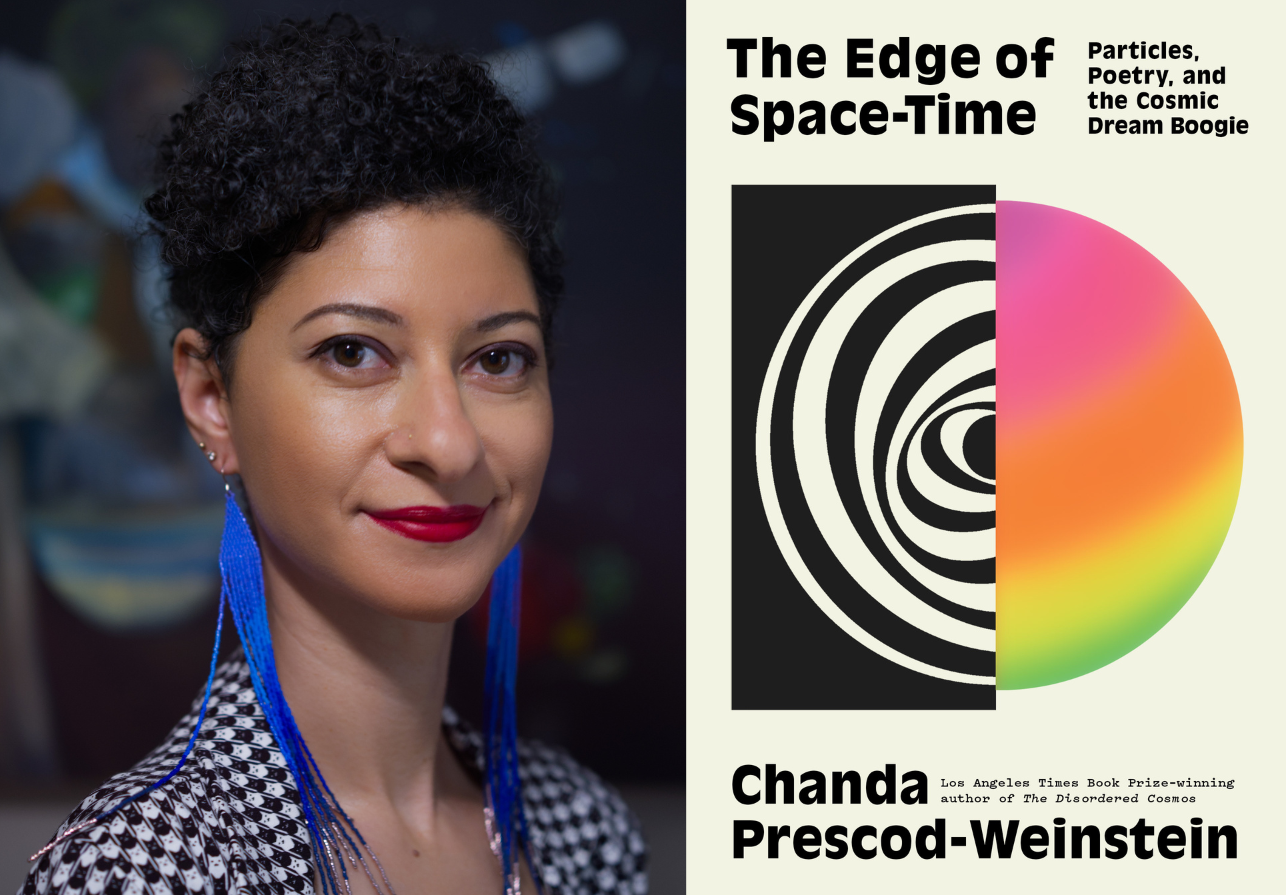
Do you ever feel like your imagination is being pummeled by an endless churn of bad news? Depressing headlines, hateful rhetoric, and dire predictions can leave us locked in a cycle of painful reaction. How can we envision a way forward without minimizing the harsh realities of the present? Chanda Prescod-Weinstein’s new book, The Edge of Space-Time: Particles, Poetry, and the Cosmic Dream Boogie, offers an unexpected answer. On its surface, this is a book about physics—quantum mechanics, black holes, and dark matter. But it’s also a profound exploration of how we think, and the possibilities that emerge when we reject the limits imposed on our imaginations.
Prescod-Weinstein, an associate professor of physics and astronomy at the University of New Hampshire and core faculty in women’s and gender studies, brings a unique perspective to both cosmology and social justice. Her research spans theoretical physics and Black feminist science studies, and in this book, she takes readers on a cosmic journey that connects neutron stars to poetry, quantum theory to pop culture, and our place in the universe to our struggles here on Earth.
This week, I caught up with Prescod-Weinstein to discuss curiosity and cosmic wonder, the mythology of genius, Deep Space Nine, and how to think beyond false narratives and manufactured inevitabilities.
This interview has been lightly edited for clarity.
Kelly Hayes: In a moment shaped by fascism, genocide, and climate crisis, what does it mean to you to be a cosmologist? Has this period changed how you think about your work, your responsibilities, or what science is for?
Chanda Prescod-Weinstein: I’m writing against despair. A sense of the big, of the wonders of the cosmos, and also the strange, like quantum theory, reminds us that the universe still holds curiosity and possibility for us. My thinking about cosmic science in this particular moment is shaped by something my mom told me, that people need to know that the universe is bigger than the bad things that happen to us. My mom, Margaret Prescod, has spent her whole life organizing, but as she said to me while I was starting work on The Edge of Space-Time, “Without joy, what the fuck is the point?” Joy is part of how we refuse the totalitarian function of dystopian politics. I was on a panel recently with Kate Marvel, who trained as a cosmologist but is now a climate scientist, and she said that cosmology helps her remember why Earth is worth saving. Every other planet we’ve found with astronomical observation is a trash planet compared to Earth, at least when it comes to habitation. I thought that was a good point, too.
KH: Well, I want to note that, two chapters into The Edge of Space-Time, I hurriedly bought another copy to share with someone I love, because I feel like this book is doing something very important, particularly for people being captured by false narratives, false binaries, and manufactured inevitabilities. It offers a chance to think expansively about the universe in ways that can help set our minds loose. But before I go on too much about why I think people should read this book, I want to ask: what did you want this book to open up for people? What kind of conversation, or shift in perception, were you hoping to facilitate?
CPW: One of the ways that authoritarianism works on us is by foreclosing on imaginative possibilities. Thinking about the fundamental nature of space-time, the quantum physics of particles, and the idea of quantum gravity resists that foreclosure. We know how to use space-time as a concept, but we don’t really understand it, metaphysically. The fact that anything happens at all—that shit happens—is kind of odd when you think about it. Even when a region of space is completely empty, it’s still filled with energy, and we don’t really know how to account for what we measure. All these really basic things that we don’t understand, which call out to us to use our imaginations—to recognize that the edge of what we know isn’t actually all there is to know. That part is important: knowing there is more to the universe than we’ve been told. Plus, what we do know is so fucking weird. Like neutrinos are non-trinary! There are three kinds of neutrinos, and they randomly oscillate between those three flavors. Why? We don’t know. But we know somewhere in nature, there is a non-trinary thing, hardwired into the universe’s basic building blocks.
KH: This book feels committed to wonder, but it never asks readers to become less politically alert in order to access that wonder. I was really struck by the way you frame cosmic inquiry as entangled with grief, struggle, and defiance rather than separate from them. Can you talk about that?
CPW: The cosmos is an important part of every community’s natural environment and ecosystem. Every community has star stories, and every community has, in its own way, concerned itself with mathematical patterns that seem to track with physical phenomena. In this sense, cosmic inquiry is an ancestral inheritance, and I wonder about who we are when we are alienated from that. The Edge of Space-Time takes seriously the idea that we need to be attuned to physical cosmology as a matter of being in conversation with our ancestors. Who are we to refuse their wonder about the cosmos? To say that this multigenerational, multi-millennial wonder is not profoundly meaningful? As a member of the Black Atlantic diaspora, I don’t see how we are entitled to ignore that legacy.
Another part of the story I wanted to tell in The Edge of Space-Time is that cosmic science can be part of how we stay politically alert. Because physics challenges our sensibilities about what is normal and how things work, it encourages us to use our critical faculties and hone our ability to engage with the abstract. I’m really inspired by The Algebra Project, which focuses on the idea that learning algebra is a civil rights issue. This is not just because of the job opportunities it opens up, but also because of the importance of knowing how to navigate symbols and metaphors. The struggles we are facing involve big, sprawling systems. They are hoping we don’t have our wits about us, can’t analyze what they are doing. Being with physics gives you a safe place to exercise parts of our brain that we need to be sharp.
KH: I was especially fascinated by your engagement with Natasha Trethewey’s essay and with Robert Frost’s assertion that “You are not safe in science [and] you are not safe in history” unless you are at home in metaphor. I had never encountered that quotation or Trethewey’s essay before, and as someone who studied creative writing and poetry when I was young, I found myself deeply moved by this idea of a “poetical education” in metaphor. I have long felt that my engagement with poetry, and learning to write poetry as a young adult, shaped the way I engage with everything from organizing to journalism. Can you talk about what Frost and Trethewey’s words opened up for you, and about how you think metaphor shapes the way we move through science, history, and the world?
CPW: I really feel that those two essays were life-changing for me. I was reading Trethewey’s essay in a book edited by Jericho Brown, How We Do It. It’s a collection of Black writers talking about the craft of writing. I was so caught off guard that I suddenly found myself plunged into a discourse on science, race science, and the relationship between science and poetry. Around that same time, Katherine McKittrick insisted that I had to read Aimé Césaire’s essay “Poetry and Knowledge.” I was trying to work through what I liked and didn’t like about the hard boundary he drew between physics and poetry. I found myself disagreeing with him about what physics did and whether it was at all different from poetry. And I realized this was a political perspective.
Physics, when it is oriented toward serving the notion that “man dominates over nature,” gets away from poetics. But when we refuse that kind of hierarchical relationship between different parts of the ecosystem, the distinction collapses, and it becomes a matter of technique. Trethewey, Frost, and Césaire made me realize that education by cosmos is its own kind of education by metaphor, because equations operate like metaphors. Trethewey’s essay also pushed me to ask myself which abiding metaphors had shaped me intellectually as a young physicist and might shape the boundaries I set for myself.
KH: I appreciated your discussion of Star Trek, and I really related to the place it holds in your imagination in relation to space. This year actually marks the 60th anniversary of Star Trek, and I am a big enough nerd to get hyped about that. I also appreciated that you mentioned Deep Space Nine, my favorite Trek series, more than once in the book. And I just knew the show had to come up, because if we’re talking about space and time, and how we understand ourselves in relation to those things, of course, we have to talk about the show where a Black man explains trauma and linear time to a bunch of god-like noncorporeal beings who live in a wormhole. As my longtime readers and listeners know, I watched that show as a young person, and it had a profound impact on me. So I just want to ask, one nerd to another: what stories or moments from DS9 still inspire you, or stoke your curiosity? And what DS9 character do you wish were here today to help us fight Nazis?
CPW: To the last question: this is a tough one. We need Major Kira Nerys (Nana Visitor), but also we need Captain Benjamin Sisko (Avery Brooks), the Emissary. Each, in their own way, is a warrior who must learn to make peace, but not at the expense of justice. Maybe I will cop out and say I think Garak (Andrew Robinson), the tailor, could be really useful, actually. I have a soft spot for Loki-like chaos actors.
DS9 interests me in part because I think the writer’s room knew they were writing not just about Ireland and The Troubles, but also Israel and Palestine. They also knew they were writing about Black liberation and understood they were pushing a bit in queer directions too. They also understood they were dealing with queerness, even though Ira Steven Behr has said he regrets not fighting harder with the studio to make that more manifest in the show. The show captures, deeply, the importance of resisting oppression and challenges us to think about how we judge violence and evaluate what constitutes “peace.” And actually, it shows that the Federation is flawed, that there are limits to the liberal humanist theories that underpinned Star Trek as a franchise. I think it is also one of the best representations of how religion might fit into a larger physical schema—what we interpret as the supernatural might be what we are yet to understand. The Prophets are such fascinating characters.
KH: In your note on “great” men of science, you argue that people historically associated with important intellectual work should not be mythologized or made to seem singular or uniquely chosen. That felt deeply connected to something we are witnessing in the present, which is that some of the most powerful people wreaking havoc and destruction right now are allowed to wear the cultural costume of genius, visionary thinking, and historical destiny, often with science-fiction-inflected fantasies attached. Some people’s harms are erased by the work they wear, and some people are simply allowed to wear the mystique of great work. You also write a bit about the billionaire class in The Edge of Space-Time, and about what they have laid claim to. Could you talk about this idea of genius, about what it shields, and about who has been allowed to invoke it, historically and in the current moment?
CPW: First of all, Elon Musk is not some kind of technical genius. If he’s good at anything, it’s surrounding himself with people who are good enough at technical stuff to carry him along. In that sense, he is simply an inferior villain to a morally bankrupt J. Robert Oppenheimer, who was actually technically highly proficient. In both cases, they had substantial social and economic capital, which made it easier for them to succeed in their endeavors. But even if someone wants to debate me about Musk’s scientific skill set, the main point is that being really good at something doesn’t make you a really good person, or a person with good values, or a person with the nerve to live those values. Oppenheimer was actually educated at the Ethical Culture School. But in the end, he was also a guy who apparently tried to poison one of his instructors at Cambridge. And his parents sailed to England to clean up that mess. And because they did, he got to go on and have an incredible academic career before helping to build one of the worst technological creations humans have ever imagined. That whole story should give us pause—though sadly, I don’t think the Nolan film encourages us to ask the right questions.
Scientists are not apart from humanity. We are people. And in some cases, we are people wielding a lot of power, but rarely with any training to evaluate what to do with it or whether that distribution of power is right in the first place. We can and should judge individuals for their moral failings, but it’s a structural problem too.
KH: In the book, you write, “Physics is a practice of struggling to get answers—and always finding new questions among the ways in which our relationship to the cosmos can be part of our boogie-woogie rumble: our challenge to a dream deferred.” Can you say more about that, and about the kinds of questions you hope readers will keep asking after they put this book down?
CPW: I hope people will allow themselves to be curious about all kinds of things. Don’t say, “Oh well, I’m not smart enough to be curious about that.” Let yourself be curious, including about what rhetorical choices political actors are making. Be curious about hope and the function of despair. Ask questions when someone says things are natural or the way that things just have to be. Push on those boundaries and look past those edges to see if there’s something else, something better on the other side. And get worried if you stop being curious. We don’t know what 96% of the matter-energy content of the universe is. So let’s take that as a proxy, the suggestion that actually, we don’t know most things. If you’ve gotten to the point where you think you’ve got it all worked out, you’re probably wrong.
We are in a fucked up situation right now. It’s been bad for a while, and the circle of people it is bad for has widened. And the ways in which it is bad have broadened. It is easy to give in to despair, but now more than ever, we have to be curious and imaginative about how we might get out of this. We owe it not just to the ancestors, who did their part in the fight, making sure we would have a chance to live and thrive in the ways that we occasionally do. We also owe it to the generations that will come after us to do everything we can. And part of the task before us is to teach them the power of wonder and the importance of joy. Because living in good relations with each other is the point, and I believe wonder and joy are part of good relations.
Organizing My Thoughts is a reader-supported newsletter. If you appreciate my work, please consider becoming a free or paid subscriber today. There are no paywalls for the essays, reports, interviews, and excerpts published here. However, I could not do this work without the support of readers like you, so if you are able to contribute financially, I would greatly appreciate your help.
Sign up for Organizing My Thoughts
Subscribe
Email sent! Check your inbox to complete your signup.
No spam. Unsubscribe anytime.
From Organizing My Thoughts via This RSS Feed.
She’s so real for that. Sometimes it is quite striking how little we know.
