


Sandra Hale Schulman
ICT
The latest: Tragedy and history in an outdoor play, robes tell tales, Dene Earth lessons
THEATER: Miccosukee actor stars in long-running historical drama
Conflicting cultures of Spanish and Native Americans, fiestas and powwow dancing, shootouts on horseback, and a tragic love story all come together in a stunning outdoor hillside amphitheater village in the show, “Ramona,’’ at the Ramona Bowl Amphitheater in Hemet, California.
The story, based on a novel by Helen Hunt Jackson published in 1884, was turned into a play that is still relevant with themes of racism, colonialism, religious oppression and a tangled love story. It is the longest-running outdoor drama in the nation, having run since 1923.
The production will complete its 103rd season this year with final performances on April 24-25 and May 2-3 at the amphitheater, which is set in a village with a cantina, gift shop and historical museum.
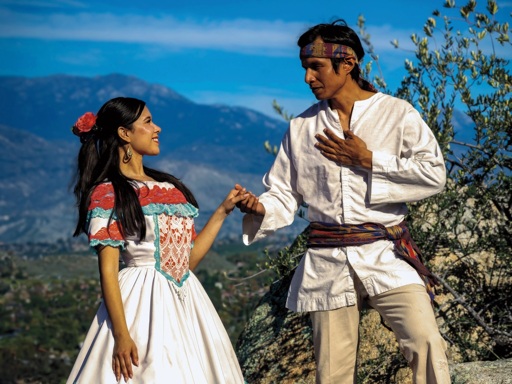
Ramona, played by Shirley Casillas, is an orphaned half-Native and half-Scottish girl, adopted by a Mexican-American woman. Ramona meets Alessandro, the son of the chief of the Temecula tribe played by Miccosukee actor Montana Cypress. Fun fact: Raquel Welch (then known as Raquel Tejada) played Ramona in 1959.
She falls in love with Alessandro and runs away with him, in defiance of her disapproving family. They have a child who falls ill, and Alessandro is shot to death after borrowing a White colonizer’s horse to get help.
The storyline follows many historical trails and features a cast of hundreds in vibrant costumes with a traditional fiesta dance scene with music by the Arias Troubadours in Act One, and then a colorful powwow with drummers in Act Two.
So how did Cypress land the reading role?
“In 2024, I was recommended to director Duane Menard, Paiute/Yurok, who knew me from Native Voices play series at The Autry Museum,” Cypress told ICT. “I’ve directed him in one of my films, and now he’s directing me in this. It’s challenging. I’m not a horse rider — my tribe is in the Florida Everglades with alligators not horses — so I had to go to the cowboy ranch and get training. It was a little scary because of all the elements of the outdoor set that goes way up a rocky hillside with real rattlesnakes, lizards and hawks that dwell there, but I felt ready.”

The long-running outdoor historical drama, “Ramona,” based on an 1884 novel by Helen Hunt Jackson, continues in its 103rd season in 2026 at the Ramona Bowl amphitheater in Hemet, Californiam with final performances April 24-25 and May 2-3. Credit: Courtesy of Ramona Bowl Amphitheater
Cypress is commanding as Allesandro with his tall, lanky build, athletic skills and authoritative voice. He even gets a dance scene with Ramona at the powwow. For him, it is all a learning experience.
“This is about the Mexican ranches, the Temecula Indians, the trade alliances, but still lots of separation in terms of class,” he said. “I’m learning as I go.”
The crowd on opening weekend of April 18-19 was wildly receptive, laughing, clapping and gasping along with the play’s drama, then lining up to meet the cast afterward.
Cypress recently spent a month in London studying Shakespeare. He credits that and his film training for the role and “saying this non-realistic dialogue in a realistic way.”
“We have to exaggerate physically more, like a silent film because of the expanded outdoor space,” he said. “We have to move, we have to run. There are live horses charging down the hills. It feels good rushing in on that horse. It’s cool.”
ART: Haida robes tell stories
Elaborate detailed robes made from beads, hides and blankets in will be on on display in an exhibit, “I Use My Haida Eyes: The History Robes of Jut-ke-Nay–Hazel Wilson,” will be on display from May 14-October 12 at The Museum of Anthropology at the University of British Columbia in Vancouver.

Haida artist Jut-ke-Nay–Hazel Wilson models a fur robe about 1985. Wilson, who died in 2016, created dozens of robes that tell the history of the Haida people. Her work will be exhibited May 14-Oct. 12, 2026, at the Museum of Anthropology at the University of British Columbia in Vancouver. Credit: Photo courtesy Robert Kardosh via Museum of Anthropology
The exhibit features 50 “history robes” by Jut-ke-Nay–Hazel Wilson(1941–2016), a Haida artist who created a series of robes in 2005-2006, to document episodes of history from a Haida perspective. The robes include narratives of her Haida ancestors, settler acts of oppression, and Wilson’s memories of childhood, gathering and harvesting in Haida Gwaii.
Drawing on the techniques of traditional “button blankets,” Wilson’s works are focused on history painting and folk art.

This history robe, “All the Nations Came Together (Putting Away the Magic)” by the late Haida artist Jut-ke-Nay–Hazel Wilson (1941-2026) shows Haida and other Indigenous women hiding their ‘‘magic”from settlers. Credit: Photo courtesy Museum of Anthropology/University of British Columbia
“I was filled with wonder when I first encountered Hazel’s series of history robes, as they pull you into Hazel’s world, and are innovative and unexpected in their form,” exhibition curator ɬəkʷəlqinəm–Jordan Wilson said in a statement.
“They have an intimate and moving quality, while being far-reaching in their historical depth,” Jordan-Wilson said. “Twenty years after its creation, this body of work continues to resonate, particularly in depicting a Canadian colonial history whose legacies Indigenous peoples and settlers alike have inherited.”
Each robe is accompanied by text the artist wrote by hand, describing the historic episode portrayed, ranging from the pre-contact period to the 1950s. Robes of particular note include “Guidance,” which portrays the moment where Wilson bears responsibility for carrying forward Haida culture through the button blankets; “The Mistake,” depicting the the Haida people’s first encounter with European explorers; “All the Nations Came Together (Putting Away the Magic),” which shows Haida and other Indigenous women hiding their ‘‘magic”from settlers; and “Tiiyaan,” depicting a tranquil evening scene of Wilson’s ancestral village.
“The series also portrays the Haida peoples’ deep and ongoing connection to their territory. In bringing together this full series for the first time,” the curator said. “This exhibition opens up a larger conversation about Indigenous values and environmental stewardship within our capitalist society’s extractive approach to land and resources.”
MOA will celebrate opening night of the exhibit on Thursday, May 14, from 6-9 p.m., with free museum admission.
BOOKS: Mind your Mother

A new book, “Mother Earth is our Elder,” by award-winning Dene activist and writer Katłı̨̀ą, offers Indigenous ways to protect Mother Earth from destruction. Credit: Courtesy of HarperCollins Publishing
Award-winning Dene activist and writer Katłı̨̀ą teaches Indigenous ways to protect and learn from Mother Earth in a new book, “Mother Earth is our Elder:” The book emphasizes a relationship of elder respect for the planet, with a transforming worldview for the climate crisis.
The Dene in Canada’s Northwest Territories have been battling environmental racism while living a balanced life through individual and collective responsibility. The book brings together Dene elders and knowledge carriers on climate change for help with answers.
Topics include cultural burning and fire medicine; Dene laws and community resilience; sustainable living practices; generational justice and responsibility; the role of dreams in environmental awareness; redefining wealth and prosperity; Indigenous sovereignty and land protection; and healing through fire and land cycles.
The post INDIGENOUS A&E: ‘Ramona’ in amphitheater, button blanket robes, elder Mother Earth appeared first on ICT.
From ICT via This RSS Feed.