

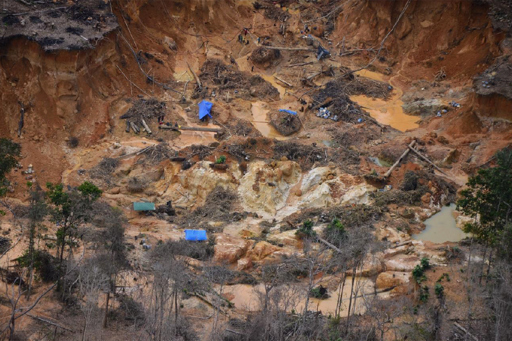
In July 2025, the Indigenous Shuar people celebrated the end of a decade-long struggle when they received official titles for three communities — the Shuar Tunants, Kampan and Tsuntsuim –- within the Kutukú Shaimi Protected Forest, in the south of the Ecuadorean Amazon. But in one of those communities, satellite imagery shows that between August and December 2025, a gaping hole appeared in the forest around a riverbend — a mining scar. Despite the Tunants territory’s newly formalized status, deforestation due to gold mining nearly tripled, reaching 2 hectares (5 acres) in size in the last three months of 2025, according to Amazon Mining Watch Panorama, a new quarterly report. The report shows that deforestation due to illegal gold mining continues to grow across the Amazon, threatening protected parts of the rainforest. In total, 6,000 hectares (more than 14,800 acres) — about seven times the size of Central Park in New York City — of new mining scars appeared across protected areas and Indigenous territories over the last three months of 2025. This mining is presumed to be illegal, as most Amazonian countries have legislation prohibiting mining in Indigenous territories and protected areas, with experts warning that greater law enforcement is needed. Most of the deforestation caused by mining during that period took place in Brazil, with roughly 2,000 hectares (about 5,000 acres) of forest being cleared. This was followed by Peru with 1,700 hectares (4,200 acres), and Guyana with 900 hectares (about 2,200 acres). New mining scars were also…This article was originally published on Mongabay
From Conservation news via This RSS Feed.