


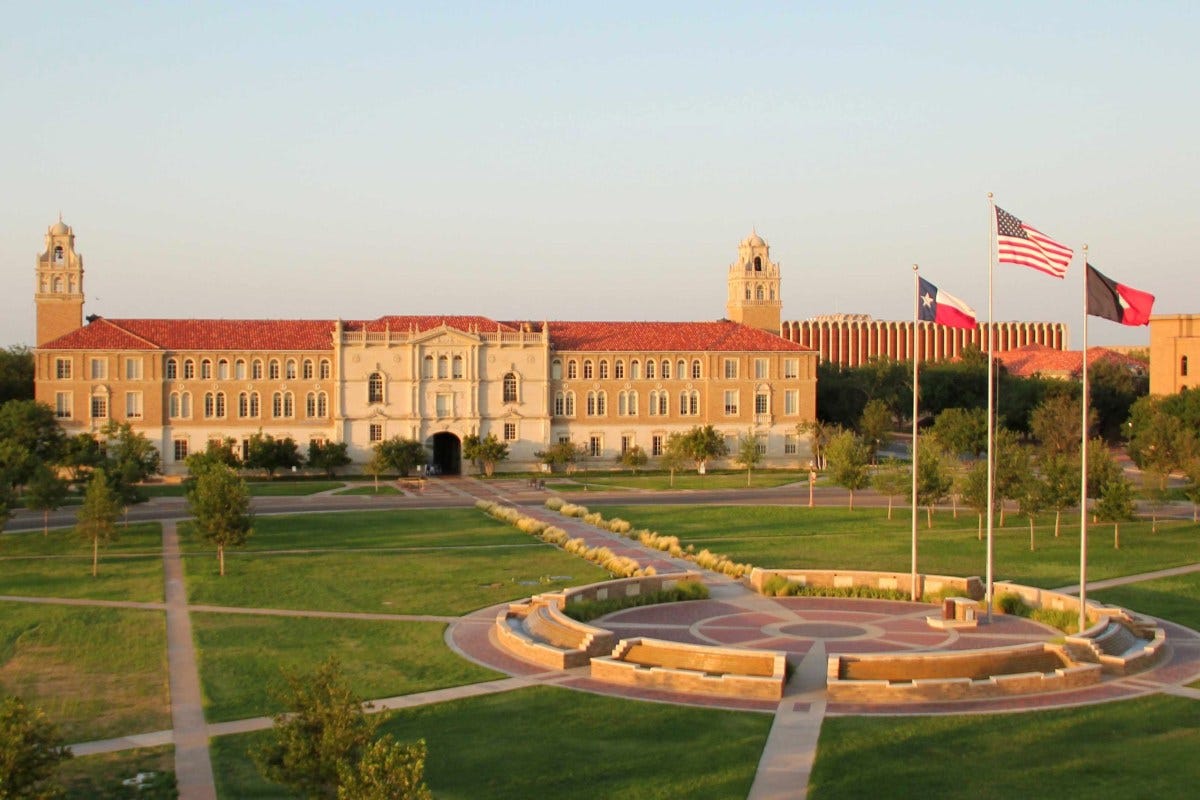
Texas Tech University
Erin In The Morning is a reader-supported publication. To receive new posts and support my work, consider becoming a subscriber.
A new memo at Texas Tech University establishes a sweeping and draconian censorship policy toward LGBTQ+ people, creating a campus equivalent of “Don’t Say Gay” in one of the most extreme anti-speech policies ever imposed at a public university. The memo bars professors from discussing LGBTQ+ topics in core and lower-level courses and eliminates entire fields of study across the five-university system. It even requires that if an industry-standard textbook includes content on sexual orientation or gender identity, instructors must skip over it and avoid discussion around it. Most troubling, however, is that the censorship regime extends beyond professors to students themselves: the memo states that "no degree-culminating student research within the TTU System will be permitted to center on SOGI topics,” a total ban on LGBTQ+ mentions in dissertations or graduate thesis work.
The memorandum, which was issued by Chancellor Brandon Creighton—a former Republican state senator who authored Texas’s ban on diversity, equity, and inclusion programs at public universities and a campus protest restriction law that a federal judge blocked as unconstitutional—went out to the presidents of all five universities in the Texas Tech University System this month. The system serves approximately 64,000 students across Texas Tech University, Angelo State University, Midwestern State University, and two Health Sciences Centers. Under the new policy, all majors, minors, certificates, and graduate degrees “centered on” sexual orientation or gender identity will be eliminated. Provosts at each university must identify every affected program and submit finalized lists to the chancellor’s office by June 15, 2026, at which point an immediate admissions freeze will take effect—no new students will be allowed to enroll in or declare any of the targeted programs. Currently enrolled students will be allowed to finish their degrees through a teach-out process, but once the last of them graduates, the fields will cease to exist at Texas Tech entirely.
The censorship policy directly targets all sexual orientation and gender identity content. “The Alternate Materials Rule requires that… in courses where course materials (inclusive of all assigned works, readings, case studies, peer-reviewed research, videos, etc.) are centered on or include sexual orientation or gender identity, alternate materials must be utilized,” reads the memo. “If instructors choose permissible works that do not center on or include these topics, instructor-led discussions, class assignments, and instructional materials must not focus on sexual orientation or gender identity.” Even passing mentions are policed: the memo instructs that “incidental references should be avoided” when selecting primary materials for core courses, and that if a history book or novel happens to include LGBTQ+ content, professors “must not highlight, assess, or allocate instructional time to it.” The memo adds that “there are no exceptions to the Alternate Materials Rule for core, undergraduate courses.”
The implications are profound—and at times border on absurd. In core and lower-level courses, there are no exceptions at all. A history professor course could not allocate instructional time to the Stonewall riots or the gay rights movement. If a U.S. history textbook includes a chapter on the AIDS crisis, the professor must skip it. An English professor assigning Oscar Wilde cannot lead a discussion of the trial and imprisonment that defined his later work and legacy. A professor teaching Virginia Woolf’s Orlando—a novel whose entire premise is gender fluidity—would appear to be in direct violation of the policy. A core literature class reading Walt Whitman’s “Calamus” poems could not explore their homoerotic themes. Sappho—the ancient Greek poet from whom the word “lesbian” derives—could not be taught with any meaningful analysis of her work’s content. A professor teaching Shakespeare’s Twelfth Night or As You Like It could not discuss the cross-dressing that is central to the plot, nor the long theatrical tradition of male actors performing female roles—because analyzing gender performance in Shakespeare would constitute allocating “instructional time” to gender identity themes. A political science class could not examine the Supreme Court’s ruling in Obergefell v. Hodges as anything other than a passing reference. A psychology professor in a core course could not discuss why homosexuality was removed from the DSM. Even a music appreciation course discussing Tchaikovsky or Freddie Mercury would need to avoid any sustained discussion of how their identities shaped their art.
The memo also imposes what it calls a “Two Human Sexes Requirement,” stating that “state and federal law and TTU System guidance dictate that only two human sexes, male and female, are recognized.” It goes further, declaring that “instructors may not teach that gender identity is a fluid spectrum, endorse the existence of more than two genders, or decouple gender from biological sex as a factual or scientific baseline.” There is a narrow carveout for intersex conditions—the memo says instruction on “chromosomal variations, Differences of Sex Development (DSDs), and intersex biological conditions is expressly permitted”—but even here, it adds that “faculty may not use these biological conditions to advocate for or validate sociological frameworks of fluid gender identities.” In practice, this means a biology professor could teach students that intersex conditions exist but would be barred from drawing the obvious scientific conclusion that biological sex is more complex than a strict binary. As Inside Higher Ed columnist John K. Wilson observed, the policy “is so extreme that it would seem to prohibit any professor (or any assigned reading) from asserting that trans people even exist, since that would mean recognizing ‘fluid gender identities.’”
Perhaps most draconian of all are the policies targeting graduate students. Under the memo, graduate students will be permanently barred from writing theses or dissertations centered on LGBTQ+ topics once current teach-out programs conclude. This is the first policy at any major American university system that extends content censorship to student work itself—not even Florida’s “Don’t Say Gay” law, which restricted classroom instruction in K-12 schools, attempted to dictate what students could write about in their own research. The memo states that “graduate theses and dissertations may only center on SOGI topics as a strictly temporary teach-out exception, explicitly limited to currently enrolled students completing their degrees within formally identified teach-out programs,” and that “upon the conclusive termination of all designated teach-out programs, no degree-culminating student research within the TTU System will be permitted to center on SOGI topics.”
Policies barring students from writing on specific topics at public universities have a long and well-established First Amendment history—and they almost always lose. In Keyishian v. Board of Regents (1967), the Supreme Court declared that “the classroom is peculiarly the ‘marketplace of ideas’” and that “the Nation’s future depends upon leaders trained through wide exposure to that robust exchange of ideas.” In Healy v. James (1972), the Court ruled that a public university could not suppress a student organization based on its viewpoint, holding that First Amendment protections apply with no “less force on college campuses than in the community at large." In Rosenberger v. Rector (1995), the Court struck down a public university’s refusal to fund a student publication based on its viewpoint, establishing that viewpoint discrimination at a public university is per se unconstitutional.
More recently, a federal court blocked Florida’s Stop WOKE Act—which imposed content restrictions on higher education strikingly similar to the Texas Tech memo—calling the law “positively dystopian” and holding that professors’ in-class speech is protected by the First Amendment. However, Texas Tech sits in the Fifth Circuit, which has proven to be the most hostile federal appeals court in the country toward LGBTQ+ rights and has consistently upheld restrictions that other circuits have struck down. Whether the Fifth Circuit would extend the same First Amendment protections to students and faculty challenging an anti-LGBTQ+ censorship policy remains an open and deeply uncertain question.
The policies have come under fierce criticism from faculty and academic freedom organizations alike. Jen Shelton, an associate professor of English who has taught at Texas Tech for 25 years, told the Texas Tribune, “I think the whole university has been betrayed. I think even the provost did not expect it to look like this.” Kelli Cargile Cook, a professor emeritus who founded Texas Tech’s Department of Professional Communication, said the policies at Texas Tech led her to cancel a class and draft a resignation letter. “I can’t stomach what’s going on at Texas Tech,” she said. A statement from the Texas Tech chapter of the American Association of University Professors (AAUP) decried the policies in a public letter to Creighton: "We have collectively dedicated many decades of our careers to Texas Tech, proud to be part of an institution where students learn and faculty teach in an environment of rigorous inquiry, open debate, and intellectual freedom. Under this policy, the Constitution of the United States of America is rendered irrelevant, academic freedom and the core mission of our university are sacrificed, and the Texas Tech University we knew no longer exists.”
The policy is already being implemented. Provosts at each of the five universities must submit finalized lists of programs to be eliminated to the chancellor’s office by June 15, 2026, after which an immediate admissions freeze will take effect. The memo also directs the TTU System to develop standardized syllabus templates so that “course materials can be efficiently evaluated by both students and component institution leadership and compliance teams”—creating a permanent surveillance apparatus for course content. Artificial intelligence has already been used to target hundreds of course materials, and further crackdowns are expected.
Erin In The Morning is a reader-supported publication. To receive new posts and support my work, consider becoming a subscriber.
From Erin In The Morning via This RSS Feed.