


This is a lightly edited excerpt from Robin Andersen’s The Complicit Lens: US Media Coverage of Israel’s Genocide in Gaza*, published by* OR Books.

Intercept (4/15/24)
How is information made legitimate, and when is it appropriate for journalists to introduce skepticism? What happens when only one side of a conflict is given the legitimate voice, always repeated and rarely questioned, even when those sources have proven many times to have promulgated lies?
Military studies scholars and analysts understand that there is always a long genesis of historical, political and economic factors that can eventually erupt into conflict. In many ways, US establishment media seemed unwilling or unable (but likely both) to narrate a more complex, historically accurate account of the war on Gaza.
The Intercept (4/15/24) reported that editorial directives at the New York Times and CNN, two of the most important news sources in the US, advised reporters to avoid certain “taboo” words, such as “genocide” and “massacre.” Yet between October 7 and November 24, 2023, the Times used the word “massacre” 53 times—referring to Israelis killed by Palestinians, but only once to refer to a Palestinian killed by Israel (Intercept, 1/9/24).
From November onward, as deaths in Gaza piled up, the Times habitually avoided using emotionally fraught terms for Palestinians. Another term, “ethnic cleansing,” was also barred from use, along with “refugee camps” and “occupied territories.”
As the Times source who leaked the directives said, “You are basically taking the occupation out of the coverage, which is the actual core of the conflict.”
US news outlets were crippled by these verbal restrictions, incapable of offering an accurate explanation of what was happening in Gaza by imposing such constraints on humanitarian language, and international principles and laws.
Islamophobic tropes
Media frames are based on underlying assumptions, articulated through familiar tropes that appear unquestioned in language and representation. Some stories are recognizable as reflections of beliefs and myths, and others are accurate renderings when accompanied by on-the-ground documentation.
Seasoned journalists entrusted to cover such a monumental conflict seemed not to be schooled in the differences. They failed to identify the history and uses of atrocity stories as propaganda, and showed no awareness of the use of Islamophobic tropes such as the “brutish knife-wielding Arab terrorist,” or the West’s long history of Orientalism and the hypersexualized Arab male, as identified by Edward Said.
Establishment media applied a “lawlessness” trope, identified by Rebecca Solnit (A Paradise Built in Hell, 2009) as a dictate of convention to blame the victims of humanitarian disasters, when in fact in such crises, she argued, communities come together to help one another. The lawlessness frame was used to direct the causes of starvation away from Israel’s engineered famine, and point the finger of blame at starving Palestinians, who were being shot by IDF snipers as they looked for food.
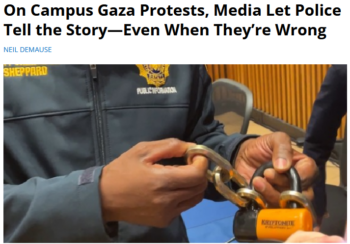
By April 2024, when police were called to break up student encampments, media relied on another powerful framing device, complete with its attendant language, to condone police violence against students at colleges and universities, first at Columbia, then at other campuses around the country. Campuses, they said, had been infiltrated by “outside agitators” (FAIR.org, 5/9/24).
Yet the critical debate articulated by student protests was part of American public discourse at the time. Though they were violently attacked by pro-Israel protesters and US law enforcement, students helped move American sentiment about the genocide to the center of cultural and political debate. By the fall of 2024, students would be hit by a wave of repression and attacks on their civil liberties and rights to freedom of expression.
Were these stereotypes taken into consideration when deciding which stories would be told, which talking points would be followed, and which perspectives would be ignored? Many of the narratives we are left with, used to explain this so-called “Israel/Palestine conflict,” are familiar media constructs and simply cannot explain a genocide.
Language of confusion
OR Books (2026)
In so many ways, big media failed to provide accurate information about Israel’s bombing attacks and their consequences on the people in Gaza. They improvised a language of confusion, denial and justification.
A combination of media tropes and frames, together with verbal inventions, downplayed Israel’s increasingly brutal genocidal violence, along with the hollow echoes that explained away every military act of violence, as the media served as “stenographers to power.” These strategies facilitated the continuation of a genocide. The failure to accurately cover the destruction of Gaza was inimical to the basic professional canons of journalism.
Genocide does not happen without a language to incite it. From collective punishment to ethnic cleansing, and the destruction of infrastructure to the withholding of food, water and medical care, Israel continually committed war crimes on a much greater scale than the initial Hamas attacks. Such acts depended on the demonization of an entire people, and the undervaluing of Palestinian life was a major feature of US reporting.
In Gaza, in addition to dismantling civilian infrastructure such as hospitals, Israel also carried out the destruction of cultural heritage sites, universities, schools and mosques, acts of destruction understood to deliberately eliminate an entire group of people defined by their ethnicity, religion, culture and identity. These are the crimes of genocide. Yet the words associated with these crimes were rarely if ever used in establishment media reporting on Israel’s attacks on Gaza.
From FAIR via This RSS Feed.