

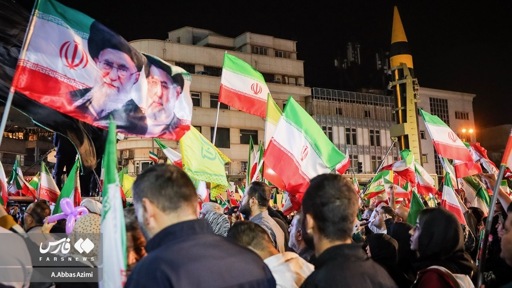
Amid fresh speculations of the resumption of US-Israeli hostilities, hundreds of thousands of Iranians took to the streets in different parts of the country on Tuesday and Wednesday as the two-week-long temporary ceasefire with the US came to an end.
The massive crowd waved Iranian flags and expressed support and solidarity with the country’s leadership and the armed forces, expressing their readiness to defend the country.
However, on Wednesday, US President Donald Trump unilaterally announced the extension of the ceasefire for an “unspecified period”, claiming it was requested by Pakistan and was necessary to give Iranian “leaders and representatives” time to “come up with a unified [peace] proposal”.
However, Trump refused to lift the naval blockade imposed on Iran on April 13.
Iran has not officially responded to Trump’s unilateral extension, claiming it will decide on the matter only after assessing the requirements of safeguarding its national interests and security, despite acknowledging Pakistan has approached them as well.
Esmail Baghaei, official spokesperson of Iran’s Ministry of Foreign Affairs acknowledged that Pakistan’s deputy prime minister, Mohammad Ishaq Dar, had called the relevant Iranian leadership seeking extension in the ceasefire.
Baghaei also told the press that, though Iran appreciated Pakistani efforts to establish peace in the region, Iran was not the initiator of the war.
Baghaei also repeated that his country is open to using all diplomatic tools whenever the “necessary and reasonable conditions exist” for the same.
Iranians oppose US maximalist demands
Iran’s official news channel IRIB published a public opinion survey on Wednesday in which it claimed an overwhelming majority of Iranians do not want the government to give in to the “maximalist” American demands.
Read more: Talks in Islamabad failed because of Washington’s maximalist approach, Iran claims
The US has emphasized that Iran should abandon its right to nuclear enrichment, restrict its missile program, and end its cooperation with regional resistance forces, such as Hezbollah, in return for peace and the lifting of all sanctions.
The IRIB survey claims more than 80% of common Iranians insist that the Iranian government must not agree to the US government’s demands related to uranium enrichment and the country’s missile program, while nearly 70% demand the government must not abandon its relations with regional resistance forces.
No talks until US naval blockade is lifted
Meanwhile, Iran has already made it clear that it won’t participate in the next round of negotiations with the US until the latter lifts its naval blockade on the country imposed on April 13.
The US has imposed the naval blockade following the failure of the first round of talks in Islamabad on April 11.
Iran has called the blockade illegal and a violation of the ceasefire agreement reached on April 8 after almost 40 days of war.
Read more: US naval blockade puts future of talks with Iran in jeopardy
Speaker of the Iranian parliament and head of the country’s peace delegation to Islamabad during the first round of talks, Mohammad Bagher Ghalibaf, also said on Wednesday that a ceasefire is meaningless if accompanied by a US naval blockade and continued hostilities.
Hours before announcing the extension of the ceasefire, Trump, in a social media post, had repeated his threats of massive destruction in Iran.
On Sunday, the US attacked and seized one Iranian container ship in the Sea of Oman, when it was returning from China.
Strait of Hormuz will remain shut
Ghalibaf also denied any possibility of Iran re-opening the Strait of Hormuz under present conditions and repeated threats.
Iran had announced the opening of the strait, crucial for global energy supplies, on Friday. However, after the US attack and seizure of its ship on Sunday it reimposed the restrictions.
The Islamic Revolutionary Guard Corps (IRGC) claimed it seized two container ships in the Strait of Hormuz on Wednesday after they failed to comply with its instructions and tried to cross the strait clandestinely.
Iranian Foreign Minister Abbas Araghchi, in a post on X on Tuesday, called the US naval blockade “an act of war and a violation of the ceasefire.”
He also reminded Trump that “striking a commercial vessel and taking its crew hostage is an even greater violation” of the ceasefire agreement.
Iranian President Masoud Pezeshkian, in a post on X on Wednesday, emphasized that the “Islamic Republic of Iran has welcomed dialogue and agreement and continues to do so.”
However, the “breach of commitments, blockade, and threats are main obstacles to genuine negotiations. The world sees your endless hypocritical rhetoric and contradiction between claims and actions,” Pezeshkian said.
The post Iran says no talks with the US unless it lifts its naval blockade appeared first on Peoples Dispatch.
From Peoples Dispatch via This RSS Feed.