

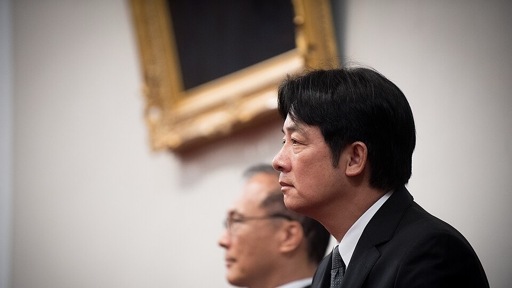
Taiwanese President Lai Ching-te was forced to cancel his scheduled trip to the southern African country of Swaziland at the last minute after Seychelles, Mauritius, and Madagascar denied him permission to use their airspace.
China’s Taiwan Affairs Office of the State Council “appreciated the position and actions of the relevant countries in upholding the one-China principle”. Swaziland is the only African country that recognizes Taiwan as a sovereign country, alongside 11 other small countries in Latin America and the Caribbean, and some Pacific islands, whose foreign policy is largely decided in Washington.
The US itself, along with the rest of the world and the UN, adheres to the one-China principle officially, while funding and arming Taiwanese separatism. The denial of airspace to Lai was a major setback to this separatist project, marking the first time a Taiwanese leader had to cancel scheduled travel due to revoked overflight clearances by multiple countries.
“Yet again, the Chinese Communist Party is trying to bully Taiwan, a close partner of the United States,” fretted the US House Foreign Affairs Committee Majority, reiterating, “We stand with Taiwan against this blatant coercion.”
Taking to X, Lai complained that “China’s coercive actions undermine the status quo, once again exposing the risks authoritarian regimes pose to the international order.”
Anti-authoritarian and pro-monarchy?
While characterizing China’s government as an “authoritarian regime”, Lai whined about not being able to travel to Swaziland to join the celebration to mark 40 years of rule by Africa’s last absolute monarch, King Mswati III, whom he referred to as a “like-minded partner”.
Crowned on April 25, 1986, Mswati inherited the throne from his father, King Sobhuza II, who seized all power in 1973 by a royal decree that suspended the 1968 constitution and banned all political parties, which remain illegal to date.
“This milestone” on April 25, 2026, marking 40 years of Mswati’s absolute monarchical rule, “is not a cause for celebration but rather a reminder of the ongoing struggles for democratic governance and human rights,” said the Communist Party of Swaziland (CPS). It had called for protests to oppose Lai’s visit.
He was to spend four days from April 22 to 26, partaking in the lavish feasts hosted by Mswati, who has taken 16 wives, and owns palaces, private jets, and a fleet of Rolls-Royce cars, while nearly 60% of his subjects live in “abject poverty”, eking out a survival on less than two dollars a day.
But the monarchy’s status quo is becoming increasingly untenable as its domestic unpopularity reached a fever pitch in mid-2021, when a violent crackdown on the country-wide, pro-democracy protests sparked a mass uprising against the monarchy. Amid attacks on his properties and businesses, Mswati fled the country, returning only after his army suppressed the uprising, killing scores and wounding hundreds.
Taiwan’s role in sustaining Swaziland’s absolute monarchy
“Helicopters, weapons, and ammunition supplied by Taiwan were used by the Swaziland army to kill protesters. It is widely known that Taiwan supplies arms and also provides training for the army,” CPS head of publicity, Sandile Xaba, told Peoples Dispatch.
“The Taiwanese separatist regime plays a dangerous role in sustaining the absolute monarchy in Swaziland,” the party maintains. Taiwan, in turn, extracts massive surpluses from cheap Swazi labor, especially women, laboring in the textile sector in which it is heavily invested.
Welcoming the “decisive action” of revoking Lai’s flight permit, the CPS celebrated his inability to arrive for the celebration as a “victory for the people of Swaziland” and “a step towards affirming our sovereignty and resisting imperialist forces that seek to undermine our nation.”
It further called upon “the Southern African Development Community (SADC) to closely monitor the withdrawal” of the “over 50 military and police personnel from Taiwan, who had entered the country as an advance team to secure” Lai.
“It is crucial for those who value democracy and peace to expose any foreign elements that threaten our sovereignty and undermine our struggle for democracy. Incorporating these personnel into our country would be tantamount to allowing mercenary contingents, complicating the ongoing fight for a democratic Swaziland,” it added.
Taiwan’s “like-minded partner” on thin ice
While Lai insisted that Taiwan’s “determination to build friendships around the world with like-minded partners remains steadfast”, the remaining dozen “like-minded partners” maintaining diplomatic ties with Taiwan are not all on solid ground.
Anti-monarchist sentiments, long brewing in the working-class industrial areas and universities, had already mobilized people in the rural areas ahead of the 2021 uprising. Now, it is also permeating the ranks of the political elite, opening fissures within the ruling class, the CPS said.
Should the monarchy fall, making way for Swaziland’s transition to democracy, Taiwan will most likely lose the only country in Africa, and one of the only 12 countries globally, that still recognizes its separatist claim to sovereignty.
The post Denied African airspace, Taiwanese president forced to cancel trip to Swaziland appeared first on Peoples Dispatch.
From Peoples Dispatch via This RSS Feed.