

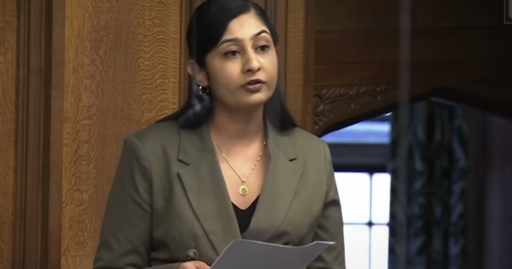
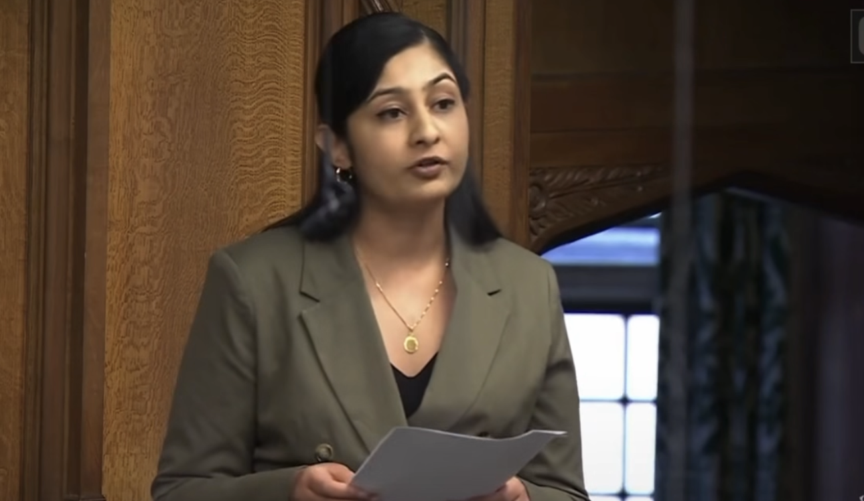
In the Commons last week, Zarah Sultana used parliamentary privilege to expose a court order that restricts reporting on certain aspects of a live criminal case, withholding important information from both jurors and the British public. But neither Novara Media nor any other British media outlet can safely report or play the contents of what she said.
On Wednesday night’s Novara Live, the Your Party MP joined host Steven Methven to discuss what she described as an “insane” attack “on all of our civil liberties”.
“The fact that only Parliament TV, only Hansard, can report on it tells you what the British state is all about – and it is about curtailing our rights to organise, to resist, to challenge when the state overreaches,” she said. “I think it is scary.”
Parliamentary privilege protects Sultana from prosecution for what she said in the chamber, but breaching the order outside of the House of Commons could be considered contempt of court, carrying a maximum two-year prison sentence.
“I was surprised to learn that the British media has no absolute right to report on what MPs say in our own parliament,” Methven said on the show.
“I’m scared that a lot of people don’t even know what’s happening,” Sultana replied. “The fact that American organisations and non-UK organisations are the only ones reporting on this is scary. How do we organise against this? And how do we fight back?”
While he did not reveal the contents of Sultana’s 14 April speech, which can be viewed online in the Parliament TV archive, Methven said that her statement was connected to very general issues relating to jury trials and the government’s current attack on them, as well as counter-terror law.
He gave a brief run-through of some of the legislation implicated in Sultana’s speech, starting in 2021, when Boris Johnson’s government passed the Counter-Terrorism and Sentencing Act, which amended and upgraded existing counter-terror law.
“One of the novelties of the 2021 Act was the widening of the idea of a charge having a terror connection,” Methven explained. “Before 2021, only specific criminal charges under the normal criminal code could be connected to terrorism… But from 2021 onwards, any crime carrying a minimum sentence of two years or more could also carry a terror connection. That means that if a defendant is found guilty of the base charge – and it’s also decided that the terror connection exists – [they could] receive a longer sentence, they’d be ineligible for early release, and be registered as terror offenders.”
Rather than a jury deciding whether or not a terror-connection exists, the 2021 act handed this power to a judge, to decide only after a jury has convicted on a base criminal charge. Essentially, this means a jury can think it is convicting for one thing, only for a judge to then turn it into something far more serious.
On the show, Methven quoted a contribution made by Lord Marks, a barrister and Liberal Democrat peer, during a debate about the Act back in 2021. “A defendant might be convicted by a jury of the basic offence, for which the appropriate penalty might be a short term of imprisonment, but sentenced on the basis of a decision taken by a judge alone, without hearing any evidence, that the offence had a terrorist connection and merited a sentence of a long term of imprisonment,” Marks said.
Sultana said she found the court order frightening. “[It] should be a wake-up call to everyone who cares about our civil liberties, who cares about our right to a fair trial,” she said. “The fact that this is happening and there is complete and utter secrecy… It is frightening, it is dystopian, it is often what we associate with authoritarian governments across the world when we highlight abuses of human rights, and in fact, it’s happening right here, right now.”
From Novara Media via This RSS Feed.
Did you know headlines about a specific subject can follow a description with the name of that specific subject?