

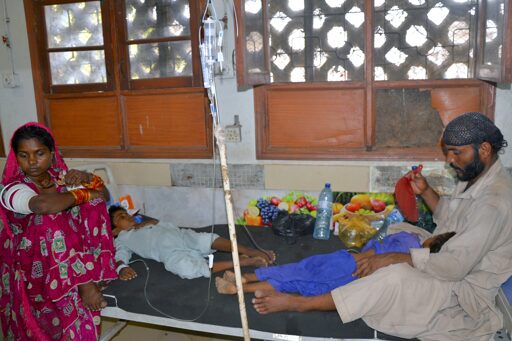
Canvas canopies, hand fans, damp cloths and solar reflective paint may not sound like elaborate medical interventions. But in Pakistan’s hottest neighborhoods, they can act as a lifeline for pregnant women and newborns from low-income households. In a recent trial of affordable cooling solutions led by researchers at Pakistan’s Aga Khan University, low-tech interventions were able to cut indoor temperatures by 3-4° Celsius (5-7° Fahrenheit). Air-conditioning, and even fans, are often not available due to unreliable electricity supply. “Many commonly recommended heat interventions assume reliable electricity, formal workplaces, and universal phone access, making them impractical for many women in low-income countries,” Gregory Wellenius, director of the Center for Climate and Health at Boston University, told Zuha Siddiqui for Dialogue Earth. Temperatures in Pakistan often reach 40°C (104°F), with “feels like” temperatures nearing 50°C (122°F) in the summer. Climate change is making heat waves in the region much more likely and frequent, according to World Weather Attribution, a network of scientists studying extreme weather events. “The heat exhausts me. My body feels like lead,” Asiya, a woman identified only by her first name, told Siddiqui. Asiya lives in Lyari, one of the most densely populated neighborhoods in Karachi, and is pregnant with her third child. “During my last pregnancy two years ago, I took showers thrice a day to cool down because I could feel my baby kicking in distress,” she added. The urban heat island effect traps heat in densely built urban areas, elevating city temperatures. In Karachi, Pakistan’s largest…This article was originally published on Mongabay
From Conservation news via This RSS Feed.