

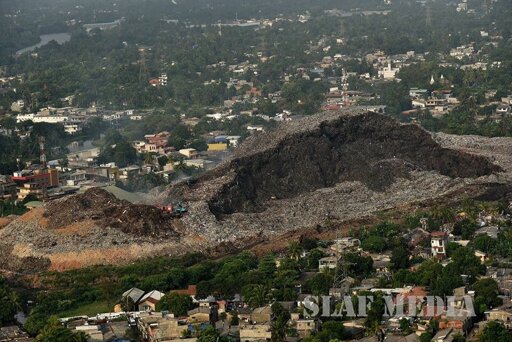
COLOMBO — As Sri Lankans celebrate the traditional New Year on April 14 each year, a period marked by family gatherings and renewal, there are no celebrations at Keerthirathna Perera’s home anymore. In 2017, the Perera family was in celebration mode in their two-level home in Meethotamulla, in western Sri Lanka. But their festive lunch was interrupted around 2 p.m. by a faint tremor. Moments later, a neighbor shouted that the stairway was suddenly cracking. Alarmed, the family rushed outside, only seconds before a deafening roar engulfed the area as a massive wave of garbage and earth surged upward. Houses shifted, some collapsed instantly, while others were simply thrust aside. When the noise eventually faded, the neighborhood found itself reduced to a chaotic field of rubble. In this confusion, Keerthirathna searched desperately for his family. He found his wife trapped waist-deep in debris and saw only his granddaughter’s hand nearby, while there was no trace of his daughter and son-in-law. Rescue teams worked through the night, pulling his wife to safety around 10 p.m. and recovering the bodies of his granddaughter and son-in-law. After continuous digging through the unstable waste mound, four days later, his daughter’s lifeless body was finally recovered. The disaster killed at least 32 people, displaced hundreds and destroyed more than 140 homes, leaving more than a thousand homeless. The collapse of the mount at Meethotamulla exposed the catastrophic consequences of unmanaged urban waste accumulation and Sri Lanka’s repeated institutional failure to tackle the solid waste problem.…This article was originally published on Mongabay
From Conservation news via This RSS Feed.