

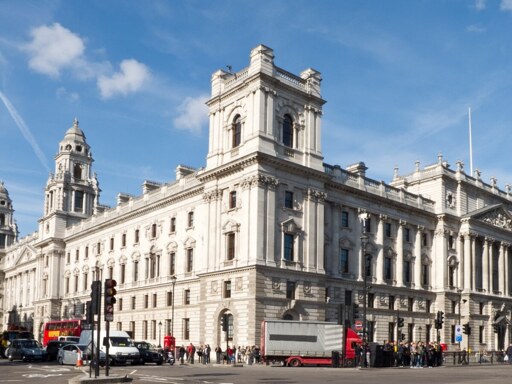

The big brains at Westminster’s treasury department have squirrelled themselves away and taken a long, serious look at the north of Ireland’s dire finances. They’ve now returned with their masterplan – fuck over the average household even more thoroughly than before.
The treasury’s proposals include highly regressive measures such as water charges, which don’t currently exist in the Six Counties. Westminster tried this before about 20 years ago, but a largely grassroots-led campaign defeated it. Infrastructure intended for per-house billing can still be found around streets in the region, hopefully to be eventually just fossil remains of what will one day be a dead neoliberal order.
Water charges: a regressive tax from the Treasury
The review authors estimate getting struggling households to pay £465 per year for the basis of all known life could bring in £357 million. Paying for anything essential is basically a tax. Ideally taxes are scaled so those with the most money pay the most. If water is paid for by usage, however – as it is in much of England – a poor person ends up paying the same amount as a wealthy person.
This is because most humans generally use the same amount of water for their daily needs. This method is called ‘metered’ measurement and is deeply unfair because it takes a much larger percentage of a low earner’s income.
The other way to do it is ‘unmetered’ – i.e. not based on how much water you use. Instead, property values are used – if you’ve a bigger house, you pay more for your water bill. This might seem better in principle, but in England property prices haven’t been evaluated since 1991. In the north of Ireland, using property value is also imperfect. It’s estimated for rates bills, the equivalent of England’s council tax. It’s also capped at a fairly low value of £400,000 for a property. If you’ve a house worth more than that, you still pay the £400k rate
That brings us on to the next big idea, where – surprise – the plan is once again a reverse Robin Hood shitshow. The treasury suggests hiking rates, which would, according to the BBC, bring the:
…typical rates bill rise from around £1,200 to almost £1,800.
Again, a bad idea due to the aforementioned valuation guesstimation, cap, and already sizeable amounts paid by people in modest houses.
Review proposes robbing middle-income earners
Other bright ideas including slashing the wages of high-on-the-hog public sector workers. You know the ones, those nurses and teachers travelling around in private jets. No wait, that’s billionaires, the people we should actually be taking money from, rather than sucking demand out of an already stuttering economy by hoovering up pennies from average earners.
The definition of insanity is doing the same thing again and again, but expecting a different result. Treasury boffins stand like wild-eyed gamblers at a fruit machine, after 45 years of pulling the same lever over and over again. Maybe just one more cut, one more hand out to the rich will finally trigger the kerrching sound as the long-awaited trickle down commences.
Or the dribble down, as Stephen Colbert memorably reframed it (the Telegraph isn’t a fan). Impoverished people can nibble on a few crumbs from the rich man’s table, or lap up some of the drool cascading from his mouth as he feasts.
One thing’s for sure, the legacy media was keen to lap up the treasury’s slop:
Stormont spending on NI public services up to 66% greater than in England
…warbled the Irish News. This is one department – the police. The actual figures average out at 120% across all departments, which is perfectly reasonable in a historically underfunded (relative to need), post-conflict society.
The BBCsalivated at how:
Water charges and rates increase could help Stormont ‘raise £3bn a year’
In characteristic fashion for an organisation that launders the views of neoliberal think tanks, the author offered no counterpoint to this.
North of Ireland politicians slam shoddy review
Six Counties politicians were less keen, voicing disdain for it across the political spectrum. Sinn Féin first minister Michelle O’Neill focused on Westminster’s inadequate provision for the needs of people in one of the poorest regions under British control. She said:
We have been under-funded for well over a decade and then some.
There needs to be a fair allocation. When you compare our allocation as an Executive with what Scotland have or what Wales have, we are below that position with our identified needs.
We have needs here as a society, we are a society that is coming from all those years of under-funding and we are trying to catch up.
Democratic Unionist Party deputy first minister Emma Little-Pengelly dismissed the review by saying:
I think some of what is in there doesn’t stand up to even the most basic of scrutiny.
She continued:
Who is suggesting that we are going to raise over £3bn in one year from a population of approximately 1.9 million?
The burden of that on hard-pressed families in Northern Ireland would be extraordinary.
Of course, local politicians have made their own contributions to poor finances. They managed to throw away around half a billion pounds on the Cash for Ash scandal that allowed people to get paid for heating empty sheds. Stormont bought significantly more PPE equipment than required during the COVID pandemic, again wasting millions. Multiple construction projects have gone way over budget.
Ultimately though, even if Assembly members corrected these mistakes, they’d still be stymied in fundraising by the limited number of levers they can pull under limited devolution. It’s another argument to break free from Britain’s sinking ship entirely, and rejoin the rest of Ireland.
Dublin may be managing its own neoliberal quagmire, but at least those in the north would get a say in changing that, rather than meagre autonomy, followed by meagre handouts from Westminster.
Featured image via the Canary
From Canary via This RSS Feed.