

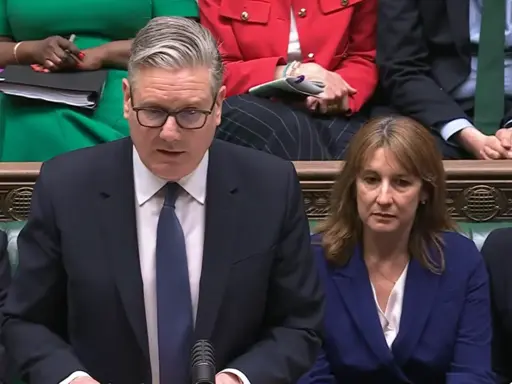

In the cavernous theatre of the House of Commons on 20 April 2026, amid two and a half hours of choreographed indignation and procedural deflection, a single sentence cut through the fog:
Why didn’t the Prime Minister ask?
Diane Abbott’s question hung in the chamber for a moment and was then, with practised establishment efficiency, allowed to evaporate. The press and broadcasters moved on. By the evening bulletins, the discourse had reverted to its most comfortable ruts: was the Prime Minister a liar, or was he merely, as the Conservative leader suggested, “grossly incompetent”? The nation was invited, once again, to choose between flattering explanations of its own government.
A question unanswered
Abbott’s question does not belong to that debate. It does not accept either of its premises. It points, with the clarity only outsiders retain, at something both parties of the Westminster duopoly have an interest in not examining too closely: the possibility that the Prime Minister appointed, to the most important diplomatic post in the world, a man under active criminal investigation for having passed sensitive government data to a convicted to a convicted sex offender – and simply did not bother to ask whether his security clearance had gone through.
There is an answer to Abbott’s question, though it is not the one the Prime Minister offered. It was supplied the following day, in much plainer language, by the very civil servant Starmer has publicly undermined. Olly Robbins, the recently-dismissed permanent secretary at the Foreign Office, told a parliamentary committee on Tuesday that he would “absolutely not” have considered it appropriate to inform Starmer that the United Kingdom Security Vetting service had recommended Mandelson be denied developed vetting clearance. He had not considered it, he explained, because decisions of that kind “must remain confidential.” This sentence received no attention.
What Robbins described – and one suspects he described it honestly, which is precisely why Number 10 briefed against him so briskly – was not a breakdown in communication. It was the system functioning exactly as designed. The British security-clearance architecture is constructed so that Prime Ministers are not told which of their appointed have failed security vetting.
The stated purpose is to insulate the clearance process from political interference, thereby preserving the impartiality of a system that ought, in theory, to stand above the ordinary churn of ministerial preference. The effect, however, is to create an institutional mechanism for the manufacture of prime-ministerial ignorance. In a governing culture that has refined the passive voice into a form of statecraft, ignorance has become the sovereign’s most reliable alibi.
Unanimous silence
This is what makes Abbott’s question so incisive, and why it was received with unanimous silence by the media establishment: it rewrites the entire structure of the scandal. In doing so, it also withdraws from the Prime Minister the last plausible defence he has left to give.
If the question is ‘did Starmer know?’, then his account can at least be entertained within its own terms. ‘Nobody told me’ is, at a stretch, a statement capable of being true. Within the narrow framing that the broadcasters and mainstream press have consented to adopt, it is also at least a defence that can be dressed up and sent into battle. But if the question is ‘why did he not ask?’, there is no defence remaining to him at all. There is only a judgement, and a judgment of a particularly damning kind.
A Prime Minister who appoints an ambassador already known, and known for years, to have been the intimate friend and longtime defender of a convicted serial child-rapist; who had been handed a report flagging his appointee’s “reputational risks” and “numerous conflicts of interest”; who had been warned that his nominee’s closeness to Jeffrey Epstein ran deeper and more incriminatingly than Mandelson had ever been willing to disclose — such a Prime Minister does not, in the ordinary course of things, simply forget to ask whether the developed vetting has come back clean.
He declines to ask, because the answer was never information he required in order to make the appointment. It was information he feared might prevent him from making it.
A deeper scandal
It fell to Gillian Keegan, of all people, to articulate on national television the moral conclusion that the Labour front bench has lacked either the honesty or the courage to reach. Starmer did not ask because, quite simply, he did not want to know. When a former Conservative education secretary is supplying the moral clarity absent from the governing party, the Prime Minister has a problem that no reshuffle can resolve.
The deeper scandal, however, lies not in the appointment itself, but in the factional machinery that produced it. Mandelson was not a rogue choice imposed upon a reluctant Prime Minister; he was the natural product of a governing project assembled, over several patient years, by Morgan McSweeney and the Labour Together operation — the same operation that installed Starmer in the leadership, purged the membership of its inconvenient dissenters, and reshaped the Parliamentary Labour Party in its own image.
An administration built by that faction was always going to appoint a Mandelson to Washington, because a Mandelson is precisely the kind of figure the faction exists to elevate: ideologically reliable, donor-friendly, and possessed of the right enemies. The failure to ask about the vetting was not a lapse of judgement within the system; it was the system producing exactly what it was designed to produce.
This is why the scandal cannot be contained by Starmer’s carefully staged contrition at the despatch box. The question he refused to ask in early 2025 is the same question that now hangs over every other appointment made under the same factional logic — the peerages, the advisers, the quiet sinecures distributed to men whose reputational baggage was known to everyone in Westminster long before the documents forced the issue into the open. The vetting architecture is merely the most convenient laundering mechanism. The factional architecture behind it is the real story.
The question itself will not go away. It cannot be withdrawn by a reshuffle, absorbed by a review, or buried by a press operation of the customary kind. It hangs, now, over everything this Prime Minister says and, more tellingly, over everything he does not.
Why didn’t the Prime Minister ask? Because he already knew the answer.
Featured image via the Canary
From Canary via This RSS Feed.